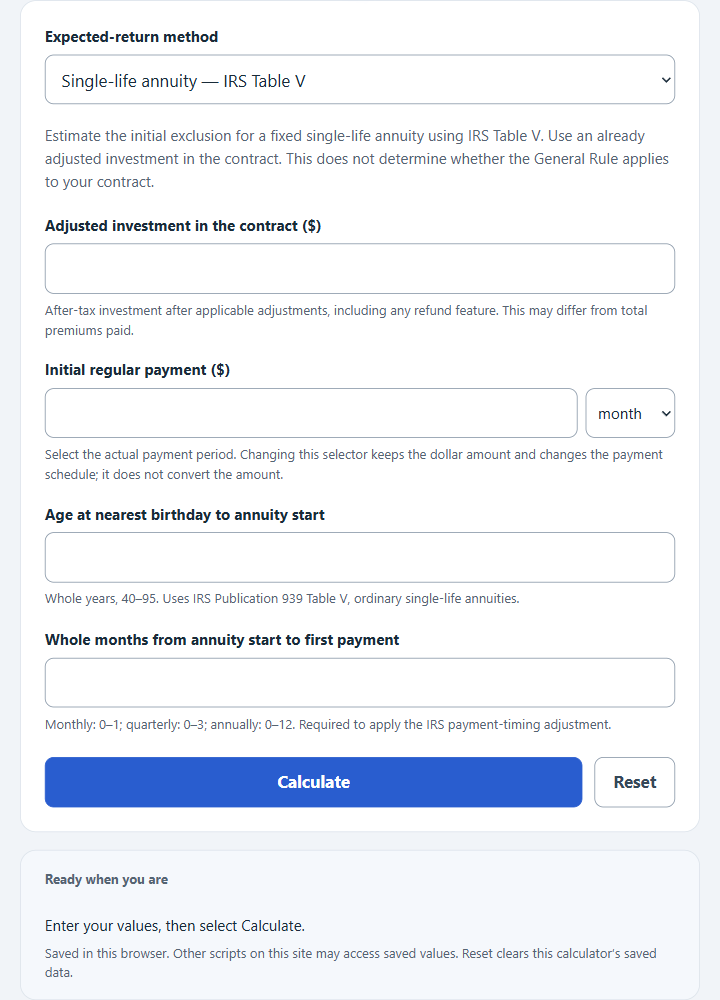
Estimate the initial excluded and taxable portions of fixed annuity payments under the General Rule. Use adjusted investment in the contract and either IRS Table V with payment timing or a verified expected-return multiple. The calculator does not determine which tax method applies.
Annuity Exclusion Ratio Formula
The following formula is used to calculate the Annuity Exclusion Ratio.
- Where AER is the Annuity Exclusion Ratio
- LS is the adjusted investment in the contract ($), which may differ from total premium paid
- MB is the monthly benefit ($)
- LE is the applicable expected-return multiple expressed in months
Divide adjusted investment by expected return, then round the decimal ratio to three places under IRS Publication 939. Multiply by the initial regular payment to find its excluded amount. The calculator takes multiples in years; divide a multiple stated in months by 12. For annuities starting after 1986, cumulative exclusions cannot exceed net cost.
How to Calculate Annuity Exclusion Ratio?
The following example problems outline how to calculate Annuity Exclusion Ratio.
Example Problem #1
- First, determine the adjusted investment in the contract ($).
- The adjusted investment in the contract ($) is 100,000.
- Next, determine the monthly benefit ($).
- The monthly benefit ($) is measured to be 560.
- Next, determine the applicable expected-return multiple (months).
- The verified expected-return multiple is assumed to be 200 months (200 / 12 years).
- Finally, calculate the Annuity Exclusion Ratio using the formula above:
AER = LS / (MB * LE) * 100
The values given above are inserted into the equation below and the solution is calculated:
AER = 100000 / (560 × 200) ≈ 0.893, or 89.3%, after rounding the decimal ratio to three places. This assumes the $100,000 is adjusted investment and the 200-month multiple is applicable.
Example Problem #2
The variables required for this problem are provided below:
adjusted investment in the contract ($) = 200,000
monthly benefit ($) = 700
expected-return multiple (months) = 200
These second-example inputs produce a ratio above 100%: $200,000 / ($700 × 200) ≈ 1.429. Check the investment and expected-return assumptions; this calculator flags the inconsistency rather than silently capping the ratio.
The entered investment exceeds expected return; the assumptions require review.