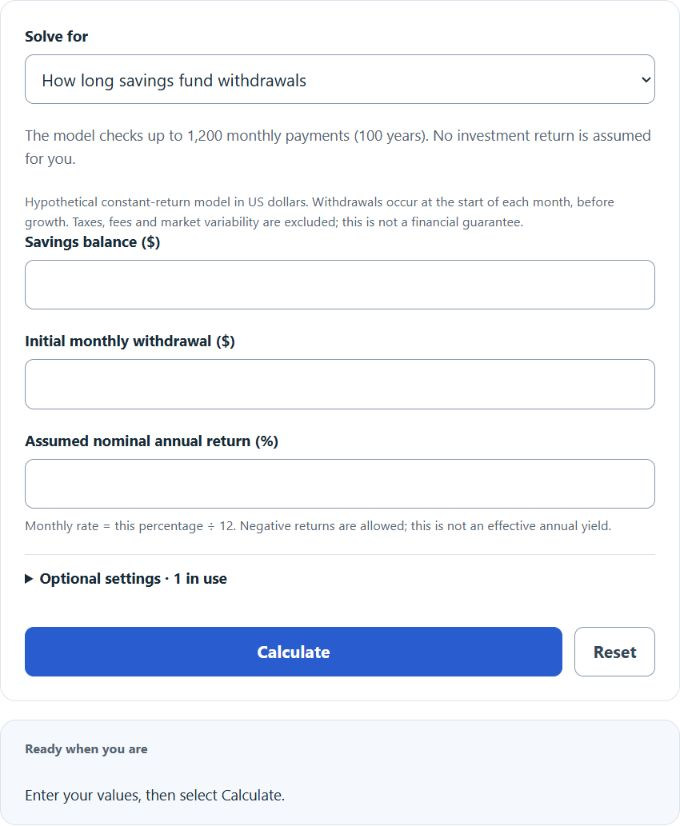
Estimate how long your savings will last from your initial balance, monthly income, monthly expenses, and annual return, showing depletion time in months.
How Long Will My Money Last Formula
This model checks monthly withdrawals at the start of each month, then applies a constant monthly return. Use the income-and-expenses mode to derive the initial net withdrawal, or enter it directly. Optional annual increases apply to that withdrawal beginning with payment 13.
- Where HL is how long your money will last (months)
- IS is the initial savings ($)
- MI is the monthly income ($/month)
- ME is the monthly expenses ($/month)
- R is the annual rate of return (%)
- i is the monthly interest rate (decimal), computed as R ÷ (100 × 12)
Notes: W₀ is the initial monthly withdrawal (max(ME − MI, 0) in budget mode), g is its annual increase as a decimal, and j starts at 0. The duration result counts full monthly payments, up to 1,200. Funding every checked payment does not prove funds last forever. With no increases and positive monthly return, the start-of-month principal-preserving threshold is IS × i / (1 + i), not IS × i.
What Is the “How Long Will My Money Last” Calculation?
Definition:
How long your money will last typically refers to the number of months or years you can continue to meet your expenses before running out of funds. It depends on your starting savings, your ongoing income and expenses, and (if applicable) any investment return you earn on the remaining balance.
How to Calculate How Long Your Money Will Last
Example Problem:
The following example outlines the steps and information needed to calculate how long your money will last.
First, determine your monthly net outflow or inflow. In this example, the monthly income is $3,000, and monthly expenses are $4,000, so the net outflow is $1,000 per month.
Next, determine your initial savings. In this example, there is $50,000 in savings.
Finally, calculate how long your money will last. For simplicity, assume a 0% annual rate of return (R = 0), so the calculation reduces to:
HL = IS / (ME – MI)
HL = $50,000 / ($4,000 – $3,000)
HL = 50 months (approximately 4.17 years)
FAQ
How does a rate of return affect how long my money will last?
When your savings or investments earn returns, your money can last longer because part of your spending shortfall may be covered by the interest or gains on your remaining balance. A higher rate of return generally extends the duration before funds are depleted (assuming all else stays constant).
Should I include inflation in my calculations?
Yes, factoring in inflation is important. Rising prices can increase your expenses over time, thereby reducing how long your savings may last if your income does not keep pace. Use the optional annual withdrawal increase to model a fixed yearly change in net withdrawals. It changes at payment 13 and every 12 payments thereafter; actual inflation and returns can vary.
What can I do to make my money last longer?
Cutting unnecessary expenses, increasing your earning potential, and investing wisely to pursue appropriate returns can all help your money last for a longer duration.