Calculate effective annual yield from a nominal rate or bond coupon, or find the nominal annual rate needed to reach a target EAY.
Effective Annual Yield Formula
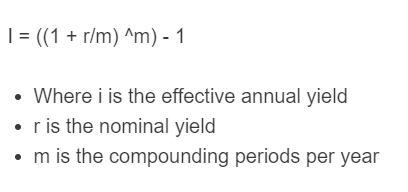
The effective annual yield (EAY) converts a nominal rate into the modeled interest-only yield over one year once compounding is included.
For continuous compounding:
To solve for the nominal rate that produces a given EAY:
- EAY = effective annual yield (decimal)
- r = nominal annual rate (decimal)
- m = number of compounding periods per year
- e = Euler’s number, about 2.71828
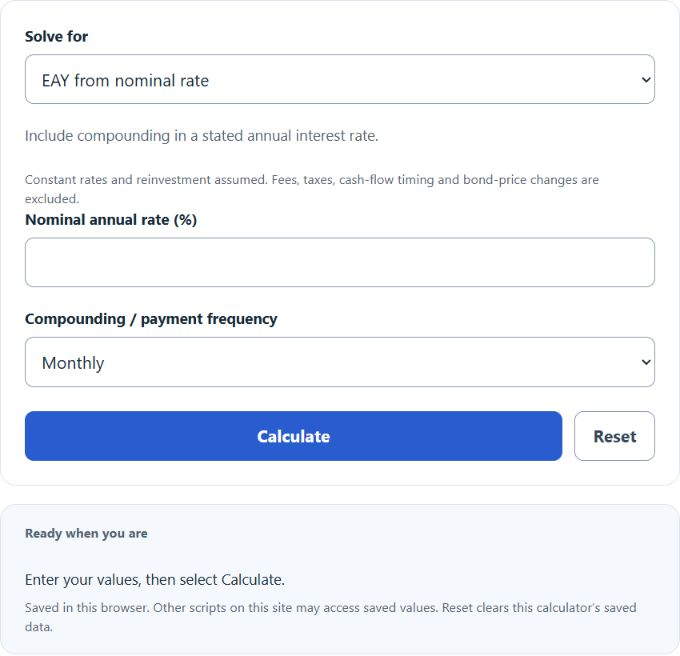
The calculator has three modes. Nominal rate takes a stated annual rate and a compounding frequency and returns the EAY. Bond coupon divides the annual coupon by the face value to get the coupon rate, then applies the same compounding formula using the payment frequency, assuming par-value basis and reinvestment at the coupon rate. This is not yield to maturity. Target EAY runs the formula in reverse to tell you what nominal rate is needed to hit a desired yield at a chosen compounding frequency.
Reference Tables
The first table shows how a 6% nominal rate translates to EAY at common compounding frequencies. The second shows the reverse: the nominal rate needed to hit a 6% EAY.
| Compounding | Periods/year (m) | EAY from 6% nominal |
|---|---|---|
| Annual | 1 | 6.0000% |
| Semi-annual | 2 | 6.0900% |
| Quarterly | 4 | 6.1364% |
| Monthly | 12 | 6.1678% |
| Daily | 365 | 6.1831% |
| Continuous | ∞ | 6.1837% |
| Compounding | Nominal rate to hit 6% EAY |
|---|---|
| Annual | 6.0000% |
| Semi-annual | 5.9126% |
| Quarterly | 5.8695% |
| Monthly | 5.8411% |
| Daily | 5.8274% |
| Continuous | 5.8269% |
Worked Examples
Example 1: Monthly compounding. A savings account quotes 5% nominal interest compounded monthly. Plug in r = 0.05 and m = 12:
EAY = (1 + 0.05/12)^12 – 1 = (1 + 0.05/12)^12 – 1 ≈ 0.051162, or 5.1162%.
Example 2: Semi-annual bond. A bond has a $1,000 face value and pays $50 in coupons per year, split into two $25 payments. The coupon rate is 50/1000 = 5%. With m = 2:
EAY = (1 + 0.05/2)^2 – 1 = (1.025)^2 – 1 = 0.050625, or 5.0625%.
FAQ
How is EAY different from APR? EAY reflects compounding of a nominal interest rate. A disclosed loan APR can include fees and is not always the interest rate used in this formula. For nonnegative rates with at least annual compounding, modeled EAY is at least the nominal rate (including equality at zero).
Why does the EAY barely change above daily compounding? The formula approaches its continuous limit, e^r – 1, very quickly. Going from daily to continuous compounding on a 6% rate adds about 0.000524 percentage points.
Does EAY assume reinvestment? Yes. The bond mode assumes you reinvest each coupon at the same coupon rate. A different reinvestment rate changes the realized return; purchase price and maturity cash flows also affect bond yield.
Can I use EAY to compare two loans? EAY compares interest-rate compounding under matched assumptions. Compare disclosed APR, fees, repayment timing and loan terms as well; lower EAY alone does not establish the cheaper loan.