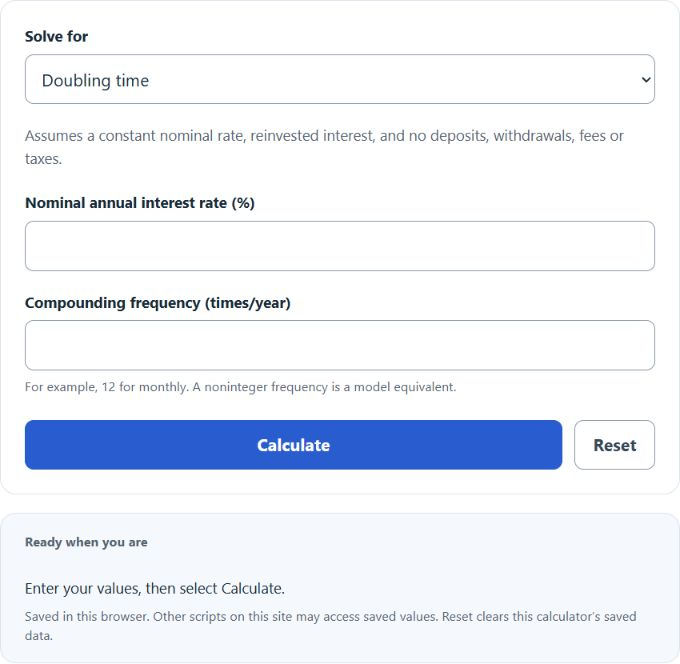
Select doubling time, nominal annual interest rate, or model-equivalent compounding frequency, then enter the two required values. Assumes a constant rate with reinvested interest and no deposits, withdrawals, fees or taxes.
Compound Interest Doubling Time Calculator Formula
The following equation gives the model doubling time for periodic compound growth. It can return a time between scheduled interest-posting dates.
- Where T is the time to double (years)
- r is the nominal annual interest rate (decimal), not the effective annual yield
- n is the positive compounding frequency per year; a noninteger inverse result is a model equivalent, not a conventional posting schedule
To calculate the time to double using compound interest, divide the natural log of 2 by the product of the compounding frequency and the natural log of (1 + r/n).
What is a Compound Interest Doubling Time Calculator?
Definition:
A compound interest doubling time calculator determines how long it will take for an investment to double in value under a given compound interest rate. When you input an interest rate and compounding frequency, the calculator computes the model time in years for the principal to grow to twice its original amount.
How to Calculate Compound Interest Doubling Time?
Example Problem:
The following example outlines the steps and information needed to calculate the Compound Interest Doubling Time.
First, determine the annual interest rate. In this example, the interest rate is 8% (0.08 in decimal form).
Next, determine the compounding frequency. Assume the interest is compounded monthly, so n = 12.
Finally, calculate the time to double using the formula above:
T = ln(2) / (12 * ln(1 + 0.08 / 12))
T ≈ 8.693189 years
FAQ
Does this formula account for continuous compounding?
The provided formula specifically uses periodic compounding. For continuous compounding, the formula would be T = ln(2) / r. However, most real-world scenarios involve discrete compounding frequencies such as monthly, quarterly, or yearly.
How accurate is the doubling time estimate?
This calculator evaluates a constant-rate growth model. Actual credited balances may reach twice the initial amount at a later posting date and can differ because of account rounding, fees, taxes, deposits, withdrawals or rate changes. A finite positive frequency requires T > ln(2)/r; equality is the continuous limit and a smaller target time has no solution.
Is there a simplified “rule of thumb” for doubling time?
Yes, the Rule of 72 is a common approximation that suggests dividing 72 by the interest rate (in percentage form) to estimate the number of years required to double an investment. While less precise than the formula, it provides a quick mental calculation.