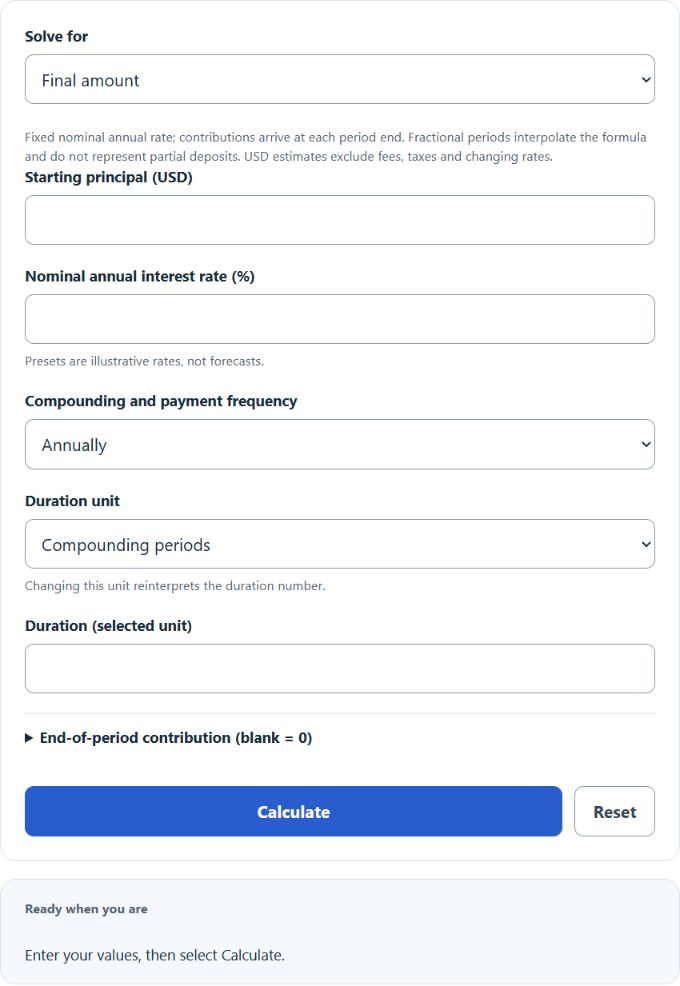
Calculate compound growth in USD with or without end-of-period contributions, solving for final amount, principal, nominal annual rate, duration, or contribution. The result also separates interest from principal and contributions.
Incremental Interest Formula
The following equation is used to calculate the Incremental Interest.
- Where I is the incremental interest ($)
- P is the principal ($)
- r is the interest rate per compounding period (decimal); divide the nominal annual percentage by 100 and by the number of periods per year
- n is the number of compounding periods
Without contributions, multiply the principal by [(1 + r)^n - 1] to find interest. With contributions, the calculator adds an ordinary annuity paid at each period end, then reports interest as final amount minus principal minus contributions. Fractional periods interpolate this formula rather than representing partial deposits.
What is Incremental Interest?
Definition:
Incremental interest refers to the additional amount accrued on a principal when the interest is compounded or added in small intervals over a period of time. It contrasts with simple interest, which is calculated only on the principal amount.
How to Calculate Incremental Interest?
Example Problem:
The following example outlines the steps and information needed to calculate the Incremental Interest.
First, determine the principal. In this example, the principal is $1,000.
Next, determine the interest rate and the number of periods. Assume a 5% interest rate compounded annually for 3 years.
Finally, calculate the incremental interest using the formula above:
I = P * [(1 + r)^n - 1]
I = 1000 * [(1 + 0.05)^3 - 1]
I = 1000 * [1.157625 - 1] = 157.625
FAQ
What is the difference between incremental interest and simple interest?
Incremental (or compound) interest is calculated on both the accumulated interest and the original principal, allowing interest to grow exponentially over time. Simple interest, on the other hand, is calculated solely on the principal amount.
Will incremental interest always be higher than simple interest?
For a positive rate per period and more than one complete compounding period, compound interest exceeds simple interest calculated on the same principal and period rate. They are equal after one period or at a zero rate; fractional periods and negative rates require separate comparison.
How can I benefit from incremental interest?
Regularly investing or saving money in accounts or instruments that offer compound interest can help accelerate earnings over time. The compounding effect allows even small principal amounts to grow significantly if given enough time.