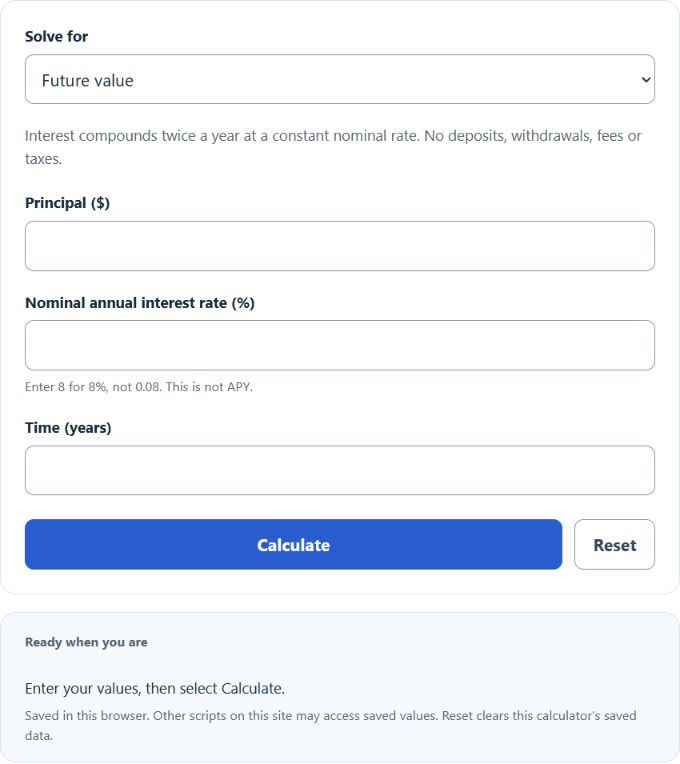
Calculate future value, principal, nominal annual interest rate, or time for semiannual compound interest. Enter the rate as a percentage: 8 means 8%.
Compound Semiannually Formula
The following equation is used to calculate future value with semiannual compounding.
- Where FV is the future value ($)
- P is the principal ($)
- r is the nominal annual interest rate in decimal form for the formula (8% = 0.08). The calculator input uses percent, not decimal form or APY.
- t is the total time (years)
To calculate semiannual compound growth, multiply the principal by (1 + r/2) raised to the power of (2 × t). This assumes a constant rate, reinvested interest, and no deposits, withdrawals, fees or taxes. Fractional years interpolate growth between crediting dates; account terms may differ.
What Is Semiannual Compounding?
Definition:
Compounding semiannually is the process of applying interest twice per year to the principal, effectively splitting the annual interest rate in half for each six-month period.
How to Calculate Future Value with Semiannual Compounding?
Example Problem:
The following example outlines the steps and information needed to calculate future value with semiannual compounding.
First, determine the principal amount. In this example, the principal is $1,000.
Next, determine the annual interest rate. Here, the rate is 8% (0.08 as a decimal).
Then, determine the total time in years. In this example, we use 5 years.
Finally, calculate the future value using the formula above:
FV = 1,000 × (1 + 0.08/2)^(2 × 5)
FV = 1,000 × (1 + 0.04)^10
FV ≈ $1,480.24
FAQ
How often is interest added in semiannual compounding?
In semiannual compounding, interest is added twice per year. This means every six months, the new interest amount is calculated and added to the principal, potentially accelerating growth compared to annual compounding.
What types of loans or investments use semiannual compounding?
Some financial products quote rates with a semiannual compounding convention. Check the product terms: this calculator models a balance compounding twice a year and does not calculate coupon payments, mortgage repayments or fees.
How does semiannual compounding compare to monthly or annual compounding?
For the same positive nominal annual rate, principal and time, more frequent compounding produces greater model growth. An 8% nominal rate compounded semiannually has an effective annual rate of (1.04)^2 − 1 = 8.16%; compare products using consistent rate conventions.