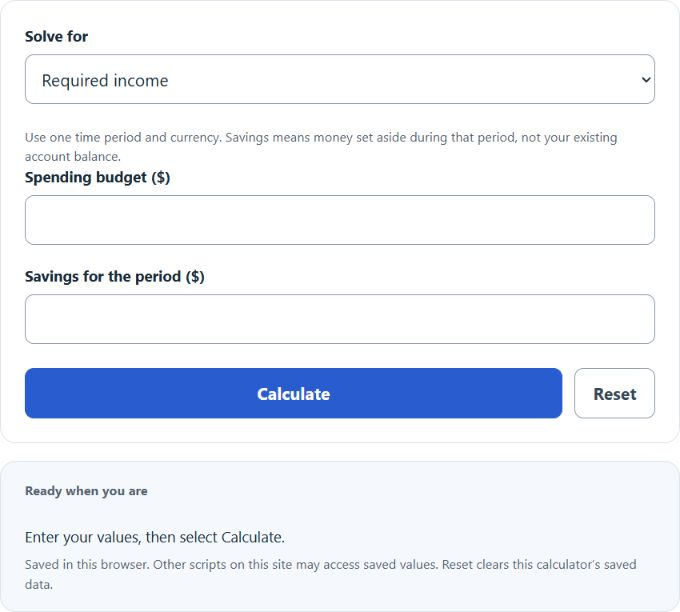
Select required income, spending budget or savings amount, then enter the two requested amounts for the same period and currency.
Reverse Budget Formula
The reverse budget calculator finds the total income needed to support a given spending budget and a target savings amount. It is useful for monthly planning, paycheck allocation, savings goal setting, and checking whether a budget is realistic for your current income level.
- TI = total income for the selected time period
- B = current budget or planned spending
- S = savings contributions or target amount set aside during the period (not the existing savings balance)
All values must use the same time frame. If your budget is monthly, then savings and total income must also be monthly. If your budget is weekly, keep every input weekly.
Rearranged Forms
Because the calculator solves the selected variable from two known values, the relationship can also be rewritten as follows:
How to Interpret the Result
Reverse budgeting starts from the outcome you want to create. Instead of spending first and saving whatever is left over, you decide how much must be saved and then determine the income required to support both spending and saving. In practice, this calculator answers one of three questions:
- How much income is needed to support my current budget and savings plan?
- How much can I spend if I want to preserve a target savings amount?
- How much can I save after covering my current budget?
For household cash budgeting, use take-home income available after taxes and payroll deductions. Do not count payroll-deducted savings again unless you adjust the income basis consistently. This calculator does not convert gross income to net income or estimate taxes.
Variable Guide
| Input | What It Represents | Typical Inclusions |
|---|---|---|
| Current Budget | Your planned spending for the period | Housing, food, utilities, transportation, debt payments, insurance, subscriptions, discretionary spending |
| Current Savings | Money intentionally set aside instead of spent | Emergency fund contributions, retirement deposits, sinking funds, brokerage contributions, goal-based savings |
| Total Income | The amount available to fund both spending and savings | Salary, wages, side income, freelance revenue, household combined income |
How to Use the Reverse Budget Calculator
- Select the value to solve and enter the two requested values.
- Verify that both numbers use the same time period.
- Click calculate to solve for the missing value.
- Review whether the result aligns with your actual income, planned savings, and required expenses.
Examples
Example 1: A household plans to spend $4,000 this month and save $1,000. The calculator determines the income required to support both.
The required total income is $5,000 per month.
Example 2: A person earns $6,500 per month and wants to save $1,500. The remaining amount is the available spending budget.
The available budget is $5,000 per month.
Example 3: A monthly income of $4,800 supports a budget of $4,200. The difference is the amount available for savings.
The monthly savings amount is $600.
Useful Budget Ratios
After finding the missing value, you can measure how efficiently income is being allocated by converting the result into spending and savings rates.
These percentages compare allocations across periods or plans and are undefined when income is zero. The calculator requires nonnegative amounts and reports a shortfall error if spending or savings exceeds the entered income.
Common Use Cases
- Estimating the income needed before moving into a higher-cost apartment
- Checking whether a savings target is realistic for your current spending pattern
- Building a monthly household plan from fixed expenses and desired savings
- Adjusting discretionary spending after a change in income
- Planning a “pay yourself first” budget structure
Common Mistakes to Avoid
- Mixing weekly, biweekly, and monthly figures in the same calculation
- Using gross income for one input and net income for another
- Leaving out irregular expenses such as annual insurance, maintenance, gifts, or travel
- Treating transfers between accounts as new income
- Ignoring debt payments that function as required monthly obligations
Practical Planning Tips
- Include sinking funds in savings if the money is being reserved for future expenses.
- If your result feels too high, reduce either planned spending or the target savings amount and recalculate.
- If your savings result is too low, review large fixed expenses first before cutting smaller discretionary items.
- Use the calculator regularly after income changes, rent increases, or major financial goals are added.
Frequently Asked Questions
Does this calculator work for personal and business budgets?
Yes. The same relationship applies as long as budget, savings, and income are measured over the same period.
Should savings include retirement contributions?
Yes, if those contributions are funded from the income entered. Avoid counting retirement contributions already deducted from take-home pay a second time.
What if my savings are zero?
That means all available income is being used to fund the current budget, leaving no planned surplus for future goals.
Can I use annual numbers?
Yes. Annual, monthly, weekly, and biweekly values all work as long as the units are consistent across every field.