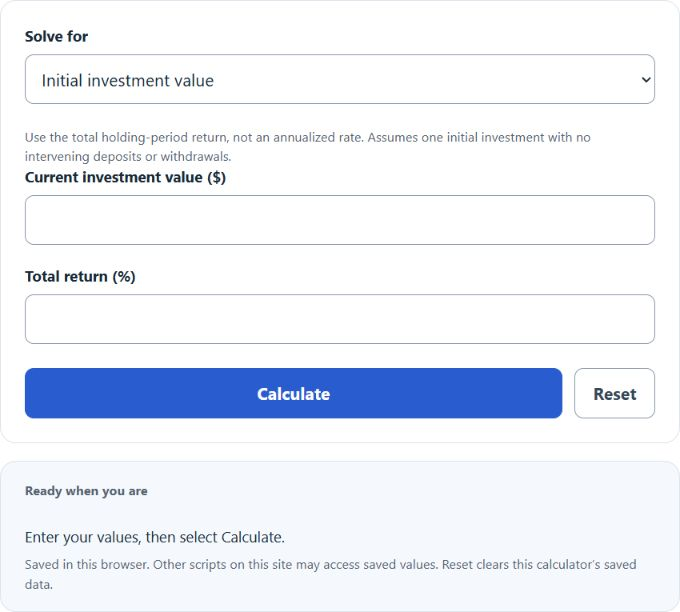
Calculate initial value, current investment value, or return rate by choosing a solve mode with this reverse ROI calculator for investments.
- All Reverse Calculators
- Reverse Depreciation Calculator
- Reverse NPV Calculator
- Reverse Interest Calculator
- All Business Calculators
Reverse ROI Formula
The reverse ROI calculation finds the initial investment value when you already know the current value and the total return rate. In other words, it back-calculates the starting principal required to reach a known ending balance.
- IV = initial value of the investment
- CV = current investment value
- RR = return rate in percent
This formula comes from the standard ROI relationship:
Rearranging that equation to solve for the starting amount gives the reverse ROI formula shown above.
How to Calculate Reverse ROI
- Identify the current investment value, or the ending amount after the gain or loss.
- Identify the return rate as a percentage.
- Convert the return rate into its decimal adjustment by dividing by 100.
- Add 1 to that adjustment.
- Divide the current value by that result to find the original investment.
If the return rate is positive, the initial value will be less than the current value. If the return rate is negative, the initial value will be greater than the current value. A return rate of 0% means the initial and current values are the same.
Examples
Example 1: Positive Return
If an investment is currently worth $150 after earning a 10% return, the original investment is approximately:
The investment started at $136.36 and increased by $13.64.
Example 2: Negative Return
If an investment is currently worth $850 after a -15% return, the original investment is approximately:
This means the investment started at $1,000 and declined by $150.
When to Use a Reverse ROI Calculator
- Estimating the original principal from a final account balance
- Checking whether a claimed return matches a known ending value
- Reconstructing the purchase amount of an asset after a gain or loss
- Reviewing portfolio performance summaries when only the ending value is available
- Comparing how much capital would have been required to reach a target balance
How to Interpret the Result
In Initial investment value mode, the output represents the amount invested at the beginning before the stated return was applied. This is useful because ROI percentages alone do not reveal the size of the original investment. A 20% return on $500 is very different from a 20% return on $50,000, and reverse ROI helps recover that missing context.
Important Notes
- This calculator assumes a single total ROI percentage, not a multi-year compounded or annualized return.
- Enter the return as a percent, so 12 means 12%, not 0.12.
- Negative returns down to -100% can be used for current value or return calculations. Solving initial value requires a rate greater than -100%.
- If the return rate is exactly -100%, the current value would be zero, so the reverse calculation is not meaningful for a nonzero ending value.
- Use a consistent beginning-and-ending value basis. This simple ratio does not adjust the timing of fees, taxes, dividends, deposits, or withdrawals; intervening cash flows require a suitable return method.
Reverse ROI vs. Standard ROI
Standard ROI starts with the beginning and ending values and solves for the return percentage. Reverse ROI does the opposite: it starts with the ending value and return percentage and solves for the beginning value.
That relationship makes reverse ROI especially useful when the final amount is known but the original invested amount is missing.
Common Input Mistakes
- Entering 0.10 for a 10% return instead of entering 10
- Using an annual return when the current value reflects multiple years of growth
- Ignoring deposits or withdrawals that changed the investment balance over time
- Confusing total return with profit amount
Quick Check Rules
- If the return is positive, the initial value should be less than the current value.
- If the return is negative, the initial value should be greater than the current value.
- If the return is 0%, the initial value should equal the current value exactly.
Use the calculator above whenever you know the ending balance and ROI and want to recover the original amount invested quickly and accurately.