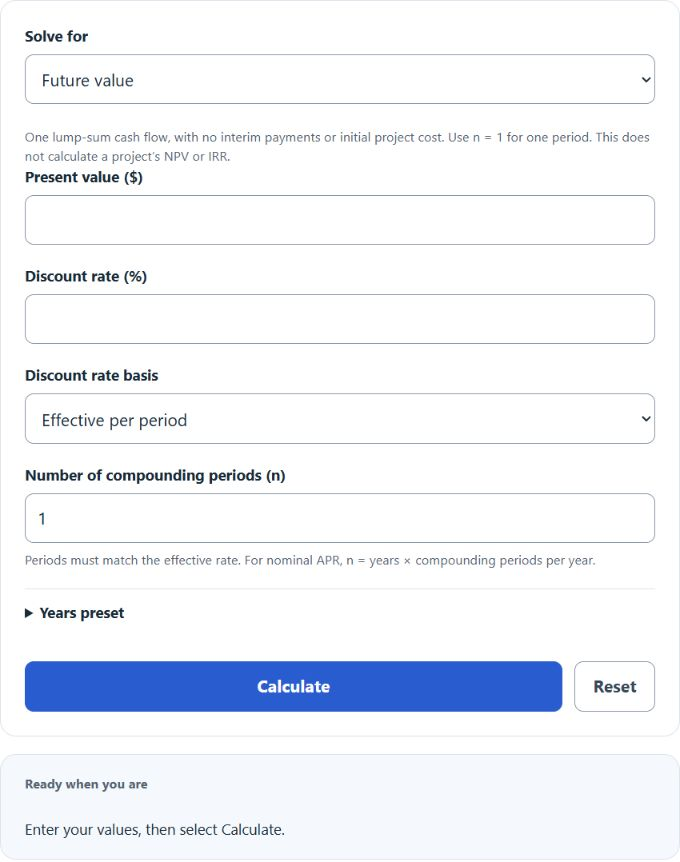
Calculate present value, future value, discount rate or duration for one lump-sum cash flow, plus real and nominal returns. This calculator does not solve project NPV or IRR.
- All Reverse Calculators
- Reverse Commission Calculator
- All Business Calculators
- Reverse Interest Calculator
Reverse NPV (Single Cash Flow) Formula
The following formula is used to calculate the implied single future cash flow (future value) from a present value. This is the reverse of the standard present value discounting equation for a single lump sum.
- Where FV is the future value / cash flow at the end of n periods ($)
- PV is the present value today ($)
- DR is the discount rate per period (%) (i.e., the effective rate used for each period)
- n is the number of compounding periods; use n = 1 for one period. With nominal APR, divide APR by compounding periods per year to obtain DR, and use n = years × compounding periods per year.
How to Calculate Reverse NPV?
The following example problems outline how to calculate the implied single future cash flow (future value) from a present value.
Example Problem #1:
- First, determine the present value (PV) ($).
- The present value (PV) ($) is given as 10,000.
- Next, determine the discount rate per period (%).
- The discount rate (%) is provided as 15.
- Finally, calculate the future value (FV) assuming the cash flow occurs after 1 period (n = 1) using the equation above:
FV = PV * (1+DR/100)
The values given above are inserted into the equation below and the solution is calculated:
FV = 10,000 * (1+15/100) = 11,500.00 ($)
Example Problem #2:
For this problem, the variables required are provided below (assume n = 1 period):
present value (PV) ($) = 60,000
discount rate (%) = 20
Test your knowledge using the equation and check your answer with the calculator above.
FV = PV * (1+DR/100) = ?