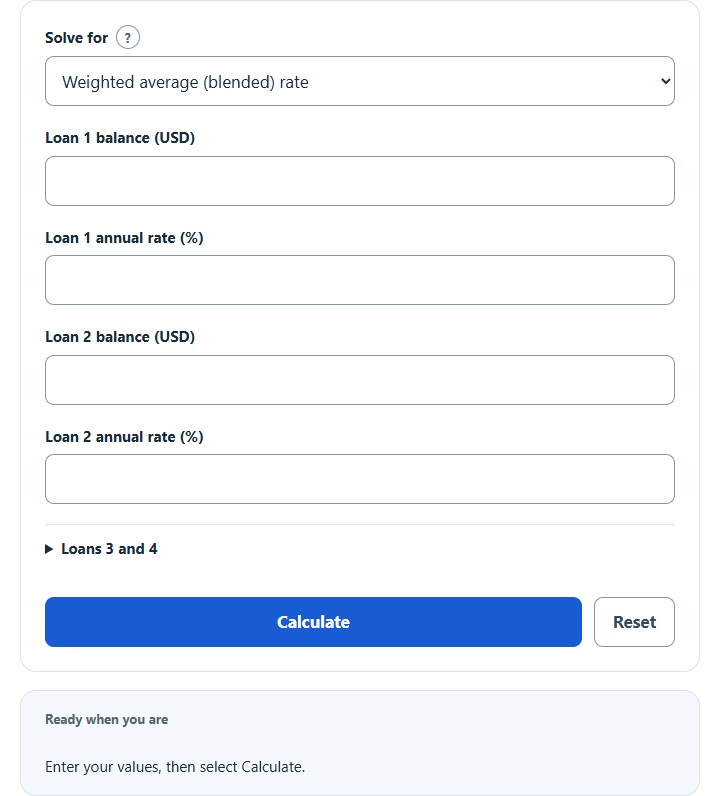
Calculate the weighted average interest rate (blended rate) of two to four loans from each balance and rate, plus annual interest and refinance savings.
Weighted Average Interest Rate Formula
The following equation is used to calculate the Weighted Average Interest Rate.
- Where WAIR is the weighted average annual rate (%). Enter rates consistently as percentages; the worked example below uses decimal rates and converts the result to percent.
- Σ(Pᵢ × Rᵢ) is the sum of the product of each principal and its associated interest rate.
- ΣPᵢ is the sum of all principals.
To calculate the weighted average interest rate, multiply each principal by its interest rate, sum these products, then divide by the total principal.
What is a Weighted Average Interest Rate?
Definition:
A weighted average interest rate reflects the proportional impact of multiple interest-bearing components—such as distinct loans or investments—by considering each principal’s share in the total.
How to Calculate Weighted Average Interest Rate?
Example Problem:
The following example outlines the steps and information needed to calculate the weighted average interest rate.
First, determine the principals and their respective interest rates. For instance, consider two loans: a $5,000 loan at 8% interest and a $10,000 loan at 6.5% interest.
Next, calculate (Principal × Rate) for each loan: ($5,000 × 0.08) = $400 and ($10,000 × 0.065) = $650.
Then, sum each principal to find the total principal: $5,000 + $10,000 = $15,000.
Next, sum the products of principals and rates: $400 + $650 = $1,050.
Finally, use the formula above to find the weighted average interest rate:
WAIR = $1,050 / $15,000 = 0.07 = 7%
FAQ
What is the advantage of calculating a weighted average interest rate?
A balance-weighted average shows the blended annual rate across multiple loans or investments. It is not an effective annual yield or APR: compounding and fees are excluded. Special products may apply their own rules, such as rounding up to the nearest one-eighth percentage point for federal Direct Consolidation Loans; this generic calculator does not apply that rounding.
Can this calculator help me decide which debt to pay off first?
The blend summarizes your balances but does not identify the best repayment order. Compare individual rates, fees, payment requirements and loan terms. The largest annual-interest contributor can reflect a large balance rather than the highest rate.
Does the weighted average interest rate change over time?
It can change if you pay off portions of your loans, take on new loans, or if the principal amounts and the interest rates themselves are adjusted over time.