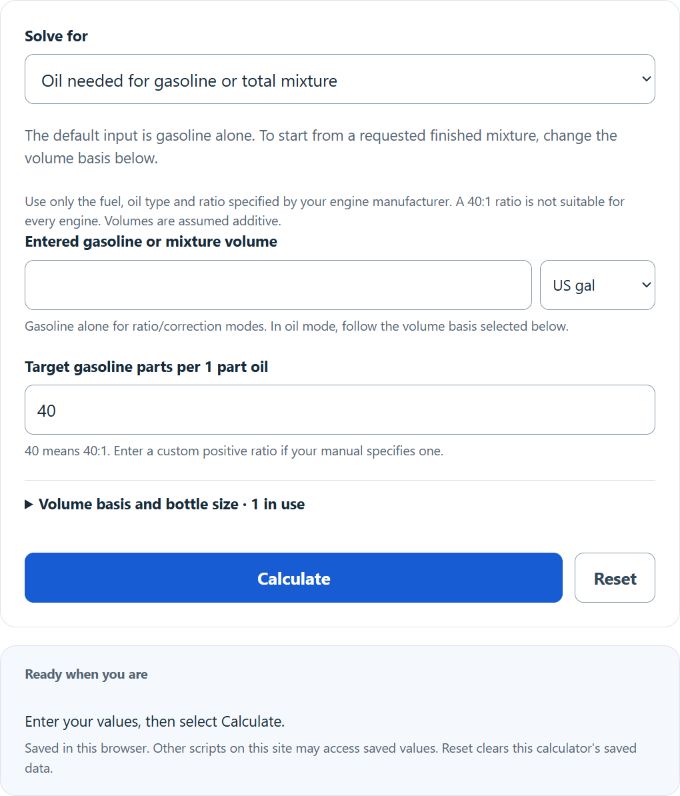
Calculate oil for a gasoline volume or a requested finished mixture, gasoline for oil, actual gas-to-oil ratio, or a correction to known amounts. Choose the ratio required by your engine manual.
- Oil to Gas Ratio Calculator
- 25 to 1 Ratio Calculator
- Liquid Dilution Ratio Calculator
- Ratio to Volume Calculator
- All Automotive Calculators
40-1 Mix Ratio Formula
The following formula applies when T is the total finished mixture volume. The calculator defaults to gasoline-only input, for which oil = gasoline ÷ R.
Variables:
- A is the amount of the first component (e.g., oil)
- B is the amount of the second component (e.g., gas)
- T is the total volume of the mixture
- R is the mix ratio (40 in a 40-1 mix ratio)
To calculate the amount of each component in a 40-1 mix ratio, divide the total volume of the mixture by the sum of the mix ratio and 1. This gives the amount of the first component. Subtract this amount from the total volume of the mixture to get the amount of the second component.
What is a 40-1 Mix Ratio?
A 40-1 mix ratio refers to the proportion of two substances mixed together. It is commonly used in reference to the ratio of gasoline to oil in two-stroke engines, such as those in chainsaws or weed eaters. In this context, a 40-1 mix ratio means there are 40 parts gasoline to 1 part oil. Use 40:1 only when the engine manufacturer specifies it. A ratio alone does not establish that the fuel or oil is suitable, uncontaminated or safe for an engine.
How to Calculate 40-1 Mix Ratio?
The following steps outline how to calculate the 40-1 Mix Ratio.
- First, determine the total volume of the mixture (T).
- Next, determine the mix ratio (R).
- Next, calculate the amount of the first component (A) using the formula A = T / (R + 1).
- Finally, calculate the amount of the second component (B) using the formula B = T - A.
- After inserting the variables and calculating the result, check your answer with the calculator above.
Example Problem :
Use the following variables as an example problem to test your knowledge.
Total volume of the mixture (T) = 100 mL
Mix ratio (R) = 40. Oil = 100/41 ≈ 2.4390 mL; gasoline ≈ 97.5610 mL. This differs from starting with 100 mL of gasoline, which needs 2.5 mL of oil and makes approximately 102.5 mL of finished mixture.
For 1 US liquid gallon of gasoline at 40:1, measure 3.2 US fluid ounces (94.6353 mL) of oil. US and Imperial gallons and fluid ounces are different units. For a known batch low on oil, add gasoline/R − existing oil. For a batch high on oil, add existing oil × R − gasoline. These calculations assume additive volumes and do not assess container capacity or unknown fuel composition.
The optional bottle calculation separates the exact fraction to measure from the number of bottles to have available. Do not pour whole bottles merely because the supply count rounds up. Follow the engine manual and accurate measuring procedures; see the manufacturer guidance on two-stroke fuel mixing.