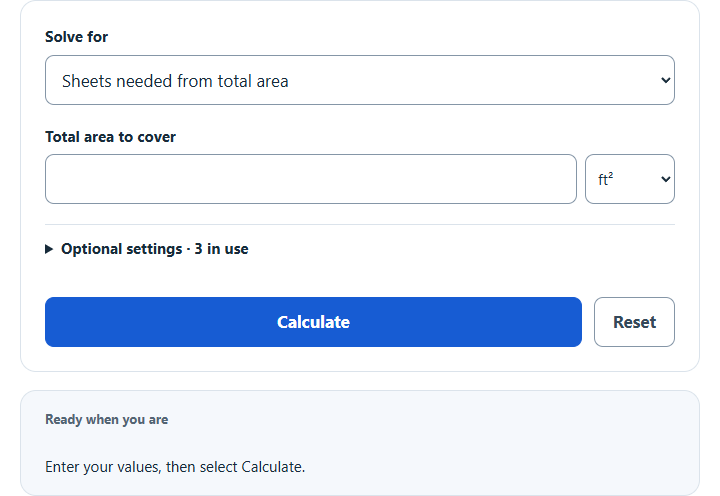
Calculate how many 4×8 sheets of plywood, drywall, or OSB you need to cover any area, including a waste allowance and total cost.
4×8 Sheet Formula
The number of full 4×8 sheets you need is the area you want to cover divided by the area of one sheet, increased by a waste factor and rounded up to the next whole sheet.
Sheets = ceil( (Area / SheetArea) * (1 + Waste / 100) )
A standard 4×8 sheet has an area of 4 ft times 8 ft, which is 32 square feet:
SheetArea = 4 * 8 = 32 sq ft
To go the other way and find the area a set number of sheets will cover, multiply the sheet count by the sheet area:
Area = Sheets * SheetArea
- Sheets: the number of 4×8 sheets required, always rounded up to a whole sheet.
- Area: the total surface you need to cover, in square feet.
- SheetArea: the coverage of one sheet, 32 square feet for a standard 4 ft by 8 ft panel.
- Waste: the extra percentage added for cuts, offcuts, and mistakes, commonly 10 percent.
- ceil: round up to the next whole number, since sheets are sold as full units.
Enter the area directly or let the calculator find it from a length and width. The solve-for selector offers sheets from total area, sheets from length and width, and gross area covered by a sheet quantity. The waste field pads the raw count so you order enough to finish the job, and the advanced options let you change the sheet size or add a price per sheet to estimate cost.
Coverage and Waste Reference
The first table shows how many 4×8 sheets cover common areas at a 10 percent waste factor. The second lists illustrative planning allowances. Cutting layouts and actual material dimensions determine the waste you need.
| Area to Cover | Bare Sheets (Area / 32) | Sheets with 10% Waste |
|---|---|---|
| 100 sq ft | 3.1 | 4 |
| 200 sq ft | 6.3 | 7 |
| 500 sq ft | 15.6 | 18 |
| 800 sq ft | 25.0 | 28 |
| 1,000 sq ft | 31.3 | 35 |
| 1,500 sq ft | 46.9 | 52 |
| Project Type | Suggested Waste Factor |
|---|---|
| Simple floor or wall sheathing | 10% |
| Roof sheathing with angles | 15% |
| Cabinets or custom cuts | 15% to 20% |
| Rooms with many openings | 10% to 15% |
Example Problems
Example 1. You are sheathing a floor that measures 20 ft by 40 ft, which is 800 square feet. Divide by 32 to get 25 bare sheets. Add a 10 percent waste factor to get 27.5, then round up. You need 28 sheets of 4×8 plywood.
Example 2. You already have 15 sheets of 4×8 drywall and want to know how much wall they will cover. Switch the calculator to solve for area covered, enter 15 sheets, and multiply by 32 square feet per sheet. The 15 sheets cover 480 square feet.
Frequently Asked Questions
How many square feet does a 4×8 sheet cover?
A standard 4 ft by 8 ft sheet covers 32 square feet. This is the same for plywood, OSB, drywall, MDF, and most other panel materials sold in the 4×8 size, so you divide your total area by 32 to find the bare sheet count.
Why should I add a waste factor?
Few areas divide evenly into 4×8 panels, so you end up with offcuts that cannot be reused, along with the occasional miscut. A 10 percent factor covers most straight runs. Bump it to 15 or 20 percent for roofs, cabinets, or rooms with many openings where more trimming is needed.
Can I use this for sheet sizes other than 4×8?
Yes. Open Optional settings and change the sheet width and length to match your material, such as a 4 ft by 9 ft or 4 ft by 10 ft panel. Select Calculate after changing the sheet size to update the area and sheet count.