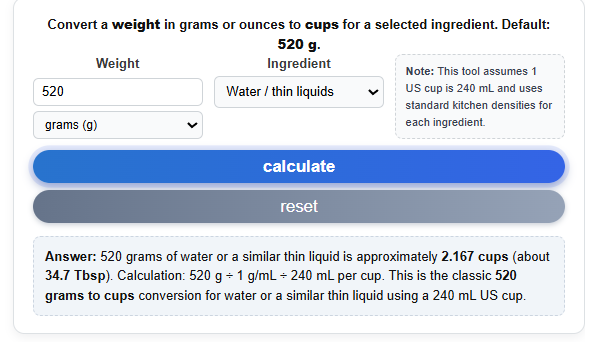
This page answers “How many cups is 520 grams?” and highlights that the result depends on which ingredient you are measuring. For example, 520 g of water is about 2.17 cups, 520 g of granulated sugar is roughly 2.55 cups, and 520 g of all-purpose flour comes out to around 3.80 cups. The interactive 520 grams to cups calculator above lets you pick the ingredient and weight so you can match recipes, meal plans, or food logs without guessing.
How the 520 grams to cups calculation works
Turning grams (g) into cups means converting a mass into a volume. To do this correctly you need the ingredient’s density (grams per milliliter) and the size of 1 cup. Here we use a US measuring cup of 240 mL.
Behind the scenes the calculator applies this general relationship:
- mL = grams ÷ density (g/mL)
- cups = mL ÷ 240 (for a 240 mL US cup)
For water-like liquids, the density is close to 1 g/mL, so 240 mL weighs about 240 g and 520 g of water is a little over 2 cups. Lighter ingredients such as flour and cocoa have lower densities, so the same weight fills more cup volume. Heavier ingredients like table salt, honey, or tightly packed brown sugar are denser, meaning fewer cups are needed to hold 520 grams.
All values here rely on common kitchen density estimates and assume level, not heaping, cups. Brand, particle size, and the way you fill a cup (scooping versus spooning and levelling) can change the exact numbers slightly, so treat them as practical working approximations.
Exact 520 grams to cups values for common ingredients
Using a 240 mL US cup and typical densities, the table below shows about how many cups you need for 260 g and 520 g of each ingredient, along with how many grams fit in a full 1 cup.
| Ingredient | Approx. density (g/mL) | 260 g (cups) | 520 g (cups) | 1 cup (g) |
|---|---|---|---|---|
| Water | ≈ 1.00 | ≈ 1.08 | ≈ 2.17 | ≈ 240 g |
| Milk (whole) | ≈ 1.04 | ≈ 1.04 | ≈ 2.08 | ≈ 249.6 g |
| Granulated sugar | ≈ 0.85 | ≈ 1.27 | ≈ 2.55 | ≈ 204 g |
| Brown sugar (packed) | ≈ 0.89 | ≈ 1.22 | ≈ 2.44 | ≈ 213.6 g |
| All-purpose flour | ≈ 0.57 | ≈ 1.90 | ≈ 3.80 | ≈ 136.8 g |
| Cocoa powder (unsweetened) | ≈ 0.53 | ≈ 2.04 | ≈ 4.09 | ≈ 127.2 g |
| Butter | ≈ 0.96 | ≈ 1.13 | ≈ 2.26 | ≈ 230.4 g |
| Vegetable oil | ≈ 0.92 | ≈ 1.18 | ≈ 2.35 | ≈ 220.8 g |
| Olive oil | ≈ 0.91 | ≈ 1.19 | ≈ 2.38 | ≈ 218.4 g |
| Table salt | ≈ 1.20 | ≈ 0.90 | ≈ 1.81 | ≈ 288 g |
| Honey | ≈ 1.42 | ≈ 0.76 | ≈ 1.53 | ≈ 340.8 g |
| Peanut butter | ≈ 0.94 | ≈ 1.15 | ≈ 2.30 | ≈ 225.6 g |
For day‑to‑day cooking and baking, these estimates are usually precise enough to move between grams and cups when a scale is not available. For very sensitive recipes, weighing in grams remains best; use these figures as a reference point and fine‑tune your own “house” measurements over time.
When to convert 520 grams to cups (and when to stay in grams)
Measuring by volume is convenient and familiar, but it can vary with scooping technique. Converting 520 grams to cups is especially handy when:
- You have a recipe written in grams but only measuring cups in your kitchen.
- You are scaling a recipe that specifies “520 g of X” and want to measure it out with cups instead.
- You are tracking food where the app expects cups, but the nutrition label lists values per 100 g or 520 g.
For strict baking or macro counting, staying in grams is normally more accurate. Use this page when you need a fast, ingredient‑aware estimate of how many cups correspond to 520 grams or any other weight you type into the calculator.
Related conversions:
- 6 grams to cups
- 62 grams to cups
- 64 grams to cups
- 7 grams to cups
- 75 cups to grams
- 96 grams to cups
- 1 gram to cups
Most popular conversions:
- 200 grams to cups
- 150 grams to cups
- 50 grams to cups
- 250 grams to cups
- 300 grams to cups
- 500 grams to cups
- 400 grams to cups
- 120 grams to cups
- 60 grams to cups
All Food and Cooking Calculators