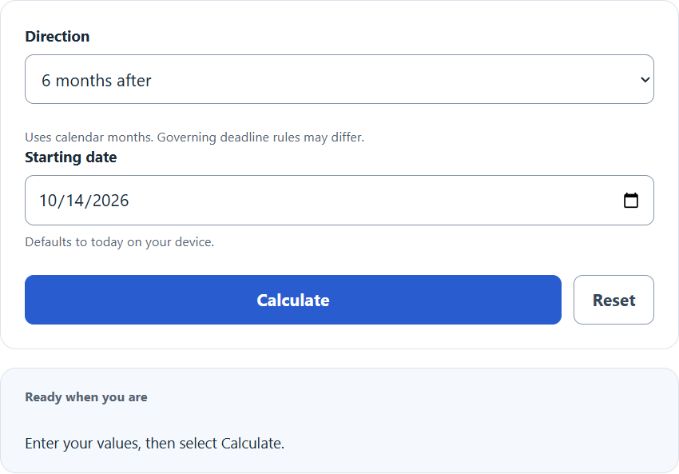
Find the calendar date exactly six months after or before a selected starting date. The calculation uses calendar months, not a fixed number of days.
Six calendar months is not a fixed number of days. Months range from 28 to 31 days, so the exact day difference depends on the starting date and leap-year status.
How to Use This Calculator
- Select the starting date.
- Choose six months after or before.
- Calculate the destination calendar date.
- Review the weekday and actual day difference.
After a successful calculation, the inputs and result remain saved in this browser. Select Reset to clear the stored values and restore the calculator defaults.
How the 6 Months From Today Calculator Works
When the destination month does not contain the starting day number, this calculator uses the last valid day of the destination month. That rule makes month-end behavior explicit and repeatable.
The primary relationship is Result date = starting date ± 6 calendar months. Dates use whole calendar days; shorter destination months are clamped to their last day.
Formula Variables and Input Guide
Select a starting date and choose whether to move forward or backward.
| Variable or term | Meaning | Unit or note |
|---|---|---|
| Start date | Selected civil date | local calendar |
| Direction | Before or after | ±6 months |
| Destination day | Same day number when valid | otherwise month end |
| Day difference | Elapsed calendar days | varies |
Choosing the Right Inputs
Enter the civil calendar date printed on the schedule, agreement, notice, or record, then choose whether to move six months forward or backward. This tool treats a month as a calendar unit; it does not substitute 180, 182, business, or banking days. If a rule defines the period in days, use that stated day-count rule instead.
Pay special attention to dates on the 29th, 30th, or 31st. When the destination month lacks the starting day number, the calculator uses the final valid day of that month. Contracts and filing rules sometimes use a different end-of-month convention, exclude holidays, or specify a time zone, so record the governing rule with the calculated date.
Practical Uses
- Finding renewal, review, or follow-up dates.
- Checking month-based contract or subscription periods.
- Planning calendar milestones around month-end dates.
- Comparing calendar months with a stated day count.
Month-end examples
| Starting date | Six months later |
|---|---|
| August 31, 2025 | February 28, 2026 |
| August 31, 2027 | February 29, 2028 |
| March 31, 2026 | September 30, 2026 |
| February 29, 2028 | August 29, 2028 |
Understanding Your Results
The calculator returns the calendar date, weekday, and actual number of calendar days between the dates.
Use the calendar result for due dates only when the applicable agreement uses calendar months. Contracts, benefits, and filing rules may define “six months” differently.
Worked Example
Six months after August 31 is the final valid day of February, because February has no 31st day.
Six months before March 31, 2026 is September 30, 2025 because September has no 31st day.
Checking the Result by Hand
Move the month number forward or backward by six, carrying into the adjacent year when necessary, and try to retain the original day number. If that day does not exist, use the destination month’s final day; August 31, 2025 therefore becomes February 28, 2026.
Count the elapsed days separately only as a description of the resulting calendar interval, remembering leap years. A clamped month-end calculation is not always perfectly reversible: moving from August 31 to February 28 and back six months can land on August 28 under the same-day rule.
Common Mistakes to Avoid
- Substituting 180 or 182 days for six calendar months.
- Overlooking the leap day in February.
- Assuming business days are excluded.
- Ignoring a contract-specific end-of-month rule.
Assumptions and Limitations
Calendar months vary from 28 to 31 days. When the destination month is shorter, this calculator uses that month’s final valid date.
Frequently Asked Questions
Is six months always 182 days?
No. The elapsed days depend on the months crossed and leap-year status.
What happens to the 31st?
If the destination month is shorter, the calculator uses its last valid day.
Does this count business days?
No. It uses ordinary calendar dates.
Which time zone is used?
The calculation is based on the civil date selected in the browser, not a moment in UTC.
Sources