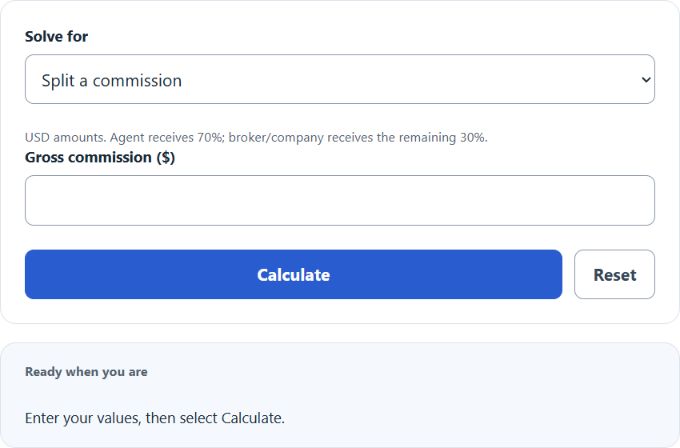
Calculate a 70/30 commission split for agents and brokers, or work backward from either share to estimate the gross commission with a clear payment breakdown.
70/30 Commission Split Formula
The following formula is used to calculate the commission split in a 70/30 commission split arrangement.
Variables:
- CS is the commission split ($)
- T is the gross commission before separate fees and taxes ($)
- R is the rate of the split (decimal)
To calculate the commission split, multiply the total commission by the rate of the split. For a 70/30 split, the rate (R) would be 0.7 for the person receiving 70% of the commission and 0.3 for the person receiving 30% of the commission.
What is a 70/30 Commission Split?
A 70/30 commission split is a type of payment arrangement, often used in real estate or sales industries, where the salesperson or agent receives 70% of the commission earned on a sale, while the remaining 30% goes to the brokerage or company. This split is typically used to cover the costs of office space, marketing, administrative support, and other resources provided by the company. The exact percentage can vary depending on the company’s policies and the individual’s level of experience or performance.
How to Calculate 70/30 Commission Split?
The following steps outline how to calculate the 70/30 Commission Split.
- First, determine the total commission ($).
- Next, determine the rate of the split (decimal).
- Next, gather the formula from above = CS = T * R.
- Finally, calculate the Commission Split.
- After inserting the variables and calculating the result, check your answer with the calculator above.
Example Problem :
Use the following variables as an example problem to test your knowledge.
total commission ($) = 500
rate of the split (decimal) = 0.7
Agent share = $500 × 0.70 = $350; broker/company share = $500 − $350 = $150. The calculator rounds the agent share to cents and assigns the remaining cents to the broker/company so the shares sum exactly to the gross commission. Reverse calculations estimate the unrounded relationship and may not identify a unique gross amount after cent rounding.