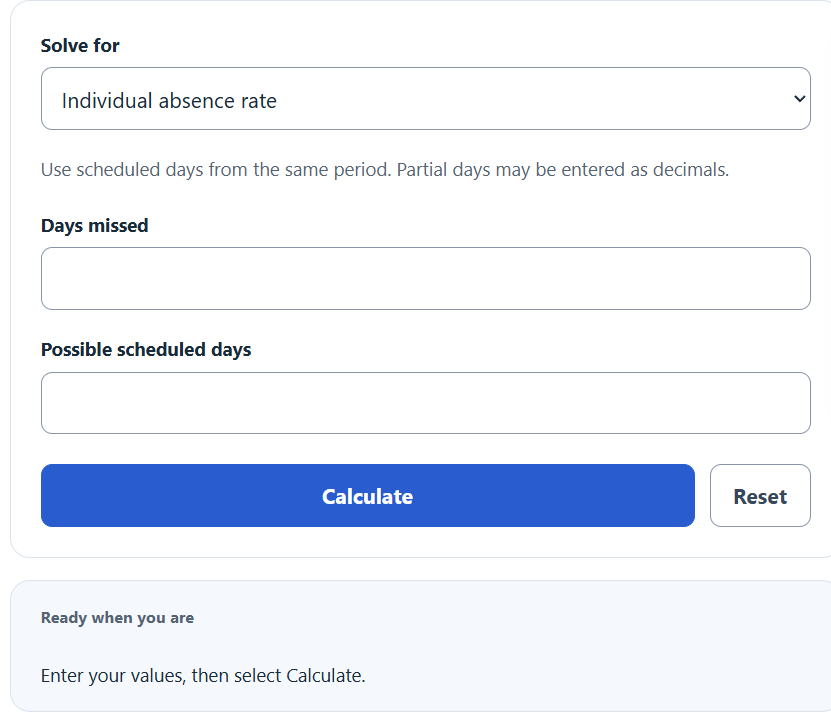
Calculate individual, workforce, or target absence rates from missed days, possible days, and scheduled person-days, plus allowed day limits.
Related Calculators
Absence Rate Formula
- Days Missed — absence days in the period (for a workforce, the sum across all people)
- Possible Days — scheduled days in the period (for a workforce, people × scheduled days each)
For the target mode, the calculator inverts the formula to find the maximum whole days you can miss without exceeding a target rate:
Partial days count as fractions. Holidays and non-scheduled days are excluded from possible days unless your policy says otherwise.
Reference Tables
Illustrative school-attendance bands and possible responses are shown below; workplace and school policies vary. Chronic school absence commonly means missing at least 10% of school days.
| Absence Rate | Common Label | Typical Action |
|---|---|---|
| Under 5% | Satisfactory | No action |
| 5% – 9.9% | At risk | Letter or check-in |
| 10% – 19.9% | Chronic | Intervention plan |
| 20% or more | Severe | Formal review |
Days that equal common absence rates over typical periods:
| Period | Possible Days | 5% | 10% | 15% |
|---|---|---|---|---|
| Work month | 22 | 1.1 | 2.2 | 3.3 |
| Quarter | 65 | 3.25 | 6.5 | 9.75 |
| School year | 180 | 9 | 18 | 27 |
| Work year | 260 | 13 | 26 | 39 |
Worked Examples
Student. A student misses 12 days of a 180-day school year. Rate = (12 / 180) × 100 = 6.67%. Below the 10% chronic threshold but in the watch range.
Workforce. A team of 50 people scheduled 22 days each (1,100 person-days) records 33 absence days. Rate = (33 / 1,100) × 100 = 3.0%.
Target limit. To stay at or below 10% across 180 possible days, the cap is floor(0.10 × 180) = 18 days. Missing a 19th day pushes the rate to 10.56%.
FAQ
Do partial days count? Yes. Enter them as decimals (a half day is 0.5).
Should holidays be included in possible days? No. Possible days are scheduled days only, not calendar days.
Why does the target mode round down? Because you cannot miss a fractional whole day in most policies. Rounding down keeps the whole-day total at or below the target. A strict “below” policy differs at exact boundaries; 18 of 180 days is exactly 10%, already at the chronic-absence threshold.