Calculate or reverse acceleration torque from rotational inertia, a speed ramp, or linear force at a radius, with SI and imperial units plus power and energy.
- All Physics Calculators
- All Torque Calculators
- Gasket Torque Calculator
- Flywheel Torque Calculator
- Pressure To Torque Calculator
- N·m to ft-lbs
Acceleration to Torque Formula
The calculator uses one of three formulas depending on the input set you choose.
Inertia + angular acceleration:
Speed ramp:
Linear acceleration at a radius:
- T = torque (N·m)
- J = mass moment of inertia (kg·m²)
- α = angular acceleration (rad/s²)
- ω_start, ω_final = initial and final angular speed (rad/s)
- t = acceleration time (s)
- m = mass being accelerated (kg)
- a = linear acceleration (m/s²)
- r = radius or lever arm where the force acts (m)
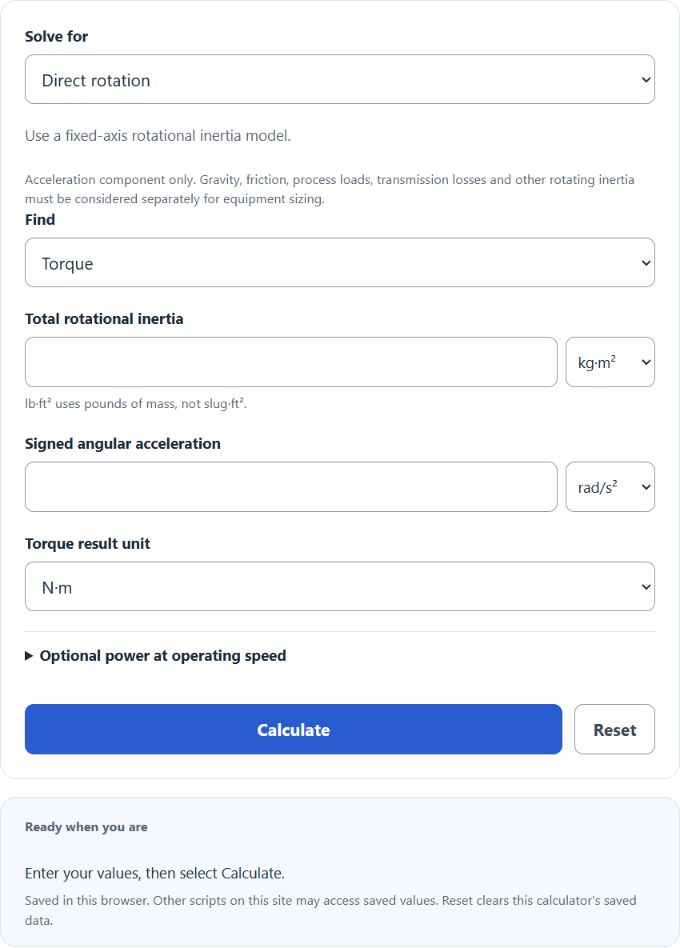
The first mode is the direct form. Enter the rotating inertia and the angular acceleration and you get the acceleration torque. Use it when α is already known.
The second mode computes α for you from a speed change over a time window, then multiplies by inertia. Use it for motor sizing where you have a target rpm and a ramp time.
The third mode handles linear loads driven through a pulley, drum, or pinion. The mass and linear acceleration give a tangential force, and that force times the radius gives the torque the shaft must deliver. This mode does not include the rotating inertia of the drum or pulley itself, so add that separately if it matters.
Reference Tables
Illustrative angular-acceleration ranges for exploring the model, not measured benchmarks or equipment sizing limits. Select values from the actual motion profile and manufacturer data:
| Application | Illustrative α (rad/s²) | Notes |
|---|---|---|
| Conveyor start-up | 2 to 10 | Soft ramp, seconds-long |
| Industrial servo | 100 to 5,000 | Depends on inertia ratio |
| CNC spindle ramp | 50 to 500 | 0 to several thousand rpm |
| Vehicle wheel, hard launch | 20 to 80 | Tire radius limited |
| Hard disk, pickup speed | 200 to 1,000 | Small inertia, fast spin-up |
Unit conversions used by the calculator:
| From | To | Multiply by |
|---|---|---|
| lb·ft² | kg·m² | 0.04214 |
| oz·in² | kg·m² | 1.829e-5 |
| rpm | rad/s | 0.10472 |
| rev/s² | rad/s² | 6.2832 |
| N·m | lb-ft | 0.7376 |
| N·m | oz-in | 141.61 |
Examples and FAQ
Example 1. A motor must spin a load with J = 0.05 kg·m² from 0 to 1,500 rpm in 0.4 seconds. Convert 1,500 rpm to 157.08 rad/s. α = 157.08 / 0.4 = 392.7 rad/s². T = 0.05 × 392.7 = 19.6 N·m of acceleration torque. Add the running torque from friction or process load to size the motor.
Example 2. A 200 kg load is lifted by a drum of radius 0.1 m at 2 m/s². T = 200 × 2 × 0.1 = 40 N·m for the acceleration component. Gravity adds m × g × r = 200 × 9.81 × 0.1 = 196.2 N·m, so the total drum torque during the lift is about 236 N·m.
Does this give peak or continuous torque? It gives the ideal acceleration component. Compare the complete torque profile with the motor's peak capability, continuous and thermal limits, and permitted duration and duty cycle; include other loads and losses.
Should I include the motor rotor inertia? Yes. Total inertia means the load inertia plus the rotor inertia plus any coupling, gearbox, and shaft inertia reflected to the motor shaft.
How do I reflect inertia through a gearbox? For gear ratio N = motor angular velocity / load angular velocity, divide load-side inertia by N² to reflect it to the motor shaft. Add motor-side and transmission inertia and account for relevant losses separately.
Why is my torque negative? Negative torque denotes the chosen negative direction. It decelerates a shaft only when opposing its angular velocity; negative torque and negative angular velocity can increase speed magnitude. Mechanical power is torque × signed angular velocity, so negative power denotes energy extraction. Equipment sizing requires the complete duty and load profile.