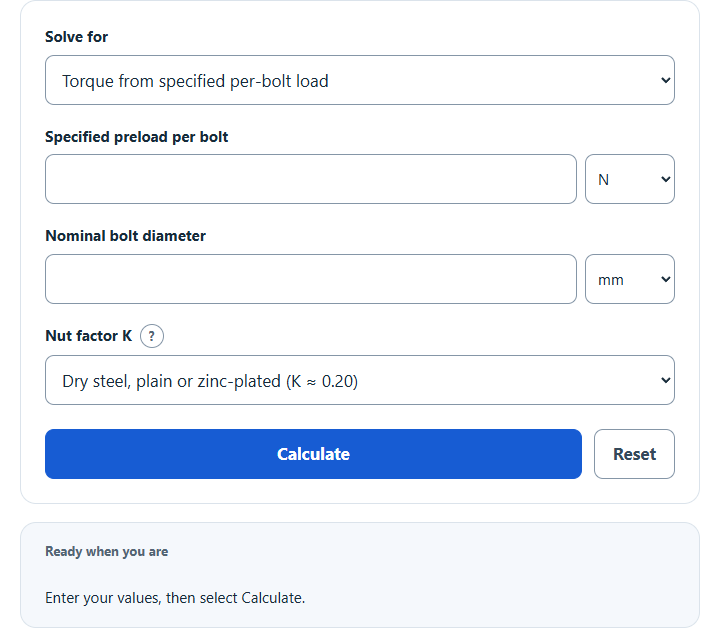
Calculate bolt torque from preload, bolt diameter and a typical nut factor, or solve for preload, diameter or K, with a gasket seating-load option.
- All Automotive Calculators
- All Torque Calculators
- Flange Bolt Torque Calculator
- O-Ring Size Calculator
- Torque Calculator
- Bolt Preload Calculator
- Clamp Load Calculator
- Nm to Ft-lbs Torque Conversion Calculator
Gasket Torque Formula
The following is a rough empirical torque–preload approximation. F is the force on one bolt and D is its nominal diameter. Pick a typical nut factor or enter one established for the actual fastener, lubrication and surfaces; the calculator does not select a safe preload.
- Where Tg is the Gasket Torque (N-m)
- F is the bolt load / preload force (N)
- D is the diameter (mm)
- k is the nut factor (k-value)
Multiply per-bolt preload by nominal bolt diameter and nut factor, dividing millimeters by 1,000 to obtain meters. The relation is T ≈ K F d. Technetics’ metal-seal catalog describes this as a rough estimate and notes the dependence on joint and friction conditions. It does not verify bolt/flange strength or sealing performance.
How to Calculate Gasket Torque?
The examples below demonstrate arithmetic only; their loads and nut factors are not recommended assembly values. For the separate annular model, area A = π(OD² − ID²)/4, seating-only load W = A × specified seating stress × specified multiplier, and equal per-bolt load is W divided by bolt count. Full-annulus contact and equal loading are assumptions. Pressure end load, effective gasket contact width, relaxation and joint limits require separate design review and a joint-specific assembly procedure. See the scope of ASME PCC-1.
Example Problem #1
- First, determine the bolt load / preload force (N). In this example, the bolt load (N) is given as 50,000.
- Next, determine the diameter (mm). For this problem, the diameter (mm) is given as 20.
- Next, determine the nut factor (k-value). In this case, the nut factor (k-value) is found to be 0.20.
- Finally, calculate the Gasket Torque using the formula above:
Tg =F*D*k / 1000
Inserting the values from above and solving yields:
Tg =50,000*20*0.20 / 1000 = 200 (N-m)
Example Problem #2
Using the same method as above, determine the variables required by the equation. For this example problem, these are provided as:
bolt load (N) = 60,000
diameter (mm) = 40
nut factor (k-value) = 0.18
Entering these given values yields:
Tg =60,000*40*0.18 / 1000 = 432 (N-m)