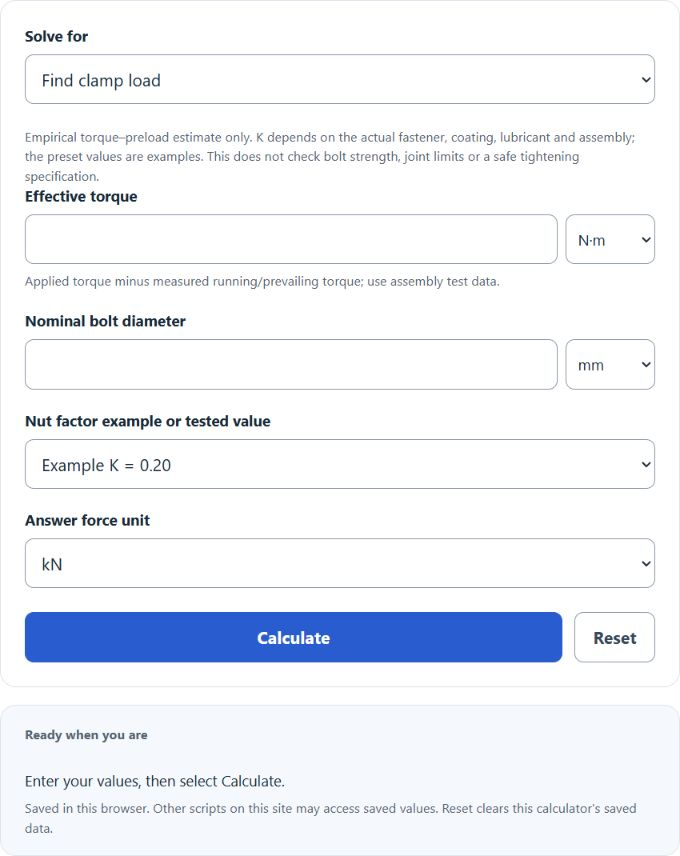
Calculate bolt clamp load from tightening torque, or solve for required torque, bolt diameter, or nut factor with metric and imperial units.
Related Calculators
- Bolt Length Calculator
- Snub Force Calculator
- Pipe Stretch Calculator
- Wind Pressure & Force Calculator
- All Construction Calculators
Clamp Load Formula
This is an empirical torque–preload estimate for a threaded fastener. In the equations below, T is effective torque in N·m after separately accounting for measured running/prevailing torque, D is nominal diameter in mm, F is preload in N, and K is the dimensionless nut factor. The estimate does not establish a safe tightening specification or joint capacity.
Rearranged forms used to solve for each missing value:
- T = torque, in Nm
- F = clamp load, in N
- D = nominal fastener diameter, in mm
- K = nut factor, dimensionless
- 1000 = conversion factor because 1 Nm = 1000 N·mm
Select clamp load, effective torque, diameter or nut factor to solve for, then enter the visible known values. Select a tested custom K or an illustrative assumed K when K is an input. Unit selectors convert the entered quantities; answer units convert the result. Diameter mode is an algebraic inverse, not a safe fastener-size selection.
Illustrative Nut Factor Values
K is an empirical torque–preload factor incorporating friction and geometry, not a fraction of torque converted into tension or a coefficient of friction. Use assembly-specific test data. The three widget presets are illustrative assumptions, not universal values for dry, oiled or plated hardware. The table gives application-dependent laboratory examples from Fastenal’s Bolted Joint Design guide; coatings, lubricants and installation conditions can change K materially.
| Fastener condition | Typical K value | Notes |
|---|---|---|
| Non-plated black finish, dry (laboratory example) | 0.20 to 0.30 | Illustrative range; use tested assembly data |
| Lubricated (laboratory example) | 0.12 to 0.16 | Lower friction increases clamp load for the same torque |
| Zinc plated (laboratory example) | 0.17 to 0.22 | Depends strongly on coating and lubricant |
| Prevailing torque lock nut | Varies | Use effective torque after separately accounting for measured running torque; no automatic locking-torque correction |
Common Unit Conversions
| Quantity | Conversion |
|---|---|
| Torque | 1 ft·lbf ≈ 1.35582 N·m |
| Diameter | 1 inch = 25.4 mm |
| Clamp load | 1 lbf = 4.4482216152605 N |
| Clamp load | 1 kN = 1000 N |
Example Calculations
Example 1: Calculate clamp load
Assume 80 N·m of effective preload torque, a 10 mm nominal diameter and K = 0.20 for this arithmetic example.
The clamp load is 40,000 N, or 40 kN.
Example 2: Calculate required torque
For an arithmetic example, assume 25 kN of preload, a 12 mm nominal diameter and K = 0.18. Joint and fastener limits require a separate check.
First convert clamp load to newtons: 25 kN = 25,000 N.
The estimated effective torque is 54 N·m. Any measured running/prevailing torque must be treated separately under the approved assembly procedure; see NASA-STD-5020B.
FAQ
What is clamp load?
Clamp load is the tensile force created in a bolt or screw when it is tightened. That tension pulls the joined parts together. In this calculator, clamp load is estimated from torque, diameter, and nut factor.
Why does the nut factor matter so much?
The nut factor accounts for friction in the threads and under the nut or bolt head. A lower K value means less torque is lost to friction, so the same torque creates more clamp load. A higher K value means more torque is lost to friction, so clamp load is lower.
Is this the same as proof load or bolt strength?
No. Clamp load is the preload created by tightening. Proof load and tensile strength are material limits of the fastener. When choosing a tightening torque, make sure the resulting clamp load stays within the allowable range for the bolt, threads, and joint.