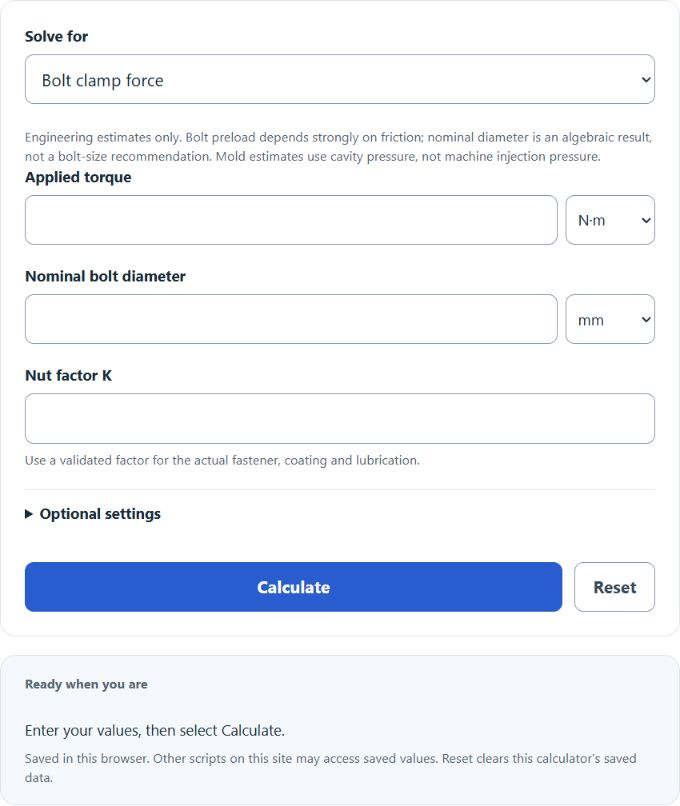
Calculate bolt clamp force from torque, diameter, and nut factor, or estimate injection-mold tonnage from projected area, cavity pressure, and a safety factor.
- All Physics Calculators
- Torque Wrench Extension Calculator
- Torque Calculator
- Bolt Preload Calculator
- Brake Caliper Clamping Force Calculator
Clamping Force Formula
The following formula is used to calculate the axial clamping force of a bolt.
- Where F is the clamping force (N or lbf)
- T is the torque applied to the bolt (N-mm, in-lb)
- K is the dimensionless empirical nut factor for the actual fastener and installation
- Illustrative dry example: K = 0.20
- Use supplier data or testing for the actual coating and lubrication
- Lubricated legacy presets are illustrative, not universal material constants
- D is the diameter of the bolt (mm, in)
To calculate bolt clamping force, divide torque by the product of the nut factor and nominal diameter, using consistent units: F = T / (K × D). The separate mold modes use total projected area × mean cavity pressure × the selected safety factor for preliminary sizing.
Clamping Force Definition
What is a clamping force? A clamping force is a measure of the force applied to an object that is used to oppose separating forces that are trying to move that object from its current location.
Example Problem
How to calculate clamping force?
- First, determine the torque applied to the bolt.
Using a torque wrench, the torque being applied to the bolt in this example is found to be 300 in-lbs.
- Next, determine the diameter of the bolt.
The bolt being used in this application is measured to be 2 inches.
- Next, determine the nut factor of the bolt.
For this illustrative example only, assume a dimensionless nut factor K = 0.20. Actual fastener, coating, lubrication and installation conditions require validated data.
- Finally, calculate the clamping force.
Using the formula, the clamping force is found to be 300/(2*.2) = 750 lbf.
About Clamping Force
What is clamping force measured in? A clamping force is typically measured using units of lbs or newtons. Clamping forces use the same units as any other force metric.
Does clamping force increase with the number of bolts? Increasing the number of bolts on a fixture will increase the clamping force. Typically the total clamping force would be approximately the sum of each of the clamping forces provided by the individual bolts.
How much clamping force do I need? The required load and safety factor depend on the joint or molding process, failure modes, materials and applicable specifications. This estimate does not establish safe bolt torque, joint capacity or machine suitability. Use validated inputs and qualified engineering guidance.
Bolt preload estimate: F = T / (K × D), with torque and diameter expressed in compatible units. Use a validated nut factor for the actual installation.