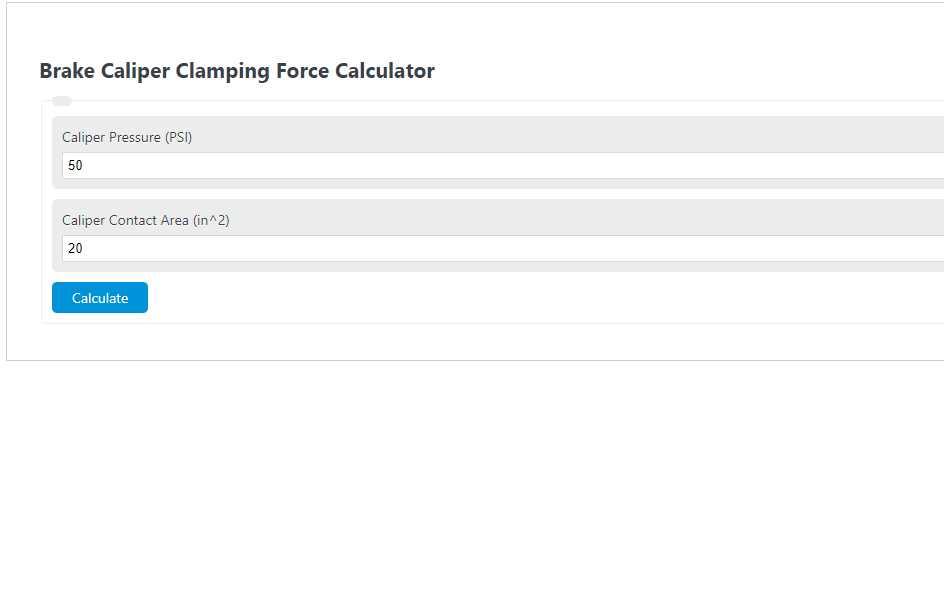
Calculate brake caliper clamping force, line pressure, or piston diameter for floating and fixed calipers in psi, bar, kPa, N, lbf, mm, and inches.
- All Automotive Calculators
- All Force Calculators
- Brake Pedal Force Calculator
- Braking Force Calculator
- Brake Efficiency Calculator
Brake Caliper Clamping Force Formula
The brake caliper clamping force is the hydraulic line pressure at the caliper multiplied by the total effective piston area that creates clamp load.
- F = brake caliper clamping force
- P = hydraulic line pressure at the caliper
- A = total effective piston area for clamping
If you need to solve for pressure or area instead, rearrange the same formula:
- Calculate clamping force: enter hydraulic line pressure and effective piston area. The calculator uses F = P * A.
- Calculate pressure: enter clamping force and effective piston area. The calculator uses P = F / A.
- Calculate effective piston area: enter clamping force and hydraulic pressure. The calculator uses A = F / P.
For consistent results, the calculator converts pressure to psi, area to square inches, and force to pounds-force internally, then converts the answer back to your selected unit.
Brake Pressure, Area, and Force Reference
| Input | Common Unit | Useful Conversion |
|---|---|---|
| Pressure | psi | 1 psi = 6.8948 kPa = 0.06895 bar |
| Area | in² | 1 in² = 6.4516 cm² = 0.00064516 m² |
| Force | lbf | 1 lbf = 4.4482 N = 0.4536 kgf |
| Brake System Item | Typical Range | How It Affects Clamp Force |
|---|---|---|
| Moderate braking line pressure | 300 to 700 psi | Higher pressure increases clamp force directly. |
| Hard braking line pressure | 800 to 1,500 psi | A large pressure increase produces a matching percentage increase in clamp force. |
| Small single-piston caliper effective area | About 3 to 6 in² | Smaller area produces less clamp force at the same pressure. |
| Larger multi-piston caliper effective area | About 6 to 12+ in² | Larger area produces more clamp force at the same pressure. |
Example Problems
Example 1: Calculate clamping force
You have 900 psi of hydraulic pressure at the caliper and a total effective piston area of 5.50 in².
The brake caliper clamping force is 4,950 lbf.
Example 2: Calculate required pressure
You want 6,000 lbf of clamping force from a caliper with 7.20 in² of effective piston area.
The required hydraulic line pressure is 833.33 psi.
FAQs
What does total effective piston area mean?
Total effective piston area is the piston area that actually contributes to clamp force. For a fixed caliper, use the sum of the piston areas on both sides of the rotor. For a sliding or floating caliper, the clamp force is commonly based on 2 × the piston-side area, because the caliper body reacts against the opposite pad.
Is clamping force the same as braking force at the tire?
No. Clamping force is the force squeezing the brake pads against the rotor. Braking force at the tire also depends on pad friction coefficient, rotor effective radius, wheel radius, tire grip, and vehicle weight transfer. Clamp force is only one part of the full braking calculation.
Why does the calculator ask for pressure at the caliper?
The formula uses hydraulic pressure acting on the caliper pistons. If pressure is measured somewhere else in the system, the actual pressure at the caliper may differ slightly because of line losses, restrictions, proportioning valves, or ABS hardware. For the most direct calculation, use the pressure at the caliper inlet.