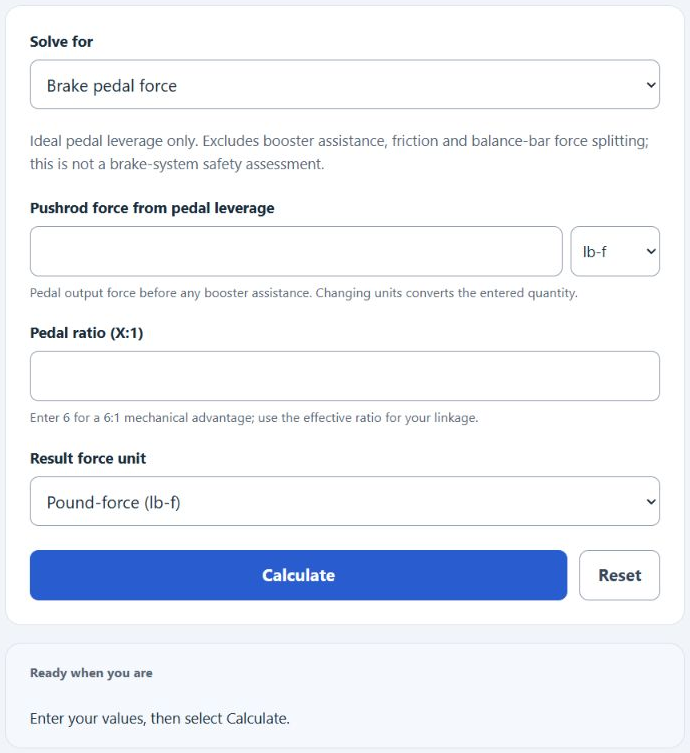
Calculate brake pedal force, master cylinder pushrod force, or pedal ratio from any two values in lb-f, kg-f, or N, with step-by-step results.
- All Automotive Calculators
- All Force Calculators
- Braking Force Calculator
- Brake Caliper Clamping Force Calculator
- Wheel Force Calculator
- Stopping Distance Calculator
- Brake Efficiency Calculator
Brake Pedal Force Formula
The brake pedal force calculator uses the relationship between driver input force, brake pedal ratio, and master cylinder pushrod force. The pedal ratio is a mechanical multiplier. This ideal model excludes booster assistance, friction, and balance-bar force splitting. Pushrod force here means total pedal output before any booster or split; it equals master cylinder input only for a direct, unassisted linkage.
- F_pushrod = master cylinder pushrod force, also called pedal output force
- F_pedal = brake pedal force, the force applied by the driver at the pedal
- R = brake pedal ratio, written as X:1
Choose the value to solve for, then enter the two displayed inputs. Forces are nonnegative magnitudes; the ratio must be positive.
- To find master cylinder pushrod force: the calculator multiplies brake pedal force by the brake pedal ratio.
- To find brake pedal ratio: the calculator divides pushrod force by brake pedal force.
- To find brake pedal force: the calculator divides pushrod force by the brake pedal ratio.
Force values may be entered in lb-f, kg-f, or N. The calculator converts the forces internally before applying the formula.
Common Brake Pedal Ratios and Force Conversions
Pedal ratio depends on the pedal arm geometry. Higher ratios multiply your foot force more, but usually increase pedal travel. The examples below are not design recommendations; verify the actual linkage and manufacturer requirements. Wilwood describes common assisted and manual ranges; the race example uses Tilton’s 900-series specifications.
| Brake setup | Typical pedal ratio | What it means |
|---|---|---|
| Power-assisted brakes | 4.5:1 to 5:1 | Lower pedal ratio because the booster adds force. |
| Manual brakes | 6:1 to 7:1 | Higher pedal ratio because the driver supplies more of the braking force. |
| Race or custom pedal box | 4.7:1, 5.5:1 or 6.2:1 (Tilton 900-series example) | Selected based on master cylinder size, pedal travel, and desired pedal feel. |
| Conversion | Factor |
|---|---|
| 1 kg-f to lb-f | 2.20462 lb-f |
| 1 N to lb-f | 0.224809 lb-f |
| 1 lb-f to N | 4.44822 N |
| 1 lb-f to kg-f | 0.453592 kg-f |
Brake Pedal Force Examples
Example 1: Calculate master cylinder pushrod force
You apply 80 lb-f at the brake pedal, and the brake pedal ratio is 6:1.
The ideal pedal output force is 480 lb-f, before any booster assistance or balance-bar split.
Example 2: Calculate brake pedal force
The pushrod force is 350 lb-f, and the brake pedal ratio is 5:1.
The required brake pedal force is 70 lb-f.
Brake Pedal Force FAQ
What is brake pedal ratio?
Brake pedal ratio is the leverage ratio of the brake pedal. A 6:1 ratio means the pedal multiplies your foot force by 6 before any booster assistance or balance-bar split. For example, 75 lb-f at the pedal becomes 450 lb-f at the pushrod with a 6:1 ratio.
Does a higher pedal ratio always mean better braking?
No. A higher pedal ratio increases pushrod force, but it also increases pedal travel. If the ratio is too high, the pedal may feel long or soft. If the ratio is too low, the pedal may feel hard and require too much driver effort.
Is pushrod force the same as hydraulic brake pressure?
No. Pushrod force is the mechanical force applied to the master cylinder. Hydraulic brake pressure also depends on the master cylinder piston area. To find brake line pressure, you would divide pushrod force by the master cylinder piston area.