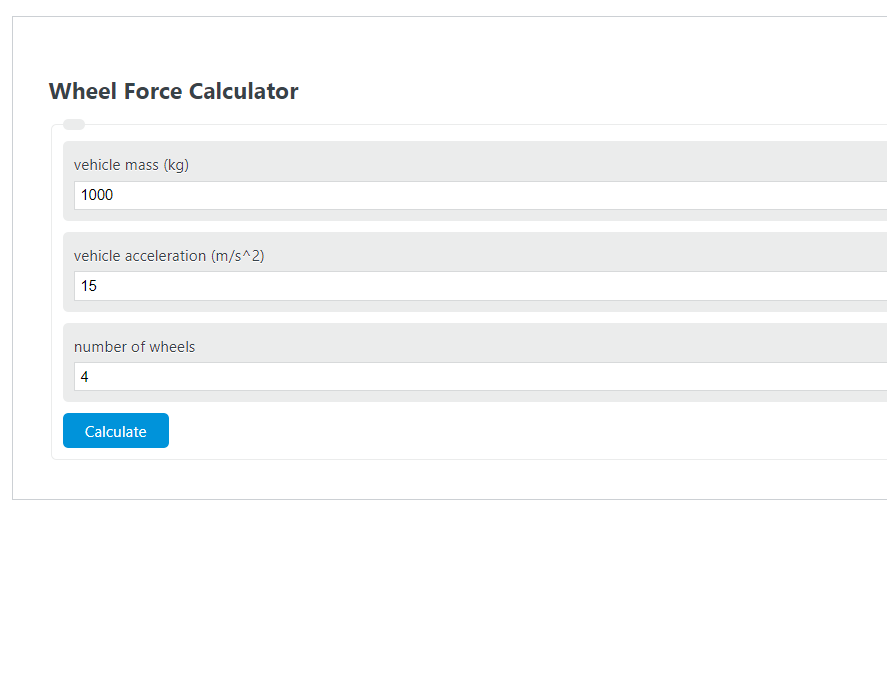
Calculate wheel force per driven wheel, vehicle mass, acceleration or driven wheels when you enter any 3 values, with kg/lb and m/s²/ft/s² units.
- All Automotive Calculators
- All Force Calculators
- Brake Pedal Force Calculator
- MPH to G Force Calculator
- Speed to Force Calculator
Wheel Force Formula
The wheel force calculator is based on Newton’s second law, split across the number of driven wheels. The main formula finds the force applied at each driven wheel:
- Fw = wheel force per driven wheel
- m = vehicle mass
- a = vehicle acceleration
- n = number of driven wheels
The calculator can also rearrange the same relationship to solve for mass, acceleration, or number of driven wheels:
- Mass calculation: If you enter acceleration, driven wheels, and wheel force, the calculator finds the vehicle mass.
- Acceleration calculation: If you enter mass, driven wheels, and wheel force, the calculator finds the vehicle acceleration.
- Driven wheels calculation: If you enter mass, acceleration, and wheel force, the calculator finds how many driven wheels would be needed for that force level.
- Wheel force calculation: If you enter mass, acceleration, and driven wheels, the calculator finds the force required at each driven wheel.
The calculator converts units internally before applying the formula. Mass is converted to kilograms, acceleration to m/s², and force to newtons, then the final result is converted back to the unit you selected.
Common Unit Conversions for Wheel Force Calculations
| Quantity | From | To base unit | Conversion |
|---|---|---|---|
| Mass | lb | kg | 1 lb = 0.45359237 kg |
| Acceleration | ft/s² | m/s² | 1 ft/s² = 0.3048 m/s² |
| Force | lbf | N | 1 lbf = 4.448221615 N |
| Force | N | lbf | 1 N = 0.224808944 lbf |
Typical Driven Wheel Counts
| Drivetrain type | Typical driven wheels | How to enter it |
|---|---|---|
| Front-wheel drive | 2 | Enter 2 |
| Rear-wheel drive | 2 | Enter 2 |
| Four-wheel drive or all-wheel drive | 4 | Enter 4 |
| Six-wheel driven vehicle | 6 | Enter 6 |
Wheel Force Calculation Examples
Example 1: Find wheel force per driven wheel
You have a 1,500 kg vehicle accelerating at 2.0 m/s² with 2 driven wheels.
The required wheel force is 1,500 N per driven wheel.
Example 2: Find acceleration
A 3,000 lb vehicle has 600 lbf of force at each of 2 driven wheels. Find its acceleration in ft/s².
First, convert the values used by the formula:
Then calculate acceleration:
Convert to ft/s²:
The acceleration is about 12.87 ft/s².
FAQ
Is wheel force the same as total vehicle force?
No. The calculator’s force field is the force per driven wheel. Total driving force is the force per driven wheel multiplied by the number of driven wheels.
For example, if each of 4 driven wheels applies 800 N, the total driving force is:
Should you enter total vehicle mass or mass on the driven wheels only?
Enter the total vehicle mass when you are calculating the force needed to accelerate the whole vehicle. The formula uses the vehicle’s total mass because the driven wheels must accelerate the entire vehicle, not just the weight resting on those wheels.
Why does the number of driven wheels matter?
The number of driven wheels determines how the total required force is divided. If the total force needed is 4,000 N, then 2 driven wheels require 2,000 N each. With 4 driven wheels, each driven wheel requires 1,000 N, assuming the force is shared equally.