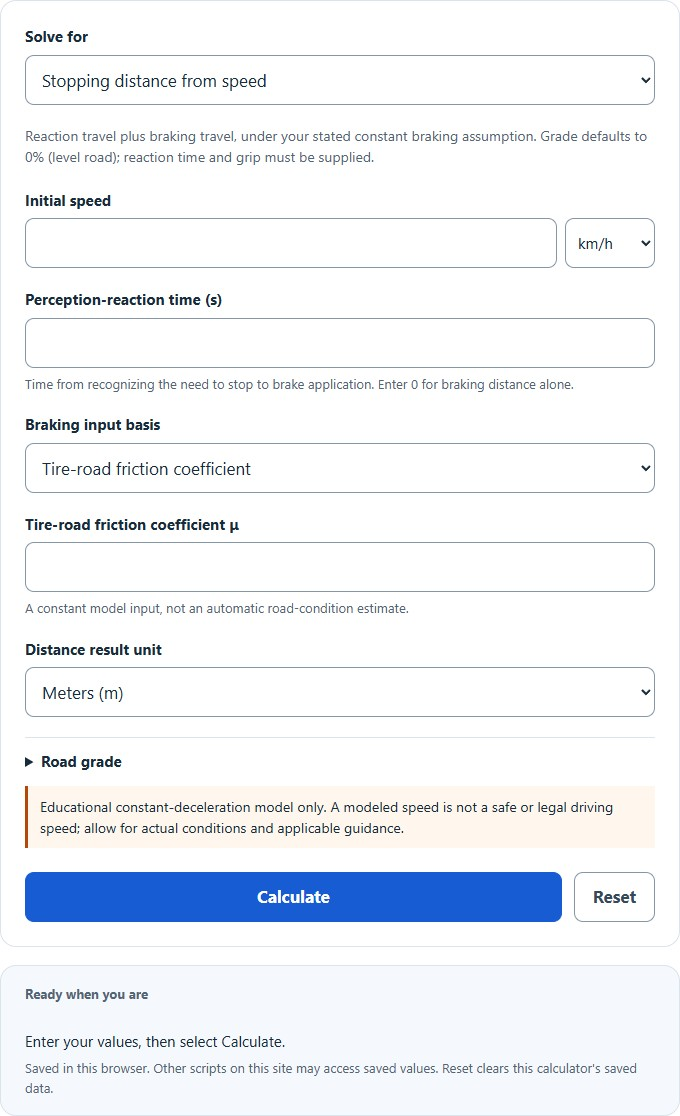
Estimate reaction, braking, and total stopping distance from speed, grip or deceleration, and grade, or reverse-solve the speed that fits a clear distance.
- All Automotive Calculators
- Brake Efficiency Calculator
- Braking Acceleration Calculator
- Braking Force Calculator
- Closing Distance Calculator
- Coefficient of Friction Calculator
- Reaction Distance Calculator
- Stopping Sight Distance Calculator
Stopping Distance Formula
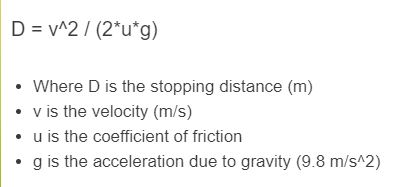
The widget estimates total stopping distance as perception-reaction travel plus constant-deceleration braking travel. It supports a friction coefficient or a level-road deceleration baseline, signed constant road grade, and a reverse speed solve. The first formula below is only the friction-limited braking component on a level surface; D in these braking-only formulas does not include reaction travel.
- D = the braking component in the level-road formula shown above
- v = initial speed of the vehicle
- μ = coefficient of friction between the tires and road
- g = standard gravity, 9.80665 m/s2, rounded to 9.81 in the illustrative examples
In practical terms, the formula says that a vehicle stops by converting its kinetic energy into frictional work. More available grip means stronger deceleration and a shorter stop. Higher speed increases the energy dramatically, so stopping distance rises very quickly as speed increases.
How the Formula Works
On a level road, the maximum idealized braking deceleration is approximated by friction:
That level-road deceleration is substituted into the constant-acceleration equation for the braking component. For the widget’s constant-grade model, let G = grade%/100 and θ = atan(G), with positive grade uphill. The friction basis uses a = g(μ cosθ + sinθ) = g(μ + G)/sqrt(1 + G²). The baseline-deceleration basis uses a = a₀ + g sinθ, explicitly assuming the entered level-road braking-force contribution a₀ stays constant on the slope. Either model requires a > 0.
Rearranged Forms
The two rearrangements below apply to the level-road braking-only equation. The widget offers total-distance and speed solves; it does not solve for μ. With reaction time included, its speed solve instead uses the positive root v = 2aD_total / (sqrt((at_r)² + 2aD_total) + at_r), evaluated in a scaled form to avoid subtracting nearly equal numbers. Zero available distance gives zero modeled speed when a is positive. This is not a safe or legal speed recommendation.
Braking Distance vs. Total Stopping Distance
The first equation above covers the braking component. The widget also includes the entered perception-reaction time, treating speed as constant during that interval, then applying the chosen effective deceleration a during braking. The total-distance equation below uses a; it reduces to μg only on a level road in friction mode.
- Reaction distance = distance traveled before the driver starts braking
- Braking distance = distance traveled from brake application to full stop
- Total stopping distance = reaction distance + braking distance
This distinction matters because even a short reaction time adds a meaningful amount of distance at moderate or high speeds.
Key Relationships
- Speed has a squared effect on the braking component. Doubling speed quadruples braking distance when effective deceleration is unchanged. The reaction component grows linearly, so total stopping distance does not generally quadruple.
- Higher friction shortens modeled braking distance when the other inputs are unchanged. A road-condition label alone does not establish the coefficient for a particular tire and surface.
- Lower grip sharply increases distance. Small reductions in friction can produce large changes in stopping distance.
- Real vehicles are not perfect models. Tire condition, brake temperature, road slope, load transfer, and surface contamination can all change the actual result.
Friction by Road Condition
A road-condition label does not provide a fixed friction coefficient. Use applicable measurements or validated data for the actual tire, surface and conditions; the table does not assign numerical coefficients or safe speeds.
| Road Condition | Coefficient of Friction | General Effect on Stopping |
|---|---|---|
| Dry asphalt or concrete | Not a fixed coefficient; use applicable measurements | Grip varies with tire, surface and temperature |
| Wet pavement | Not a fixed coefficient; use applicable measurements | Water depth, drainage and tire condition affect grip |
| Loose gravel | Not a fixed coefficient; use applicable measurements | Loose material can affect braking predictability |
| Packed snow | Not a fixed coefficient; use applicable measurements | Snow condition and tires affect grip |
| Ice | Not a fixed coefficient; use applicable measurements | Ice condition, temperature and tires affect grip |
Example
If a vehicle is traveling at 20 m/s and the tire-road coefficient of friction is 0.70, the estimated braking distance is:
If the same vehicle is traveling at 40 m/s on the same surface, the distance becomes:
This illustrates the most important rule in braking analysis: increasing speed has a much larger effect on stopping distance than many drivers expect.
Unit Conversions
The raw equation is most commonly applied in SI units, where speed is in meters per second and distance is returned in meters. If speed is given in km/h or mph, convert it first unless the calculator handles the conversion automatically.
Assumptions and Limitations
- The road grade is constant and entered as signed rise/run percent, not degrees. Zero grade is the disclosed default.
- The coefficient of friction is treated as constant during braking.
- After the entered perception-reaction interval, braking is modeled with constant effective deceleration and no additional brake build-up delay.
- Aerodynamic drag and engine braking are neglected.
- ABS behavior, tire slip variation, and weight transfer are not modeled directly.
- The entered perception-reaction time is included; enter zero to isolate braking distance. Speed, distance, grip and reaction time start blank rather than assuming personal driving conditions.
Use this model for educational comparisons under stated assumptions. Actual reaction, brakes, tires, weather, gradient transitions and driver behavior vary. Do not use a reverse-solved speed as a safe-speed limit, legal advice, or a substitute for applicable stopping-sight-distance design guidance.