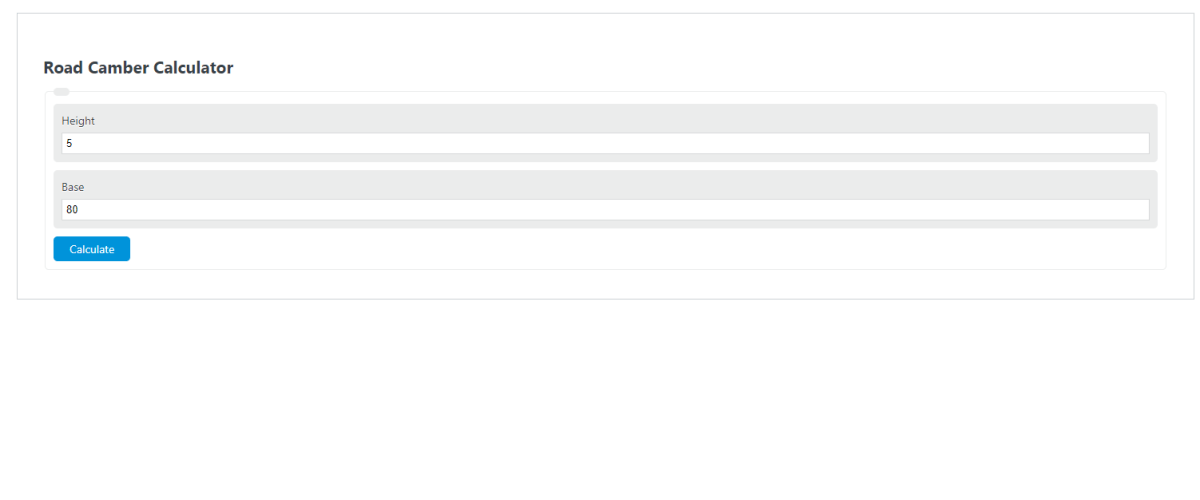
Calculate road camber from width and drop, or find the required drop for a target crossfall on one-way falls and crowned road designs.
Related Calculators
- Ramp Length Calculator
- Cross Slope Calculator
- Slope to Degrees Calculator
- Angle to Slope Calculator
- Grade Slope Calculator
- All Construction Calculators
Road Camber Formula
The road camber angle describes the transverse slope of a road surface. This calculator treats the camber as a right triangle, where the camber height is the vertical rise and the base is the horizontal run over which that rise occurs.
Where:
- A = road camber angle in degrees
- H = camber height, or vertical difference
- B = horizontal base associated with that height
If you need to solve for a missing dimension instead of the angle, the same relationship can be rearranged as follows:
Many field measurements are also expressed as percent crossfall rather than degrees. That conversion is:
Where C is the cross slope in percent.
What Road Camber Means
Road camber is the sideways slope built into a pavement surface so water drains off instead of collecting on the travel path. On a crowned road, the center is higher than the edges. On a one-way sloped surface, one side is intentionally higher than the other. In both cases, the camber angle is based on the same rise-over-run geometry.
Proper camber improves drainage, reduces standing water, and helps limit splash, hydroplaning risk, and premature pavement wear. Too little camber can leave water on the surface, while excessive camber can negatively affect ride quality, lane position, and tire loading.
How to Use the Calculator Correctly
- Measure the camber height as the vertical difference between the high point and the low point.
- Measure the base as the horizontal distance corresponding to that height.
- Enter both values using the same unit system.
- The calculator returns the camber angle in degrees.
If the road has a centered crown and you measured the total width from edge to edge, calculate each side separately. In that case, the run for one side is half the total width:
Where W is the full road width across both sides.
Interpreting the Result
| Measure | Meaning | Relationship |
|---|---|---|
| Camber Angle | The actual angle of the road surface relative to horizontal. | A = tan⁻¹((H) / (B)) |
| Percent Crossfall | Slope expressed as rise per 100 units of horizontal run. | C = 100((H) / (B)) |
| Slope Ratio | Useful when reading the surface as 1 in n. | n = (B) / (H) |
Example
If the camber height is 5 inches and the horizontal base is 80 inches, the angle is:
The corresponding percent crossfall is:
So the surface rises 6.25 units for every 100 units of horizontal run.
Common Input Mistakes
- Using the sloped surface length instead of horizontal base. The formula requires horizontal run.
- Mixing units. Height and base must use the same unit system.
- Using full crowned width as one-side run. For a symmetric crown, use half-width for each side calculation.
- Confusing angle and percent slope. A degree value and a percent crossfall are not the same measurement.
When This Calculator Is Useful
- Checking drainage performance on roads, driveways, and paved yards
- Estimating crown geometry during grading or resurfacing
- Converting field-measured rise and run into an angle
- Comparing alternative cross slopes for construction planning
- Verifying whether an existing surface matches a target profile
For the most reliable result, measure the vertical difference carefully and make sure the base represents the exact horizontal distance over which that difference occurs. Small measurement errors in height can noticeably change the calculated angle, especially on short runs.