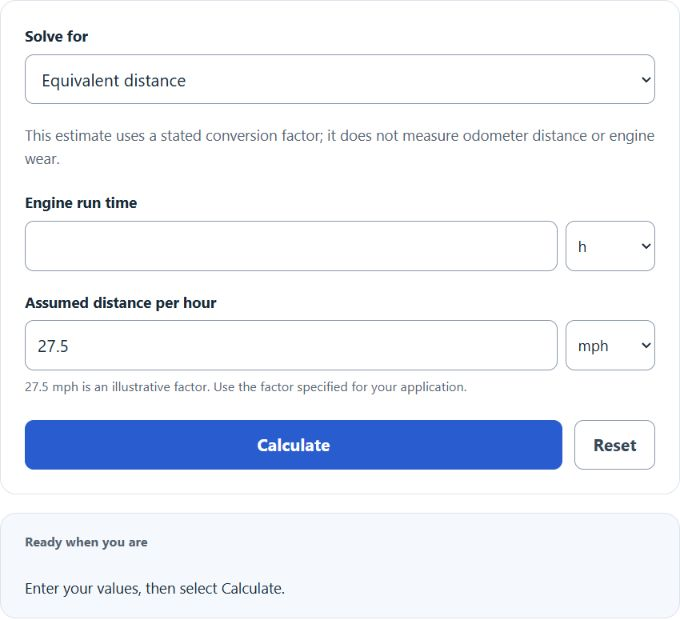
Choose equivalent distance, engine hours, or a distance-per-hour factor, with hours, minutes, mph, km/h, miles, and kilometers. The estimate depends on your stated factor; it does not measure engine wear.
| Engine Hours to Miles | Miles to Engine Hours |
|---|---|
| 0.5 hours = 13.75 miles | 10 miles = 0.3636 hours |
| 1 hour = 27.5 miles | 25 miles = 0.9091 hours |
| 2 hours = 55 miles | 50 miles = 1.8182 hours |
| 5 hours = 137.5 miles | 100 miles = 3.6364 hours |
| 10 hours = 275 miles | 250 miles = 9.0909 hours |
| 20 hours = 550 miles | 500 miles = 18.1818 hours |
| 25 hours = 687.5 miles | 1,000 miles = 36.3636 hours |
| 50 hours = 1,375 miles | 1,500 miles = 54.5455 hours |
| 75 hours = 2,062.5 miles | 2,000 miles = 72.7273 hours |
| 100 hours = 2,750 miles | 3,000 miles = 109.0909 hours |
| 150 hours = 4,125 miles | 5,000 miles = 181.8182 hours |
| 200 hours = 5,500 miles | 10,000 miles = 363.6364 hours |
| 250 hours = 6,875 miles | 20,000 miles = 727.2727 hours |
| 300 hours = 8,250 miles | 30,000 miles = 1,090.9091 hours |
| 500 hours = 13,750 miles | 50,000 miles = 1,818.1818 hours |
| 750 hours = 20,625 miles | 100,000 miles = 3,636.3636 hours |
| 1,000 hours = 27,500 miles | 150,000 miles = 5,454.5455 hours |
| 1,500 hours = 41,250 miles | 200,000 miles = 7,272.7273 hours |
| 2,000 hours = 55,000 miles | 250,000 miles = 9,090.9091 hours |
| 3,000 hours = 82,500 miles | 300,000 miles = 10,909.0909 hours |
| Formulas: miles = hours x 27.5 and hours = miles / 27.5. (Table assumes speed fixed at 27.5 mph.) | |
| Engine Hours to Miles | Miles to Engine Hours |
|---|---|
| 0.5 hours = 30 miles | 50 miles = 0.8333 hours |
| 1 hour = 60 miles | 100 miles = 1.6667 hours |
| 2 hours = 120 miles | 250 miles = 4.1667 hours |
| 5 hours = 300 miles | 500 miles = 8.3333 hours |
| 10 hours = 600 miles | 1,000 miles = 16.6667 hours |
| Formulas: miles = hours x 60 and hours = miles / 60. (Table assumes speed fixed at 60 mph.) | |
Related Calculators
- Idle Hours Calculator
- Excess Mileage Calculator
- Boat Fuel Consumption Calculator
- Boat Repower Calculator
- All Automotive Calculators
Engine Hours to Miles Formula
The core formula for converting engine hours to equivalent miles is:
Where M is an estimated equivalent distance, EH is run time in hours, and S is an assumed distance-per-hour factor. The editable default of 27.5 mph is an illustrative assumption, not a universal OEM wear standard. Use a factor and hour definition appropriate to your application.
Checking Vehicle-Specific Conversion Factors
Maintenance instructions may specify how idle time affects a service schedule for a particular vehicle. Do not generalize such instructions to other engines or treat an assumed factor as a measurement of wear.
| Manufacturer | Miles per Engine Hour | Context |
|---|---|---|
| General Motors (GM) | Consult the model manual | No universal GM factor is established here |
| Ford (Power Stroke Diesel) | 25 miles per idle hour | Specified in the linked Ford diesel maintenance instructions; verify applicability to your vehicle |
| Ford / International (General) | Consult the model manual | Do not assume a shared factor across these manufacturers |
| Industry General Standard | 27.5 mph example | Illustrative calculator default, not a verified industry standard |
| Heavy-Duty Trucks (Mixed Driving) | Consult the model manual | The duty cycle and manufacturer instructions control the choice |
| Agricultural Tractors | Consult the model manual | No universal tractor factor is established here |
| Rates vary by engine type, duty cycle, and operating conditions. Use the calculator above to input a custom rate. | ||
There is no universal conversion rate. These Ford diesel maintenance instructions equate an hour of idling with approximately 25 miles for their stated maintenance context. Check the original manual for your particular vehicle and distinguish idle hours from total engine hours.
Why Engine Hours Matter More Than Odometer Miles
An odometer records distance traveled, while an engine-hour counter can include operation when the vehicle is stationary. At an assumed 27.5 miles per engine hour, 3,000 hours gives 82,500 equivalent miles. This is a conversion scenario, not evidence that a truck with 40,000 odometer miles has experienced twice the measured wear.
Extended idling can change a vehicle’s maintenance requirements. Follow the manufacturer’s time, distance, engine-hour, oil-life, and severe-service criteria rather than using this calculator to set an oil-change interval.
Idle Time Fuel Consumption Data
A 2016 EPA SmartWay fact sheet reports about 0.8 gallons per hour for a typical combination truck at idle. At that illustrative rate, 100 trucks idling two hours every day for 365 days would consume 58,400 gallons. Actual consumption depends on the engine, accessories, and conditions; this figure is not a passenger-vehicle rate.
| Vehicle Type | Assumed Gallons per Hour | Annual Cost (2 hrs/day, $3.50/gal) |
|---|---|---|
| Passenger Car (4-cyl) (illustrative) | 0.16 – 0.3 | $409 – $766 |
| Light-Duty Truck / SUV (illustrative) | 0.3 – 0.5 | $766 – $1,278 |
| Medium-Duty Truck (illustrative) | 0.5 – 0.8 | $1,278 – $2,044 |
| Heavy-Duty Class 8 Truck (illustrative) | 0.8 – 1.0 | $2,044 – $2,555 |
Warranty Implications of Excessive Engine Hours
This calculator cannot establish warranty coverage or a manufacturer’s warranty mileage. Coverage depends on the written warranty and applicable service requirements. Do not treat hours multiplied by an assumed factor as an official odometer reading or a coverage decision.
For vehicles with substantial stationary operation, keep service records and follow the maintenance schedule specified for the vehicle and duty cycle. An assumed equivalent-distance calculation alone does not establish neglect or a warranty exclusion.
Maintenance Scheduling by Engine Hours
Some maintenance schedules use engine hours as well as time and distance, particularly for extended idling. The applicable limits vary by model and operating conditions; there is no universal 250–300-hour diesel or 200–250-hour gasoline interval supplied by this calculator.
A comparison ratio is equivalent distance divided by odometer distance, a dimensionless number. For example, using an explicitly assumed 33 mph factor, 1,812 hours × 33 mph = 59,796 equivalent miles, and 59,796 / 60,837 ≈ 0.983. This does not establish a normal idle ratio or diagnose excessive idling. Use separately recorded idle hours when actual idle time is needed.
Types of Engine Hour Meters
Hour-meter definitions vary. Some mechanical meters relate operating time to engine revolutions at a reference speed; electronic meters may track elapsed run time, ignition-on time, or idle time. Consult the device or vehicle documentation before comparing readings. Some dashboards, diagnostic tools, and telematics systems provide separate engine and idle-hour counters.
A compatible aftermarket hour meter may be an option for equipment without a built-in counter. Confirm what the device measures and use an installation suitable for the equipment. Prices and installation requirements vary.
FAQ
Why is the default conversion factor 27.5 miles per engine hour?
The default 27.5 mph factor is an editable illustrative assumption. It is not established here as an OEM durability-test result or a universal wear conversion. Replace it with a factor appropriate to your specific application.
How do I find the engine hours on my vehicle?
On trucks and commercial vehicles, check the instrument cluster for an engine hours display, often accessible through the trip computer menu. On vehicles without a dashboard readout, a mechanic can retrieve total engine hours from the Electronic Control Module (ECM) using a diagnostic scan tool connected to the OBD-II port. Some telematics systems and fleet management platforms also track and report engine hours remotely. For older vehicles or equipment without electronic tracking, an aftermarket hour meter can be wired into the ignition circuit.
Should I use engine hours or odometer miles for oil changes?
Follow the manufacturer’s specified service triggers, including time, mileage, engine hours, oil-life monitoring, and severe-service conditions where applicable. This calculator does not prescribe an oil-change interval.
Can excessive engine hours void my vehicle warranty?
Warranty coverage depends on the written warranty and applicable requirements. This calculator cannot decide whether coverage applies, and an assumed hours-to-miles conversion is not an official warranty determination. Keep the maintenance records required for your vehicle.