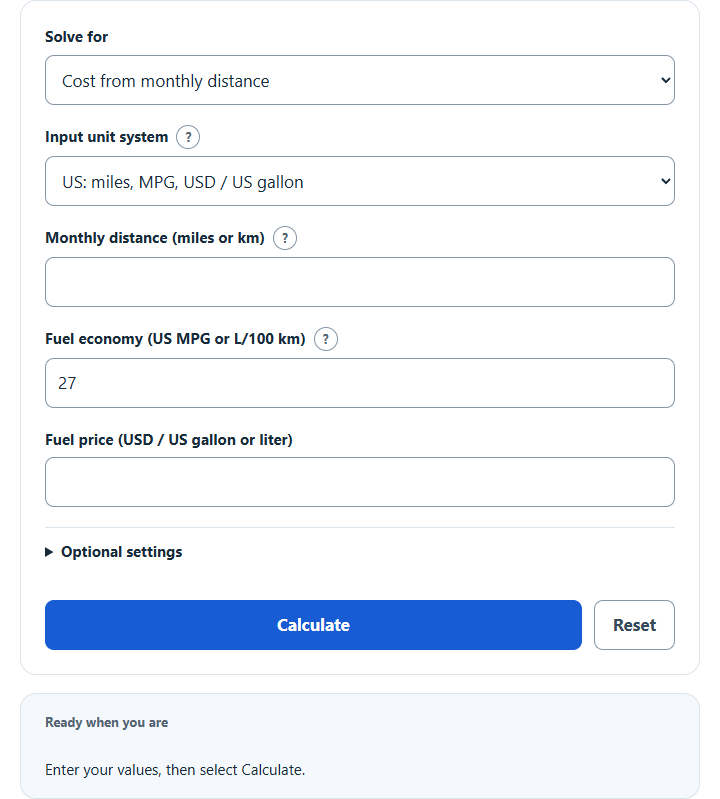
Calculate your monthly gas cost from miles driven, fuel economy and gas price, or see how far a monthly gas budget goes, in US or metric units.
- Distance to Empty (DTE) Calculator
- Annual Fuel Cost Calculator
- Cost Per Mile of Driving Calculator
- All Automotive Calculators
Gas Cost Per Month Formula
The following equation is used to calculate the Gas Cost Per Month.
- Where CGM is the gas cost per month ($/month)
- M is the monthly miles driven on average
- MPG is the miles per gallon of the car
- GC is the average cost of gas for the month ($/gallon)
To calculate monthly fuel cost in US units, divide monthly miles by US MPG, then multiply by USD per US gallon. In metric units, multiply monthly kilometers by L/100 km, divide by 100, and multiply by USD per liter. Weekly driving patterns use the entered weeks per month; weekly averages use that same value.
What is the Average Gas Cost Per Month?
Definition:
Monthly gasoline spending depends on distance, fuel economy and local prices; there is no universal household amount. For illustration, 1,000 miles per month at 25 US MPG and $3.50 per US gallon costs $140 per month, or $1,680 over 12 identical months. These example values are not calculator defaults.
FAQ
How can I improve my car’s MPG to reduce my gas cost per month?
To improve your car’s MPG and reduce gas costs, ensure regular maintenance such as tire pressure checks, oil changes, and air filter replacements. Driving habits also affect fuel efficiency; avoid rapid acceleration and excessive idling.
What factors influence the cost of gas?
The cost of gas is influenced by several factors including crude oil prices, refinery processes, demand, taxes, and distribution and marketing costs. Seasonal changes and geopolitical events can also have a significant impact.
Is it more cost-effective to use electric vehicles compared to traditional gasoline-powered cars?
Compare the vehicles using your driving distance, their efficiency, local gasoline and electricity prices, charging arrangements and purchase and maintenance costs. Energy costs alone do not determine total ownership cost. The U.S. Department of Energy provides consumer guidance and vehicle comparison resources.