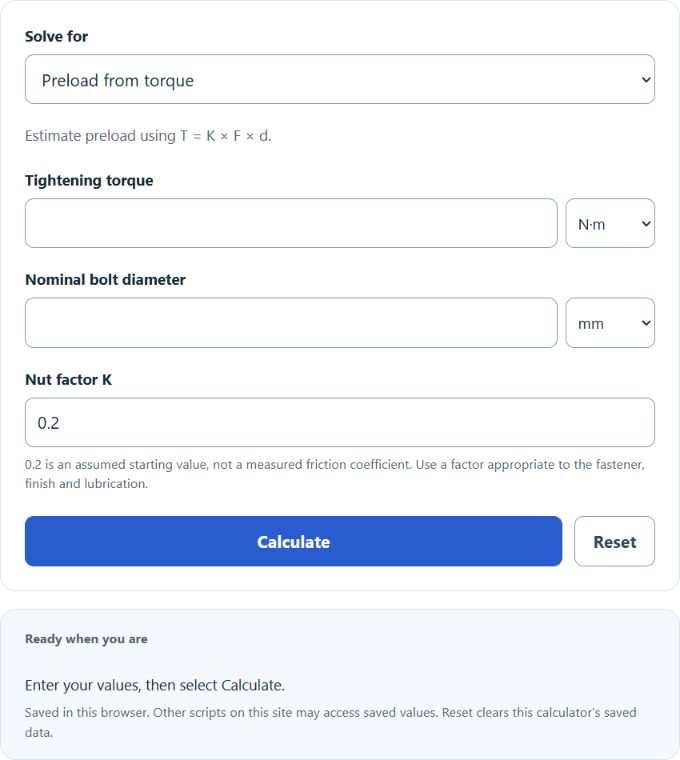
Calculate bolt preload from tightening torque or required torque from preload using bolt diameter and nut factor.
- All Construction Calculators
- Clamping Force Calculator
- Thread Pitch Calculator
- Lead Angle Calculator
- Pin Shear Calculator
- Helix Angle Calculator
- Flange Bolt Torque Calculator
- Bolt Length Calculator
- Bolt Pull-Out Force Calculator
- Bolt Area Calculator
Bolt Preload Formula
For the proof-load mode, the following formula calculates a selected preload force. The torque modes instead use T = K × F × d, with d in metres, F in newtons and T in N·m. Nut factor K depends on the fastener and friction conditions; the starting value 0.2 is an assumption.
- Where F is the preload force
- c is the selected design fraction of proof load (percentage divided by 100); it is not determined by permanent or reusable status alone
- A is the tensile stress area (thread stress area) of the bolt
- S is the proof strength (proof stress) of the bolt
To calculate the bolt preload, multiply the constant by the tensile stress area and the proof strength.
Bolt Preload Definition
A bolt preload is defined as the tension force created in a fastener (in most cases a bolt) when it is tightened.
A common design goal is to apply enough preload to keep the joint clamped under service loads without exceeding the bolt’s proof load.
Bolt Preload Example
How to calculate bolt preload?
The following example problem will go over the step-by-step process of calculating a selected bolt preload.
First, choose a preload fraction justified for the joint and installation method. This arithmetic example assumes 90%; it does not establish that 90% is appropriate for a particular connection.
Next, the tensile stress area (thread stress area) of the bolt must be determined. In most cases, this can be found on a manufacturer's datasheet, but it can be calculated using a formula. For this problem, the tensile stress area is 15 in².
Next, the proof strength (proof stress) of the bolt must be determined (typically from the bolt grade/specification). For this example, the proof strength is 33,000 psi.
Finally, the bolt preload can be calculated using the formula above.
F = c * A * S = 0.90 * 15 * 33,000 = 445,500 lbf.