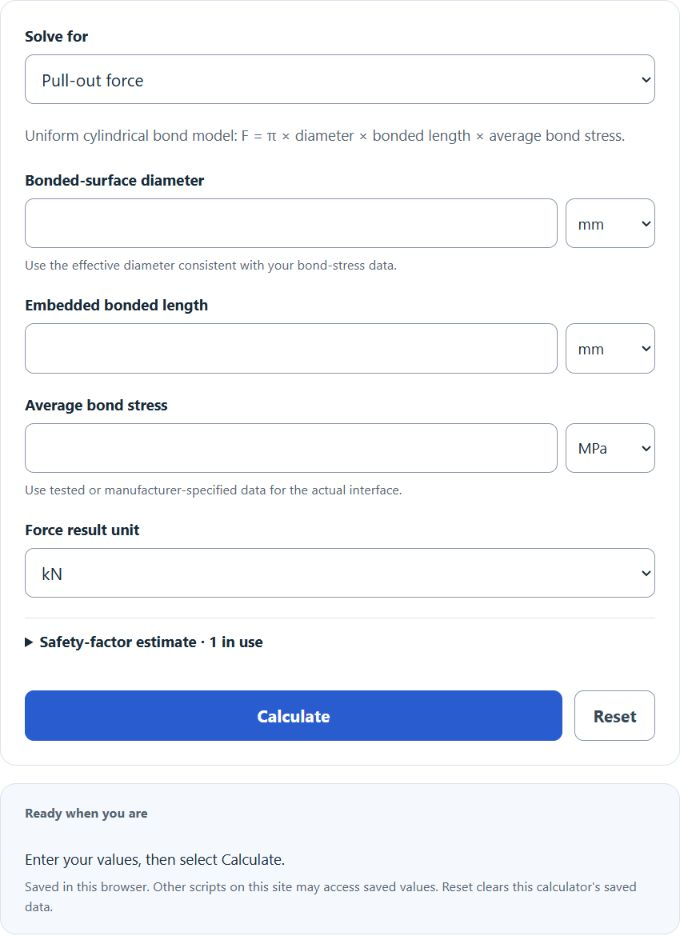
Calculate bolt pull-out force, diameter, embedment length, or average bond stress with metric and imperial units, safety factor, and worked steps.
- All Construction Calculators
- All Force Calculators
- Ball Screw Force Calculator
- Flange Bolt Torque Calculator
- Bolt Preload Calculator
- Bolt Length Calculator
- Winch Line Pull Force Calculator
- Wire Pull Force Calculator
- Bolt Area Calculator
Bolt Pull-Out Force Formula
The calculator uses the bonded surface area of a cylindrical bolt or anchor and multiplies it by the average bond stress. Internally, diameter and embedded length are in millimetres, bond stress is in MPa, and force is in newtons. Inch/psi examples below are equivalent.
Rearranged formulas used when a different value is missing:
- F = bolt pull-out force
- D = bolt diameter
- L = embedded or bonded length
- tau = average bond stress, also called bond strength
- pi = 3.14159
Select the value to solve for, then enter the visible required inputs. The calculator rearranges the same uniform-bond equation. Inverse modes use nominal force; the safety factor only divides the secondary force estimate and does not establish a verified allowable capacity. Unit selections are converted internally before the formula is applied, then the result is converted back to the unit you selected.
Common Unit Conversions for Bolt Pull-Out Calculations
| Quantity | Conversion | Unit used in inch/psi examples |
|---|---|---|
| Diameter or length | 1 in = 25.4 mm = 2.54 cm | in |
| Length | 1 ft = 12 in, 1 m = 39.3701 in | in |
| Bond stress | 1 MPa = 145.038 psi, 1 kPa = 0.145038 psi | psi |
| Force | 1 lb-f = 4.44822 N, 1 kN = 224.809 lb-f | lb-f |
Inputs That Affect Pull-Out Force
| Input change | Effect on calculated force | Reason |
|---|---|---|
| Double the diameter | Force doubles | Bonded circumference is proportional to diameter. |
| Double the embedded length | Force doubles | More length gives more bonded surface area. |
| Double the bond stress | Force doubles | The same area is assumed to resist twice the stress. |
Example
Example 1: Calculate bolt pull-out force
Suppose a bolt has a diameter of 0.5 in, an embedded length of 4 in, and an average bond stress of 1,200 psi.
The pull-out force is about 7,540 lb-f, or about 33.54 kN.
Example 2: Calculate required embedded length
Suppose the target pull-out force is 10,000 lb-f, the bolt diameter is 0.75 in, and the average bond stress is 1,500 psi.
The required bonded length is about 2.83 in.
FAQ
What does average bond stress mean?
Average bond stress is the assumed shear stress acting between the bolt surface and the surrounding material or adhesive. The calculator treats this value as uniform along the bonded length. Real pull-out behavior can vary because of concrete strength, adhesive type, hole cleaning, edge distance, embedment depth, cracking, corrosion, and installation quality.
Is bolt pull-out force the same as bolt tensile strength?
No. Pull-out force is the force needed to break the bond or surrounding material around the embedded bolt. Bolt tensile strength is the force needed to fracture the bolt itself in tension. A connection can fail by pull-out, bolt rupture, concrete breakout, adhesive failure, thread stripping, or another mode. The lowest applicable capacity controls the design.
Should the diameter be the nominal bolt diameter or the hole diameter?
Use the diameter of the bonded surface that is resisting pull-out. For a plain cylindrical anchor, this is usually the bolt or anchor diameter. If you are modeling a threaded, deformed, or adhesive anchor, the correct effective diameter may depend on the test data or design method you are using.