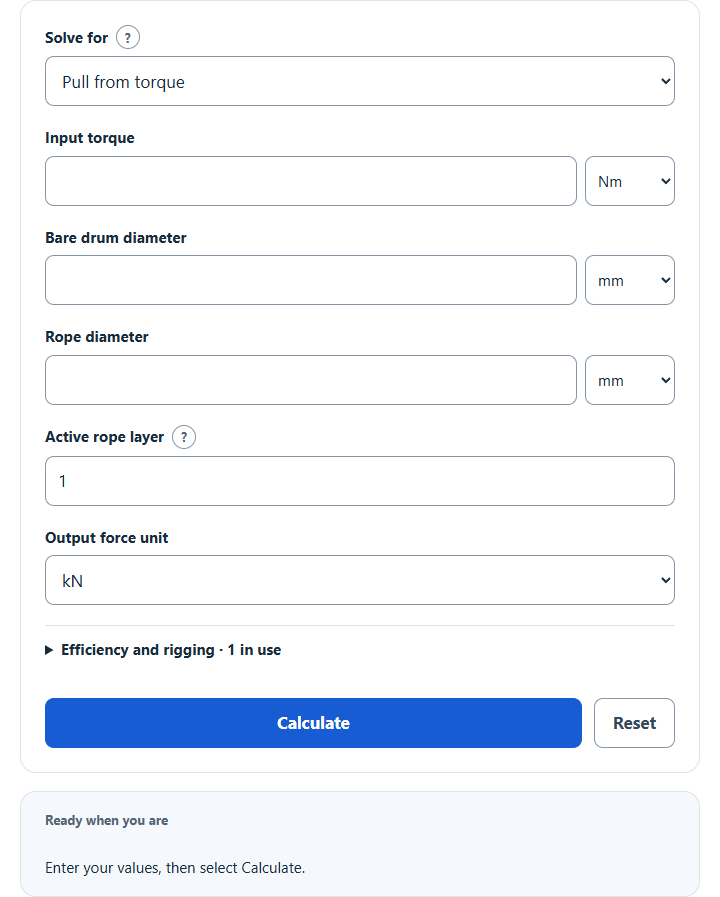
Calculate winch line pull from drum torque, drum and rope diameter and rope layer, find the torque for a target pull, or estimate vehicle recovery demand.
- All Automotive Calculators
- All Force Calculators
- Torque to Force Calculator
- Screw Torque to Linear Force Calculator
- Torque to Weight Calculator
- Wire Pull Force Calculator
Winch Line Pull Force Formula
The following equation gives static tangential line force from torque already delivered at the drum and the rope-center working radius.
- Where WF is the winch force (N)
- T is the torque output (N-m)
- X is the distance from the center axis the winch acts at (m)
For torque already at the drum, divide by the rope-center radius and use100% efficiency in this calculator. For torque before an entered loss, multiply by efficiency first. The layer model uses radius = bare drum diameter/2 + rope diameter × (layer −0.5); rigged pull additionally applies the selected illustrative allowance. Recovery mode is a separate weight-force × (terrain fraction + sin uphill angle) × planning multiplier ÷ allowance estimate. Terrain and rigging factors are assumptions, not universal coefficients or hardware ratings.
What is a Winch Force?
Definition:
Winch force is a term used to describe the amount of force a winch can exert.
A winch machine is a mechanical device that is used to pull in (wind up) or let out (wind out) or otherwise adjust the "tension" of a rope or wire rope (also called "cable" or "wire cable"). It consists of a spool and an attached hand crank in its simplest form.
How to Calculate Winch Line Pull Force?
Example Problem:
The following example outlines the steps and information needed to calculate winch force.
First, determine the torque exerted by the winch. For this problem, the torque is measured to be 450 N-m.
Next, determine the distance from the center axis the winch acts on. In this case, the distance is measured to be 2 m.
Finally, calculate the winch force using the formula above:
WF = T/X
WF = 450/2
WF = 225 N