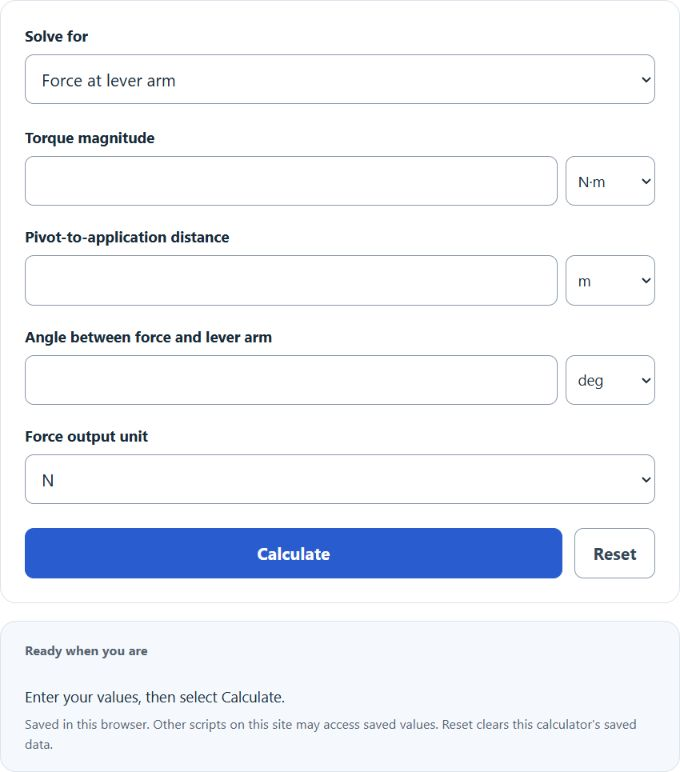
Select torque, lever arm length, angle, or applied force at a lever arm as the quantity to solve, then enter the three known nonnegative magnitudes. This is a lever-arm calculation, not screw axial thrust or bolt clamp load.
- All Physics Calculators
- All Force Calculators
- Torque to Force Calculator
- Bolt Pull-Out Force Calculator
- Screw Jack Force Calculator
- Ball Screw Force Calculator
- Lever Torque Calculator
- Newton To kg
Torque to Force at a Lever Arm Formula
The following equation is used to calculate the applied force at a lever arm from an applied torque about a pivot/axis (for example, the force you apply on a wrench handle). Only the component of force perpendicular to the lever arm produces torque.
- Where F is the applied force at the lever arm (N)
- T is the applied torque (N·m)
- L is the lever arm length (m)
- θ is the angle between the force direction and the lever arm (degrees or radians, but be consistent when evaluating sin)
To calculate the force from a torque, divide the torque by the product of the lever arm length and the sine of the angle between the force direction and the lever arm. If you are trying to estimate bolt/screw axial clamp load from tightening torque, use a torque-to-tension model that includes thread geometry and friction (this formula does not provide clamp load).
| Torque (Nm) | Torque (lb·ft) | Linear Force (N) | Linear Force (lbf) |
|---|---|---|---|
| 1 | 0.738 | 4 | 0.899 |
| 2 | 1.475 | 8 | 1.798 |
| 3 | 2.213 | 12 | 2.698 |
| 5 | 3.688 | 20 | 4.496 |
| 7.5 | 5.532 | 30 | 6.744 |
| 10 | 7.376 | 40 | 8.992 |
| 12.5 | 9.220 | 50 | 11.240 |
| 15 | 11.063 | 60 | 13.489 |
| 17.5 | 12.907 | 70 | 15.737 |
| 20 | 14.751 | 80 | 17.985 |
| 25 | 18.439 | 100 | 22.481 |
| 30 | 22.127 | 120 | 26.977 |
| 35 | 25.815 | 140 | 31.473 |
| 40 | 29.502 | 160 | 35.969 |
| 45 | 33.190 | 180 | 40.466 |
| 50 | 36.878 | 200 | 44.962 |
| 60 | 44.254 | 240 | 53.954 |
| 75 | 55.317 | 300 | 67.443 |
| 100 | 73.756 | 400 | 89.924 |
| 150 | 110.634 | 600 | 134.885 |
| Assumes lever arm r = 0.25 m and angle θ = 90° (sin θ = 1). Relationship: T = F × r × sin θ ⇒ F = T / (r × sin θ). Unit facts: 1 N·m = 0.737562 lb·ft; 1 lbf = 4.44822 N (1 N ≈ 0.224809 lbf). | |||
What is (Tightening) Torque?
Definition:
Torque is a turning moment (a “twisting” effect) equal to a force times a perpendicular distance (lever arm). When tightening a screw or bolt, the tightening torque is the torque applied about the fastener’s axis (for example, by a wrench).
For fastener tightening, the relationship between applied torque and the resulting clamp load is influenced heavily by friction at the threads and under the nut/bolt head (and therefore by lubrication and surface finish). This calculator, however, converts a known torque into an equivalent applied force at a lever arm using the basic torque relationship.
How to Convert Torque to Force at a Lever Arm?
Example Problem:
The following example outlines the steps and information needed to convert an applied torque to the force applied at the end of a lever arm.
First, determine the applied torque. In this example, the torque is measured to be 400 lb·ft.
Next, determine the lever arm length. The lever arm in this case is 2 ft.
Next, determine the angle between the force direction and the lever arm. For this problem, the force is applied at a 60-degree angle relative to the lever arm.
Finally, calculate the force using the formula above:
F = T / (L * sin(θ))
F = 400 / (2 * sin(60))
F = 230.94 lbf