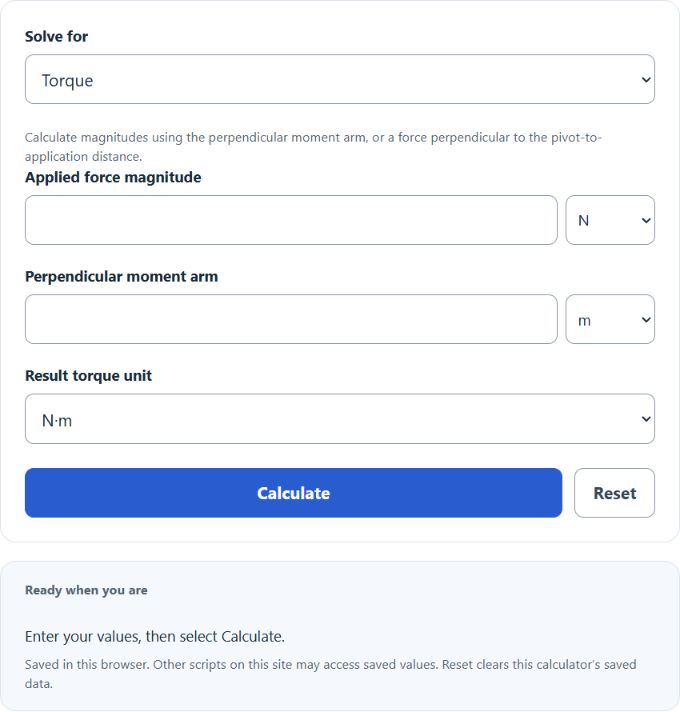
Choose torque, force, or distance and enter its two known values in N, kN, lbf, m, cm, ft, in, and N-m or lbf-ft, with step-by-step calculations.
- All Physics Calculators
- All Torque Calculators
- Lever Force Calculator
- Pivot Force Calculator
- Lever Distance Calculator
Lever Torque Formula
Lever torque is the turning effect created when a force is applied at a distance from a fulcrum. For a simple lever with the force applied perpendicular to the lever arm, torque equals the applied force multiplied by the distance from the fulcrum to the point where the force acts.
Where:
| Variable | Meaning | Typical Units |
|---|---|---|
| TL | Lever torque | N·m, lb-ft |
| FL | Applied lever force | N, lbf |
| d | Distance from the fulcrum to the point of force application | m, ft, in |
This relationship shows two important ideas immediately: increasing the force increases torque, and increasing the lever arm length also increases torque. That is why longer handles, breaker bars, pry bars, and wrenches make it easier to rotate an object.
General Torque Relationship
If the applied force is not perfectly perpendicular to the lever arm, only the perpendicular component of the force produces a turning effect. In that case, use the more general torque equation:
Here, r is the distance from the pivot and θ is the angle between the force direction and the lever arm. When the force is applied at 90°, sin(θ) = 1, so the equation simplifies to the basic lever torque formula used by this calculator.
How to Calculate Lever Torque
- Measure the applied force.
- Measure the distance from the fulcrum to the point where the force is applied.
- Make sure the units are consistent.
- Multiply force by distance to get torque.
In practical terms, use the shortest perpendicular distance from the fulcrum to the line of action of the force. That perpendicular distance is the true moment arm.
Solving for Other Variables
If you know the torque requirement and need to find the force or distance, rearrange the formula as follows:
These forms are useful when sizing a handle length, estimating the force needed to loosen a fastener, or comparing lever designs.
Examples
Example 1
A force of 50 N is applied 0.75 m from the fulcrum.
The lever produces 37.5 N·m of torque.
Example 2
A force of 75 N is applied 0.33 m from the fulcrum.
The resulting torque is 24.75 N·m, which is commonly rounded to 25 N·m.
Example 3
If a task requires 120 N·m of torque and the handle length is 0.40 m, the required force is:
This shows how a shorter lever requires more force to achieve the same turning effect.
Why Lever Length Matters
Torque scales directly with distance from the pivot. If the applied force stays the same:
- Doubling the lever arm doubles the torque.
- Halving the lever arm halves the torque.
- A longer lever reduces the force needed for the same torque output.
This is the core reason levers provide mechanical advantage. A longer moment arm allows the same user input to create a larger rotational effect.
Common Applications
- Wrenches and breaker bars
- Pry bars and crowbars
- Door handles and latches
- Seesaws and simple lever systems
- Manual clamps and linkage mechanisms
- Machine design, statics, and maintenance work
Common Mistakes
- Using the total bar length instead of the distance from the fulcrum to the force application point.
- Ignoring the angle of the force when it is not applied perpendicular to the lever.
- Mixing units, such as using newtons with inches without converting.
- Confusing torque with force; they are related, but not the same quantity.
Unit Notes
The calculator converts the selected input units internally. Direct multiplication outside the calculator follows these unit relationships:
- N with m gives N·m
- lbf with ft gives lb-ft
- N with cm gives torque in N·cm unless converted
If your answer seems too large or too small, the first thing to check is unit consistency.
Practical Interpretation
The calculator is most accurate for straightforward lever problems where the geometry is known and the force is applied cleanly at a measured distance from the pivot. Real systems may also involve friction, deformation, dynamic loading, or multiple forces, which can change the actual torque required in practice.
Frequently Asked Questions
Is lever torque the same as moment?
In most engineering and physics contexts, torque and moment refer to the same rotational effect of a force about a point or axis.
What happens if I push at an angle?
Only the perpendicular component of the force contributes fully to torque. If the angle is not 90°, use the general torque equation with the sine term.
Can I increase torque without increasing force?
Yes. Increasing the distance from the fulcrum increases torque even if the applied force stays the same.