Lever Force Calculator solves effort, load, or either arm length with N, lbf, kgf, metric and US distances, efficiency losses, torque, and mechanical advantage.
- All Physics Calculators
- AMA (Actual Mechanical Advantage) Calculator
- Tipping Force Calculator
- Crane Tipping Load Calculator
- Effort Force Calculator
- Resistance Force Calculator
- Lever Torque Calculator
Lever Force Formula
The lever force calculator uses the principle of moments: the turning effect created by the effort arm must balance the turning effect at the load point for an ideal lever. This makes it easy to estimate the output force when you know the effort force and the two arm distances.
In this equation:
| Variable | Meaning | Typical Units |
|---|---|---|
| FL | Lever force at the output or load point | N, lbf, kgf |
| EF | Effort force applied to the lever | N, lbf, kgf |
| D1 | Perpendicular distance from effort force line to fulcrum | m, ft, in |
| D2 | Perpendicular distance from load force line to fulcrum | m, ft, in |
The relationship is directly proportional to the effort force and the effort arm distance, and inversely proportional to the load arm distance. That means:
- Increasing EF increases FL.
- Increasing D1 increases FL.
- Increasing D2 decreases FL.
How to Use the Calculator
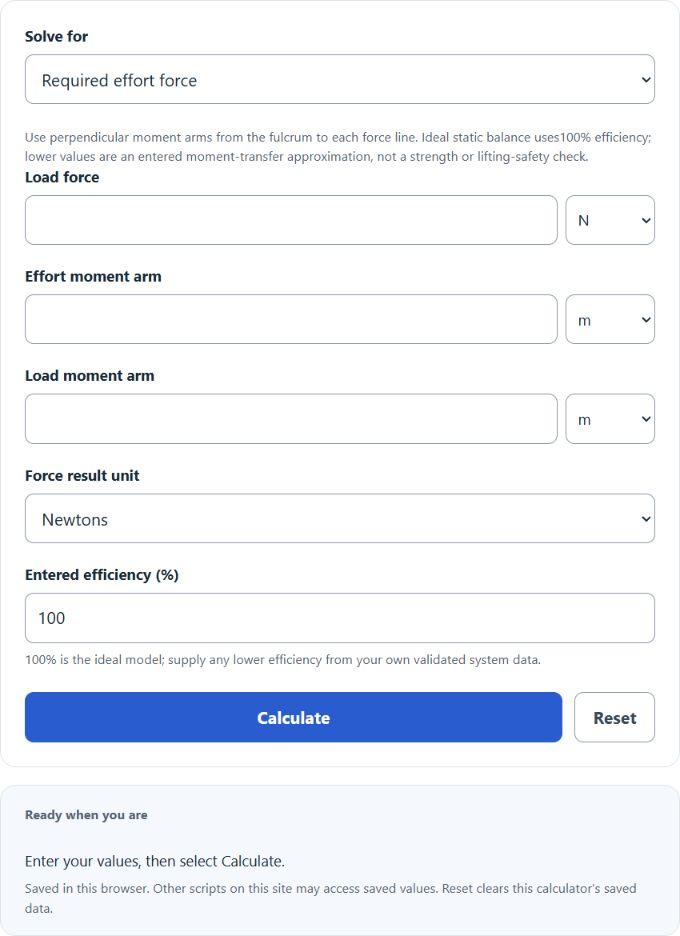
- Select effort, load or either moment arm as the value to solve for.
- Enter the distance from the effort point to the fulcrum.
- Enter the distance from the fulcrum to the output or load point.
- Enter all shown quantities, choose the result unit and efficiency, then select Calculate.
Choose each input’s unit independently; the calculator converts forces to newtons and moment arms to meters. Use perpendicular distances from the fulcrum to the force lines, not full lever lengths.
Rearranged Equations
Because the calculator can solve for any missing variable when the other three are known, the lever equation can be rearranged into these forms:
Effort force:
Distance from effort to fulcrum:
Distance from fulcrum to load point:
Mechanical Advantage of a Lever
A lever’s force multiplication is often described by its mechanical advantage. For an ideal lever, mechanical advantage depends on the ratio of the arm lengths.
- If MA > 1, the lever increases output force.
- If MA = 1, the input and output forces are equal.
- If MA < 1, the lever trades force for speed or motion.
This is why a long-handled pry bar can lift heavy loads with modest effort, while a short-handled tool requires much more input force.
Example
Suppose an effort force of 21 N is applied 3 ft from the fulcrum, and the load point is 0.75 ft from the fulcrum.
The resulting lever force is 84 N. The feet units cancel in the distance ratio because both arm lengths use the same unit.
What Lever Force Means
Lever force is the force delivered by the lever at the output point. In practice, this is the force pushing, lifting, pressing, or resisting at the load end of the bar. The same physics applies whether you are analyzing a crowbar, wrench, pedal, seesaw, clamp handle, or other simple machine built around a fulcrum.
In an ideal static case, the equation assumes:
- a rigid lever,
- a fixed fulcrum,
- forces applied perpendicular to the lever arm, and
- negligible friction and deformation.
For the optional nonideal model, FL = η × EF × D1 / D2, with η entered as a fraction. Ideal equations above and the example use η =1. A real system also has loss moments; this entered efficiency does not predict strength, stability or safe working load.
Common Input Mistakes
- Selecting the wrong distance unit for D1 or D2.
- Measuring the full lever length instead of the distance from each force to the fulcrum.
- Using angled or diagonal measurements instead of the effective perpendicular arm distance.
- Confusing mass in kilograms with force in kilograms-force (kgf).
Quick Interpretation Guide
| Change | Effect on Lever Force |
|---|---|
| Increase effort force | Lever force increases in the same proportion |
| Increase effort arm distance | Lever force increases in the same proportion |
| Increase load arm distance | Lever force decreases |
| Halve the load arm distance | Lever force doubles |
Related Concepts
If you are comparing lever setups, it is often helpful to calculate torque, effort force, fulcrum position, or mechanical advantage alongside lever force. Together, these values give a clearer picture of how geometry changes the force delivered by a lever system.