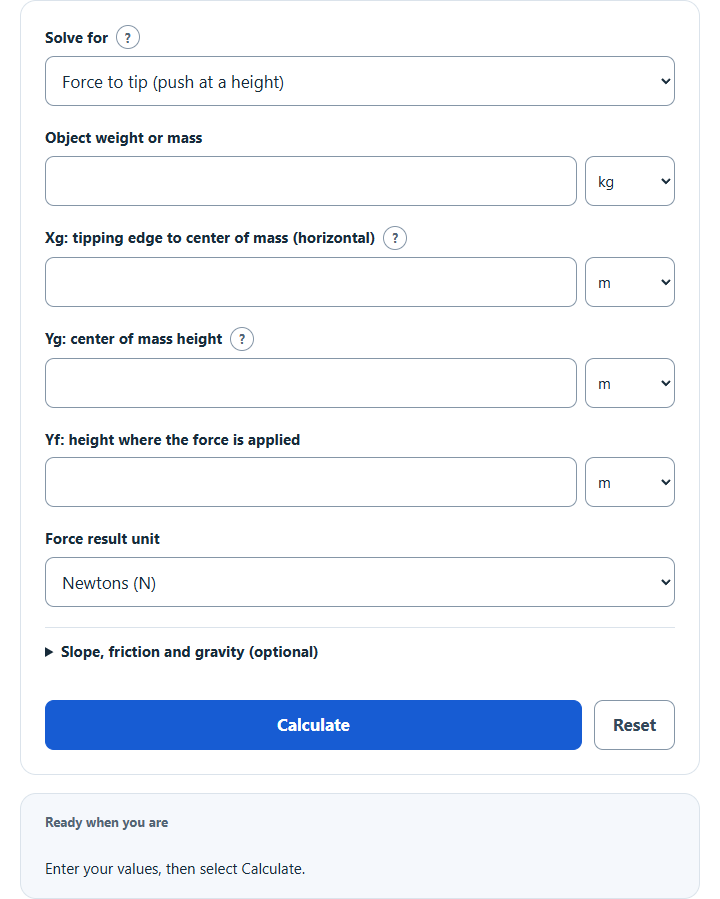
Calculate the tipping force needed to tip an object from its weight, center of mass distance, and push height, plus safety factor and counterweight needed.
- All Physics Calculators
- Overturning Moment Calculator
- Net Force Calculator
- Applied Force Calculator
- Crane Tipping Load Calculator
- Forklift Load Center Capacity Calculator
- Moment of Force Calculator
Calculator Functions
| Function | What it does | What it requires |
|---|---|---|
| Force to tip (push at a height) | Finds the horizontal push that starts an object rotating over one bottom edge | Requires the object weight or mass, the horizontal distance from the tipping edge to the center of mass (Xg), the center of mass height (Yg) and the height where the force is applied (Yf) |
| Force to tip with a lever | Finds the tipping force from the lever formula with arms above and below the center of mass | Requires the object mass, the lever angle and the lever lengths above (a) and below (b) the center of mass |
| Will a force tip it? (safety factor) | Checks whether a known push tips the object and gives the safety factor against tipping | Requires the object weight or mass, Xg, Yg, Yf and the applied force |
| Counterweight to stop tipping | Finds the counterweight that brings the object up to a target safety factor | Requires the object weight or mass, Xg, Yg, Yf, the applied force, the distance from the tipping edge to the counterweight (Xb) and the target safety factor |
Weight goes in as kg, lb, N or lbf, lengths as m, cm, mm, in or ft, and the force result comes out in newtons, kilogram-force or pound-force. Three optional settings apply to every function except the lever one: ground tilt toward the tipping edge, a coefficient of friction, which adds a slide-or-tip check, and gravity, which is 9.80665 m/s² unless changed. The lever function takes gravity only.
Tipping Force Formulas
| F | Horizontal force that just tips the object |
| W | Weight of the object. A mass is multiplied by gravity [2] |
| Xg | Horizontal distance from the tipping edge to the center of mass. Half the base width for a uniform box |
| Yf | Height above the ground where the force is applied |
An object tips when the turning effect of the push about the bottom edge exceeds the turning effect of its weight, and at that point the ground reaction acts at the very edge [1]. The push has a moment of F × Yf and the weight has a restoring moment of W × Xg, so setting them equal gives the formula.
Force to tip (push at a height)
A block that weighs 75 lbf, has a base 12 in wide and is pushed 9 in above the floor has Xg = 6 in, so it tips at 75 × 6 ÷ 9 = 50 lbf. On a slope the restoring moment changes with the tilt angle θ:
Yg sin θ)
Yg is the height of the center of mass, and the force to tip is Mr ÷ Yf. A 100 kg object with Xg = 0.3 m and Yg = 0.5 m, pushed at 1 m, tips at 294.2 N on level ground and at 204.58 N on a 10° tilt toward the edge. With no push at all it goes over once the tilt reaches the critical angle, tan⁻¹(Xg ÷ Yg), which is 30.96° here. With a coefficient of friction μ the result also says which happens first: on level ground the object slides instead of tipping if μ × W is smaller than the tipping force [1].
Force to tip with a lever
b ÷ (a + b)
m is the mass, g is gravity, x is the angle between the lever and the direction of the push, and a and b are the lever lengths above and below the center of mass. For a 680 kg object, a 65° angle and a = b = 0.5 m, the result is 680 × 9.80665 × cos 65° × 0.5 = 1,409.12 N. The angle must be under 90°. This formula is a simplified lever model and does not use the base width, so it gives a different answer from the push function.
Will a force tip it? (safety factor)
The safety factor is the restoring moment divided by the overturning moment of the applied force. At 1 or above the object stays down, and below 1 it tips. The 100 kg object above has Mr = 294.2 N·m, so a 200 N push at 1 m gives 294.2 ÷ 200 = 1.471 and it does not tip.
Counterweight to stop tipping
÷ (Xb × g)
mb is the counterweight mass and Xb is its horizontal distance from the tipping edge on the stable side. The extra restoring moment needed is divided by that distance and by gravity. For the same object with a 250 N push, a target of 1.5 and Xb = 0.5 m, the counterweight is (1.5 × 250 − 294.2) ÷ (0.5 × 9.80665) = 16.48 kg. If the target is already met, the answer is that none is required.
Limits of This Estimate
- The object and the ground are treated as rigid, with one straight tipping edge. Soft ground, flexible legs, wheels and shifting loads behave differently.
- The push is steady and horizontal. Impacts, wind gusts and moving loads can tip an object with a smaller average force.
- The lever formula is a simplified model and does not come from a published standard. These estimates are based on the best available data and estimations.
- A counterweight is assumed to be fixed to the object and not to move the tipping edge. The result is not a design check for cranes, lifts, shelving or other equipment covered by safety standards.
Sources
- Penn State, Mechanics Map, Slipping vs. Tipping: the condition for tipping about an edge and the comparison with sliding
- NIST, Guide for the Use of the International System of Units (SP 811), Appendix B.8: standard gravity in the kilogram-force factor, and the pound-force, pound, inch and foot factors