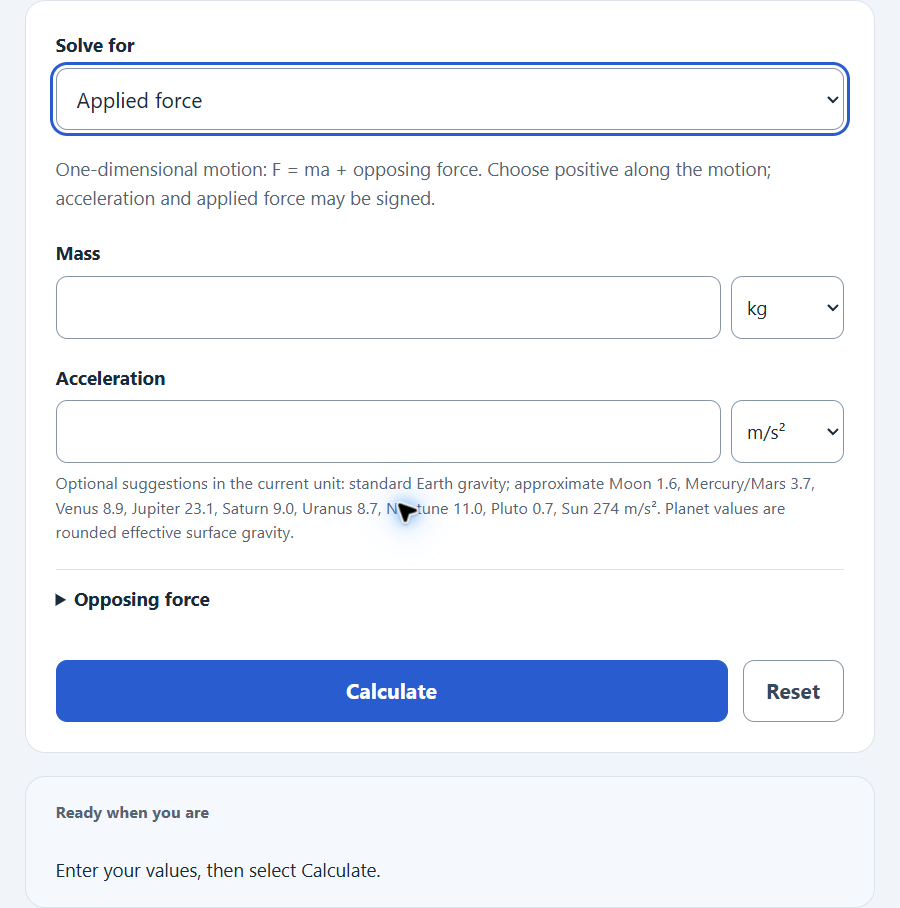
Choose what to solve for, enter the known values and select Calculate. Applied force, weight, work and power modes support metric and imperial units. Optional opposing force defaults to zero; blank work-mode time omits power.
- All Physics Calculators
- Net Force Calculator
- Resultant Force Calculator
- Average Force Calculator
- Average Resistive Force Calculator
- Extension Force Calculator
Applied Force Formula
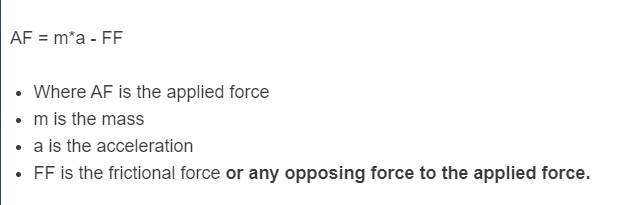
The following formula is used to calculate an applied force.
- Where AF is the applied force
- m is the mass
- a is the acceleration
- FF is the frictional force (or any opposing force that acts opposite the motion).
To calculate an applied force, multiply the mass by the acceleration, then add the frictional (opposing) force. (Equivalently, along the direction of motion: AF − FF = m·a.)
As stated above, this equation takes into account cases where there is a force opposing the motion of the object (such as friction or drag).
Applied Force Definition
An applied force is a force exerted on an object by a person or another object (typically a push or pull). It may or may not cause acceleration, depending on the net force on the object.
Is applied force contact or noncontact?
In standard physics terminology, an “applied force” is typically a contact force (a push or pull). Non-contact forces like gravity act at a distance, but they are usually not described as an “applied force.”
Is force applied through distance?
A force can be applied whether or not an object moves. Distance becomes important when calculating work: if a force acts while the object undergoes a displacement, the work done is W = F·d·cos(θ). If there is no displacement, the work done by that force is zero.
Can applied force be negative?
An applied force can be negative with respect to direction but not with respect to magnitude. For example, a force could have a magnitude of 20 N in the negative x-direction.
Does applied force affect friction?
A perpendicular applied force can increase or decrease the normal force, depending on its direction. Kinetic friction depends on the normal force; static friction adjusts up to its limiting value.
How to find applied force without acceleration?
If you don’t directly know the acceleration, you can compute it (for constant acceleration) from velocity change and time using a = (vf − vi)/t. Then compute the net force using Fnet = m·a, and finally compute applied force by accounting for opposing forces (for 1D motion): Fapplied = Fnet + Fopposing.
How to find applied force with mass and coefficient of friction?
To find an applied force with mass and coefficient, first, find the friction force. Then determine the acceleration of the object. The applied force will equal the friction force plus the mass of the object times its acceleration.
Is applied force equal to net force?
An applied force can equal a net force if the applied force is the only force acting on the object. Otherwise, the applied force will not equal the net force.
What happens if friction force is greater than applied force?
If an object is at rest and the applied force is less than the maximum static friction, it will not start moving. If the object is already moving and kinetic friction is greater than the applied force (in the direction of motion), the net force is opposite the motion, so the object will decelerate and eventually stop.
What happens when force is applied to an object?
A force applied to an object can change its motion. If the applied force results in a nonzero net force, the object will accelerate in the direction of that net force.
Applied Force Example
How to calculate an applied force?
- First, determine the mass.
Measure the mass of the object. (Typically in kg)
- Next, determine the acceleration.
Measure or calculate the acceleration in the direction of the applied force.
- Next, determine any opposing forces.
Measure any opposing forces such as friction that are opposite of the applied force.
- Finally, calculate the applied force.
Using the formula above, calculate the applied force.
FAQ
A force is an interaction (a push or pull) that can change an object’s motion. When the net force on an object is not zero, it accelerates according to Newton’s second law.