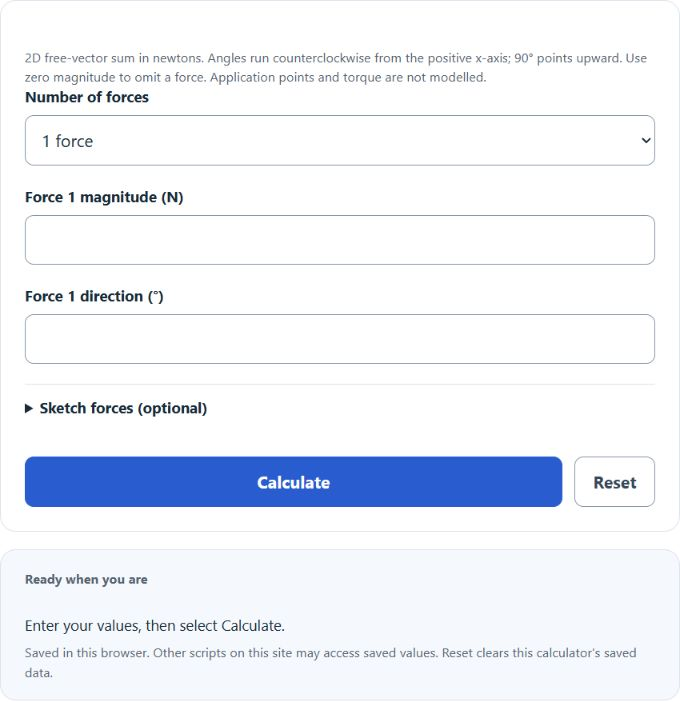
Enter up to five force magnitudes in newtons and directions in degrees, counterclockwise from the positive x-axis. Use exact numerical entry or the optional sketch input. The calculator sums free vectors in two dimensions; it does not calculate torque from application points. A zero resultant has no direction.
Related Calculators
- All Physics Calculators
- All Force Calculators
- Acceleration Calculator
- Resultant Force Calculator
- Applied Force Calculator
- Magnitude of Force Calculator
- Net Torque Calculator
What is Net Force?
Net Force Definition:
The net force is simply the sum of all forces acting on an object. This can be further complicated when the forces are acting in different directions. In this case, the forces need to be broken down into their x and y components and then summed.
Net Force Formula
The following formula is used to calculate the net force acting on an object.
- Where F1, F2, etc. are the forces
- a1, a2, etc. are the angles those forces make with the positive x-axis (horizontal)
Net Force Definition
The net force is simply the sum of all forces acting on an object. This can be further complicated when the forces are acting in different directions. In this case, the forces need to be broken down into their x and y components and then summed.
Net Force Example
How to calculate net force?
In this example problem, we will be determining the net (resultant) force from two individual forces acting on an object.
These forces and angles are given as 20 N at 5° and 10 N at 60° (angles measured from the horizontal/positive x-direction).
First, we must break these forces into their X and Y components, which is done by multiplying the force by the cosine and sine of the angle, respectively.
Doing this we find the X components to be 19.92 N and 5.00 N respectively.
X = 20*cos(5°) = 19.92
X = 10*cos(60°) = 5.00
For the Y components, they are calculated to be 1.74 N and 8.66 N respectively.
Y = 20*sin(5°) = 1.74
Y = 10*sin(60°) = 8.66
Next, the components are added together to get
F-x direction = 19.92 + 5.00 = 24.92 N
F-y direction = 1.74 + 8.66 = 10.40 N
With the individual components in hand, the magnitude of the force can be calculated with the following formula F = Sqrt(Fx^2+Fy^2) ≈ 27.00 N.
For this example the direction is atan2(Fy, Fx) ≈ 22.70 degrees counterclockwise from the positive x-axis. Unlike a plain inverse tangent of Fy/Fx, atan2 selects the correct quadrant; the direction of a zero resultant is undefined. See NASA’s explanation of the vector sum of forces.
FAQ
A net force is the sum of all of the forces acting upon an object.