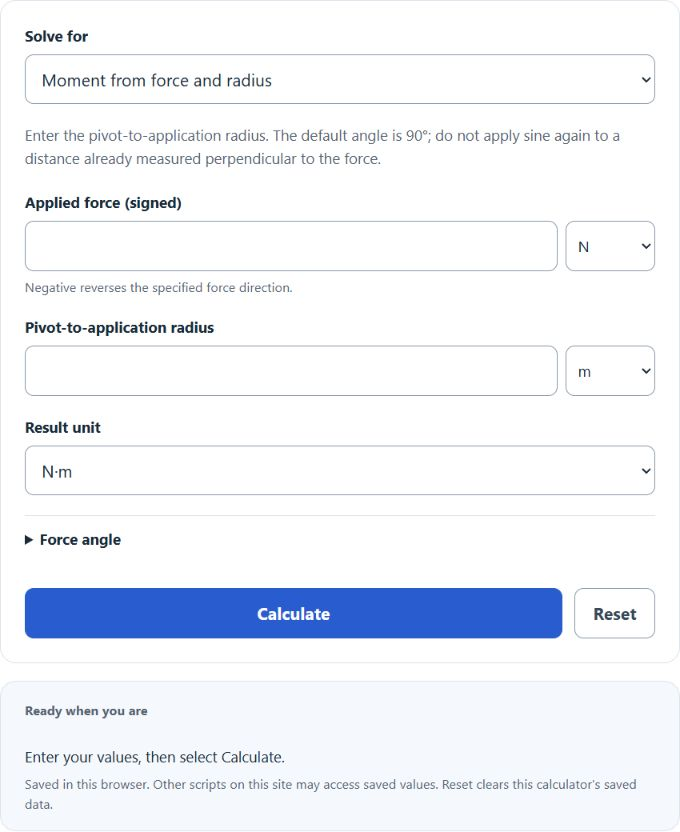
Calculate moment of force from force and lever arm distance, solve for the missing force or distance, or find the 2D moment about a point from Fx, Fy, x, y vector components.
Moment of Force Formula
The moment of force is calculated using the following formulas depending on the information available.
Scalar form (perpendicular force):
Scalar form (force at an angle):
2D vector cross product form:
- M is the moment of force, measured in newton-meters (N-m)
- F is the applied force in newtons (N)
- In M = F × d × sin(θ), d is the pivot-to-application radius in meters. The perpendicular moment arm is d × |sin(θ)|. When using a perpendicular distance directly, use M = F × d without another sine factor.
- θ is the oriented angle from the position vector toward the positive force direction; the widget uses degrees, with blank meaning 90°.
The perpendicular-force form is M = F × d. For a pivot-to-application radius at an angle, use M = F × d × sin(θ). Scalar force and moment are signed under the stated oriented-angle convention. Inverse solves reject impossible or nonunique zero-denominator cases and a negative inferred radius. The vector form Mz = x × Fy − y × Fx determines direction from the components.
What is a Moment of Force?
A moment of force is the tendency of a force to rotate an object about an axis, pivot point, or fulcrum. It quantifies how effectively a force produces rotational motion rather than linear motion. The concept originates from Archimedes’ study of levers around 250 BCE, where he formalized the principle that a small force applied far from a pivot can balance a much larger force applied close to it.
In engineering and physics, the terms “moment of force,” “torque,” and “moment” are used interchangeably in most practical contexts, though some disciplines draw subtle distinctions. In mechanical engineering, “torque” typically refers to moments that cause rotation about a shaft or axle (like an engine crankshaft), while “moment” is more commonly used in structural analysis to describe bending effects in beams and columns. In physics, both terms describe the same mathematical quantity: the cross product of the position vector and the force vector.
A related but distinct concept is the couple, which consists of two equal and opposite forces separated by a distance. A couple produces a pure moment with zero net translational force. Turning a steering wheel with both hands is a common example of a couple: the two hands push in opposite directions, creating rotation without pushing the wheel in any one direction.
Sign Convention and Direction
Moments are vector quantities, meaning they have both magnitude and direction. In 2D analysis, the standard sign convention defines counterclockwise moments as positive and clockwise moments as negative. This follows the right-hand rule: if you curl the fingers of your right hand in the direction of rotation, your thumb points in the direction of the moment vector (out of the page for counterclockwise, into the page for clockwise).
In 3D analysis, the moment vector is computed as M = r x F, where r is the position vector from the pivot to the point of force application. The resulting moment vector is perpendicular to both r and F, and its direction is determined by the right-hand rule. For planar problems, only the z-component of the moment matters, which simplifies to the scalar equations above.
The Principle of Moments
The principle of moments (also called Varignon’s theorem) states that the moment of a resultant force about any point equals the sum of the moments of the individual component forces about that same point. In static equilibrium, the sum of all moments about any point must equal zero. This principle is the foundation of structural analysis and is used in everything from sizing beams in buildings to balancing a child’s seesaw.
For a system in rotational equilibrium: the sum of all clockwise moments about a pivot equals the sum of all counterclockwise moments. This is how engineers determine reaction forces in supported beams, the load capacity of cranes, and the stability of retaining walls.
Illustrative Torque Calculations
The following values are calculated from explicitly stated inputs. They are examples of the equations, not measured reference data, torque specifications or operating limits.
| Stated model inputs | Moment (N·m) | Moment (lbf·ft) |
|---|---|---|
| 50 N at 0.3 m, perpendicular | 15 | ≈11.0634 |
| 50 N at 0.3 m, 30° | 7.5 | ≈5.5317 |
| 75 kW shaft power at 1,450 RPM | ≈493.9291 | ≈364.3034 |
The shaft-power example uses T = P / ω, where ω = 2 × π × RPM / 60, and assumes that the stated 75 kW is mechanical shaft power at the stated speed. Use actual equipment data for a real installation.
Moment of Force Unit Conversions
Moment of force is expressed in various units depending on the measurement system and industry. The following conversion factors are commonly needed when working between SI and imperial units.
| From | To | Multiply By |
|---|---|---|
| N-m | lb-ft | 0.7376 |
| lb-ft | N-m | 1.3558 |
| N-m | lb-in | 8.8507 |
| lb-in | N-m | 0.1130 |
| N-m | kgf-m | 0.1020 |
| kgf-m | N-m | 9.8067 |
| N-m | kN-m | 0.001 |
| N-m | dyn-cm | 10,000,000 |
Levers and Mechanical Advantage
The moment of force is the physical basis for how levers amplify force. A lever is a rigid bar that rotates about a fixed fulcrum. By applying a force far from the fulcrum, you generate a large moment that can overcome a heavier load placed closer to the fulcrum. The mechanical advantage (MA) of a lever equals the ratio of the effort arm length to the load arm length:
There are three classes of levers, each defined by the relative positions of the fulcrum, effort, and load:
Class 1 places the fulcrum between the effort and load. Examples include a crowbar, a pair of scissors, and a seesaw. The mechanical advantage can be greater or less than 1 depending on relative arm lengths.
Class 2 places the load between the fulcrum and the effort. A wheelbarrow is the classic example: the wheel is the fulcrum, the load sits in the tray, and the handles are where you apply effort. Class 2 levers always have a mechanical advantage greater than 1.
Class 3 places the effort between the fulcrum and the load. The human forearm is an example: the elbow is the fulcrum, the bicep applies force near the elbow, and the hand holds the load at the far end. Class 3 levers always have a mechanical advantage less than 1 but provide greater speed and range of motion.
Engineering and Real-World Applications
Structural engineering: When a beam supports a load, the beam experiences internal bending moments. Engineers calculate the maximum bending moment to select beam sizes that prevent failure. A simply supported beam with a central point load P and span L produces a maximum bending moment of M = P x L / 4 at midspan. Steel I-beams, reinforced concrete beams, and timber joists are all sized primarily based on moment capacity.
Automotive: For an illustrative ideal drivetrain with 350 N·m input torque, ratios of 3.5:1 and 3.7:1 give 4,532.5 N·m before losses. Wheel force also depends on tire radius; acceleration requires mass, traction, gearing, power and other conditions.
Bolted joints: Applied torque is an indirect way to control preload. The estimate T = K × d × F uses assembly-specific nut factor K, bolt diameter d and desired clamp force F. Friction, lubrication and installation conditions can change the result substantially. Use the validated fastener and joint specification; this point-force calculator does not determine bolt preload or a safe tightening torque.
Biomechanics: Joint moments depend on the person, posture, movement, load and measurement method. A force-radius calculation alone does not determine safe lifting, rehabilitation loads or human strength limits.
Robotics: Joint torque requirements dictate motor sizing in robotic arms. A 6-axis industrial robot lifting a 10 kg payload at full arm extension of 1.2 m requires at least 117.7 N-m at the shoulder joint (10 kg x 9.81 m/s2 x 1.2 m) just to hold the payload statically, before accounting for the arm’s own mass and any dynamic loads from acceleration.
Relationship Between Torque and Power
Torque and power are closely related through rotational speed. Power is the rate at which work is done, and for a rotating shaft:
Where P is power in watts, T is torque in N-m, and omega is angular velocity in radians per second. This means a motor producing 100 N-m at 3,000 RPM delivers approximately 31.4 kW (about 42 horsepower). Conversely, a motor rated at 75 kW running at 1,450 RPM must be producing roughly 494 N-m of torque. This relationship is fundamental to motor selection in industrial systems: you can trade torque for speed (and vice versa) using gearing, but total power remains constant (minus friction losses).
FAQ
What is the difference between moment of force and torque?
In most practical contexts, they are the same thing. Both describe the rotational effect of a force about a point. “Torque” tends to be used when describing rotation about a shaft or axle (engines, motors, fasteners), while “moment” is more common in structural analysis (beam bending, support reactions). The mathematical definition is identical: M = r x F.
Can the moment of force be negative?
Yes. The sign indicates rotational direction. Using the standard convention, counterclockwise moments are positive and clockwise moments are negative. When using the vector cross product M = r x F, the sign emerges naturally from the component calculation. In equilibrium problems, negative moments balance positive ones so the net moment equals zero.
What happens when the force passes directly through the pivot point?
The moment is zero. If the line of action of the force passes through the axis of rotation, the perpendicular distance (moment arm) is zero, making M = F x 0 = 0. This is why pushing directly toward a door hinge does not cause the door to swing. Only the component of force perpendicular to the line from the pivot to the point of application produces a moment.
How do you increase the moment of force without increasing the applied force?
Increase the lever arm length. This is the principle behind tools like breaker bars, long-handled wrenches, and cheater pipes. A 0.5 m wrench requires 200 N to produce 100 N-m of torque, but extending to a 1.0 m handle requires only 100 N for the same moment. You can also adjust the angle of force application: a force applied at 90 degrees to the lever arm produces the maximum moment, while any other angle reduces the effective moment by the factor sin(theta).
What is a couple, and how does it differ from a single moment?
A couple consists of two equal-magnitude, opposite-direction forces separated by a perpendicular distance. The moment of a couple equals one of the forces multiplied by the distance between them (M = F x d). Unlike a single-force moment, a couple produces pure rotation with zero net translational force, and its moment value is the same regardless of which reference point you choose. Steering wheels, screwdriver grips, and faucet handles all rely on couples.
Why do torque specifications matter for bolts?
Follow the exact vehicle, fastener and joint specification and installation procedure. Torque is an indirect preload control affected by friction and assembly conditions; a generic range does not establish a safe value. This calculator does not select tightening torque or verify joint safety.