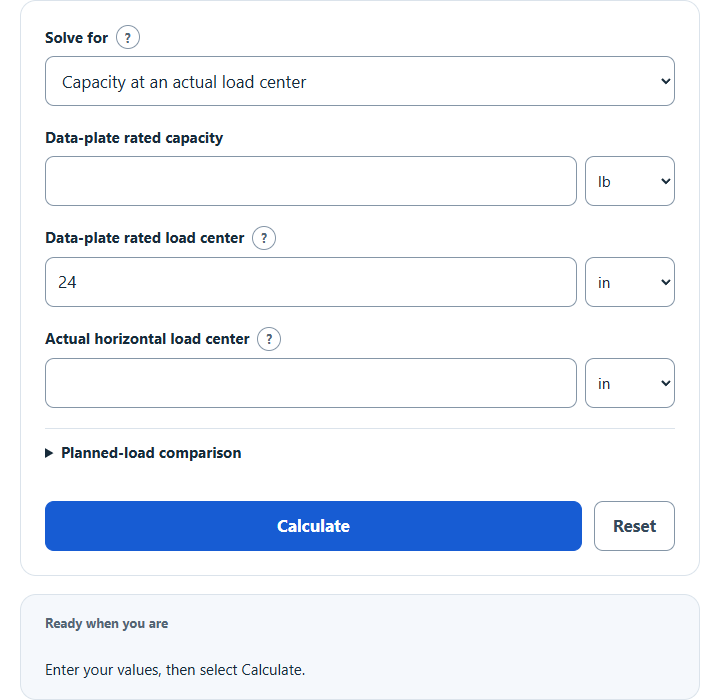
Calculate forklift load capacity at any load center from the data-plate rating, with a capacity chart, or find the maximum load center for a load.
- All Construction Calculators
- Crane Tipping Load Calculator
- Scissor Lift Force Calculator
- Tipping Force Calculator
- Handling Lift Capacity Calculator
- Safe Working Load Calculator
- Wheel Over Point Calculator
Calculator Functions
| Function | What it does | What it requires |
|---|---|---|
| Capacity at an actual load center | Estimates how much a forklift can carry when the load center is longer than the rated one | Requires the data-plate rated capacity, the data-plate rated load center and the actual horizontal load center |
| Maximum load center for a load | Estimates the longest load center at which a given load stays within the estimate | Requires the data-plate rated capacity, the data-plate rated load center and the load weight |
| Rated capacity needed for a load | Estimates the data-plate rating a truck needs to carry a load at a given load center | Requires the load weight, the data-plate rated load center and the actual horizontal load center |
Weights can be entered in pounds, kilograms or tonnes and load centers in inches, millimeters or centimeters. The rated load center is filled in as 24 inches and can be changed to match the data plate. The first function can also compare a planned load weight with the estimate, and it lists the estimated capacity at five load centers stepping out from the rated one.
Forklift Load Center Capacity Formula
FLC ≤ SRC
| FLC | Estimated capacity at the actual load center (lb) |
| SRC | Rated capacity on the data plate (lb) |
| SLC | Rated load center on the data plate (in) |
| ALC | Actual load center: the horizontal distance from the vertical face of the forks to the load’s center of gravity (in) |
OSHA gives this ratio as a field calculation of approximate safe load capacity and says it does not produce exact figures and should be used only as a guideline, with the forklift manufacturer as the source of more precise information [1]. Trucks with a capacity of 30,000 lb or less are normally rated at a 24 inch load center [2].
Capacity at an actual load center
The main formula applies directly. A truck rated for 5,000 lb at 24 inches that picks up a load with a 28 inch load center has an estimated capacity of 5,000 × 24 ÷ 28 = 4,285.71 lb, a 14.29% reduction [1]. A truck rated for 4,000 lb at 24 inches is estimated at 2,666.67 lb at 36 inches [1]. A load center shorter than the rated one does not raise the estimate above the data-plate rating.
Maximum load center for a load
A truck rated for 5,000 lb at 24 inches carrying a 4,000 lb load reaches the estimate at a load center of 5,000 × 24 ÷ 4,000 = 30 inches. A load heavier than the data-plate rating has no answer, because no load center allows it.
Rated capacity needed for a load
A 4,000 lb load with a 36 inch load center calls for a truck rated for at least 4,000 × 36 ÷ 24 = 6,000 lb at 24 inches. When the actual load center is shorter than the rated one, the rating needed equals the load weight.
How to Calculate Forklift Load Capacity
Read the rated capacity and rated load center from the truck’s data plate. Find the actual load center, which for an evenly loaded pallet is half the load’s length measured out from the fork face. Divide the rated load center by the actual load center and multiply by the rated capacity [1]. For a 3,000 lb truck rated at 24 inches carrying a 60 inch long load, the load center is 30 inches and the estimate is 3,000 × 24 ÷ 30 = 2,400 lb [2].
Limits of This Estimate
- The result is an estimate and does not authorize a lift. The data plate and the manufacturer’s capacity information for the exact truck govern, and the approved capacity can be lower [1].
- Attachments, lift height, mast tilt, side shift and a load whose center of gravity is high or off to one side all change capacity and are not modeled.
- Half the load length is the load center only when the weight is evenly spread. An uneven load needs its real center of gravity.
- The two reverse functions rearrange the same ratio. They do not give an approved load center or a truck specification.
Sources
- Occupational Safety and Health Administration, Powered Industrial Trucks (Forklift) eTool, Load Composition: the field calculation of safe load capacity, its two worked examples and its limits
- Occupational Safety and Health Administration, 29 CFR 1910.178 Appendix A, Stability of Powered Industrial Trucks: the 24 inch rated load center and the 3,000 lb load-moment example