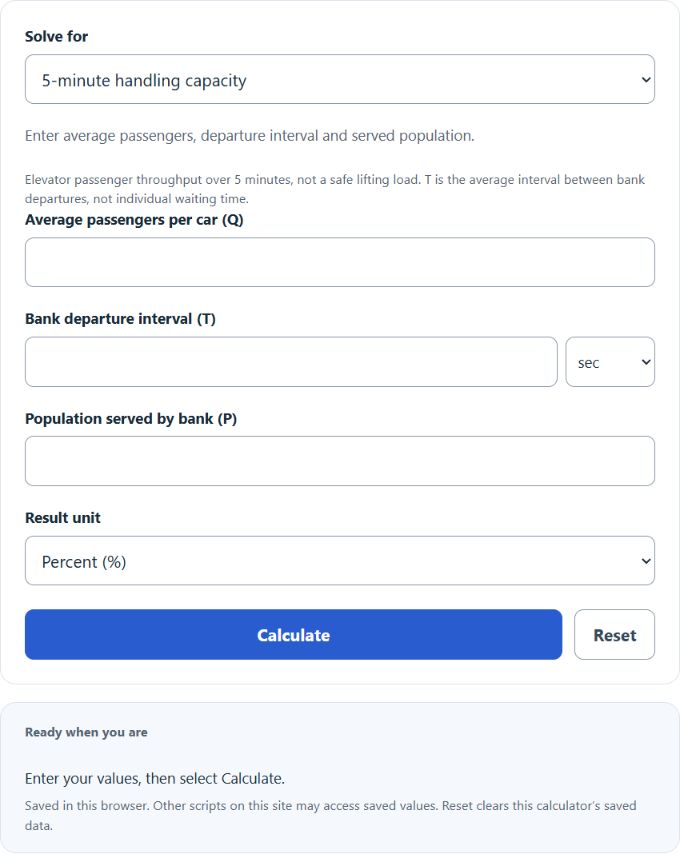
Calculate elevator passenger handling capacity, bank departure interval, average passengers, or served population over a 5-minute peak period. Select the value to solve for and enter the other three.
- All Construction Calculators
- Elevator Capacity Calculator
- Waiting Time Calculator
- People Per Hour Calculator
- Queue Length Calculator
- Queuing Theory Calculator
Handling Lift Capacity Formula and Guide
Handling lift capacity (HLC) measures how much of a served population can be transported by a lift or elevator system during a 5-minute peak period. It is a compact way to compare service performance because it combines passenger loading, car interval, and population demand into one result.
If you want the result as a decimal instead of a percent, use:
The constant 300 represents 5 minutes converted to seconds. When calculating manually, the interval T should be in seconds.
Variable Definitions
| Symbol | Meaning | Typical Units | Why It Matters |
|---|---|---|---|
| HLC | Handling lift capacity over 5 minutes | Percent (%) or decimal | Shows the share of the population the system can move in the measured period |
| Q | Average number of passengers carried per departing car | People | Higher average loading increases capacity |
| T | Average interval between departures from the lift bank | Seconds | Shorter intervals increase capacity because service arrives more often |
| P | Total population served during the peak period | People | Larger populations reduce the percentage handled unless service also improves |
Rearranged Equations
If you know any three variables, the relationship can be rearranged to solve for the fourth. In the equations below, use HLC as a percent value. For example, use 15 for 15%, not 0.15.
How to Use the Calculator
- Enter the average number of passengers carried per departing car, Q. Use a realistic operating average rather than the absolute rated maximum.
- Enter the bank departure interval, T, rather than an individual passenger’s waiting time. If you are working by hand, convert minutes or hours to seconds before using the formula.
- Enter the total population served during peak traffic, P.
- Select the unknown variable in the calculator’s Solve for control.
- Review the result as either a percent or a decimal, depending on how you prefer to interpret capacity.
Example Calculation
Assume a lift carries an average of 15 passengers, the interval is 30 seconds, and the served population is 1,000 people.
This means the system can handle 15% of the served population in 5 minutes.
How Each Input Changes the Result
| Change | Effect on HLC | Reason |
|---|---|---|
| Increase Q | HLC rises | Each departing car transports more people |
| Decrease T | HLC rises | Cars arrive more frequently during the 5-minute window |
| Increase P | HLC falls | The same service must cover a larger population |
How to Interpret the Result
A higher handling lift capacity generally indicates a stronger ability to move people during peak demand. However, HLC should be interpreted together with interval and passenger experience:
- High HLC with long intervals can still feel slow because passengers wait longer between cars.
- Low HLC may indicate too few cars, low average occupancy, long intervals, or an oversized population load.
- Similar HLC values can come from very different operating patterns, so interval and average loading should always be reviewed alongside the final percentage.
Practical Tips for Better Estimates
- Use the average carried load, not the theoretical maximum capacity posted inside the car.
- Use the interval measured during the actual peak period, not a quiet off-peak average.
- Define population carefully. The served population should match the group of people who actually depend on that lift bank.
- Keep units consistent. Manual calculations should use seconds for interval when applying the standard formula.
- If the result seems too high or too low, recheck whether percent and decimal values were mixed up.
Common Mistakes
- Entering 0.15 when the formula expects 15 for a 15% result.
- Using rated car capacity instead of the more realistic average passenger count.
- Using the total building occupancy when only part of the building is served by the lift group being analyzed.
- Leaving the interval in minutes without converting to seconds for manual calculations.
- Assuming HLC alone describes comfort, wait perception, or traffic distribution across all floors.
Ways to Improve Handling Lift Capacity
- Reduce the car interval so lifts arrive more frequently.
- Improve dispatching or group control to smooth traffic flow.
- Increase effective average loading without creating overcrowding.
- Add lift capacity where demand is consistently above acceptable service levels.
- Reduce the population load on a lift group through zoning or traffic redistribution.
Frequently Asked Questions
What does the 5-minute period represent?
It is a standard short peak window used to estimate how much of the served population a lift system can move when demand is heaviest.
Is handling lift capacity the same as waiting time?
No. Handling lift capacity measures how much population can be moved, while interval focuses on how often service arrives. They are related, but not identical.
Why does the calculator use average passengers instead of maximum passengers?
Real lift performance depends on what cars typically carry during operation. Maximum rated capacity is rarely achieved consistently, so average loading gives a more realistic estimate.
Can this calculator be used to compare two lift systems?
Yes. It is especially useful for side-by-side comparisons when you want to see how changes in loading, interval, or served population affect overall capacity.