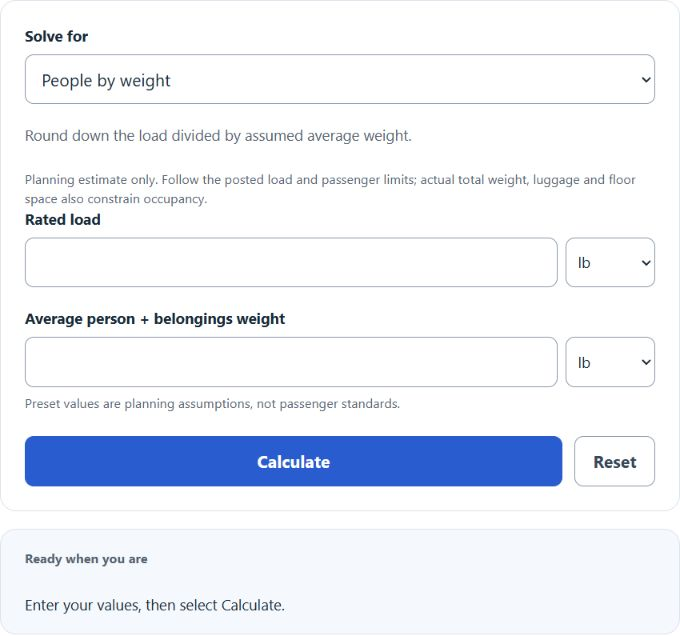
Calculate elevator capacity from rated load and average person weight, or estimate trips and time needed to move a group of any size.
- All Construction Calculators
- Elevator Acceleration Calculator
- Handling Lift Capacity Calculator
- Safe Working Load Calculator
- Working Load Limit Calculator
- Weight to Force Calculator
Elevator Lift Capacity Formula
The following two example problems outline the steps and information needed to calculate the Elevator Lift Capacity.
Variables:
- ELC is the Elevator Lift Capacity (persons)
- LW is the posted rated load (lb)
- W is the assumed average person and belongings weight (lb)
For a weight-based planning estimate, divide the posted rated load by the assumed average person and belongings weight, then round down to a whole number. Follow both posted passenger and load limits; this estimate does not certify safe occupancy.
Using W = 150 lb is one planning assumption, not a universal passenger standard. Include belongings and consider actual total weight and available floor space.
How to Calculate Elevator Lift Capacity?
The following steps outline how to calculate the Elevator Lift Capacity.
- First, determine the posted rated load and assumed average person and belongings weight in the same unit.
- Next, gather the formula from above: ELC = floor(LW / W).
- Finally, calculate the Elevator Lift Capacity.
- After inserting the variables and calculating the result, check your answer with the calculator above.
Example Problem :
Use the following variables as an example problem to test your knowledge.
Posted rated load = 2000 lb; assumed average person and belongings weight = 150 lb.
ELC = floor(2000 / 150) = 13 people as a weight-based estimate, subject to the posted passenger limit.