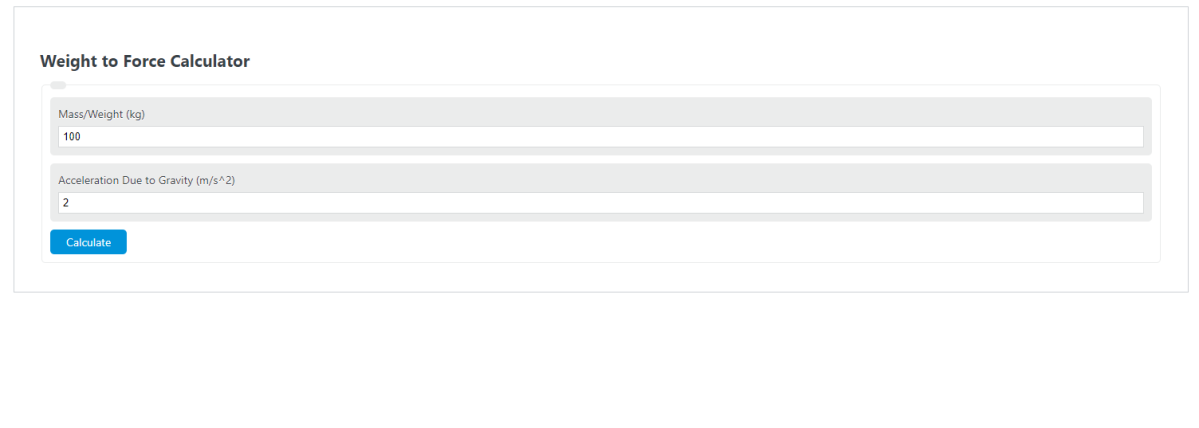
Convert mass to weight force, force back to mass, or solve gravity with Earth, Moon, Mars, Jupiter, and custom presets plus N, kN, lbf, kgf, and unit steps.
- All Physics Calculators
- Mechanics and Physics Unit Converters
- All Force Calculators
- Gravitational Force Calculator
- Torque to Force Calculator
- Pound Mass to Pound Force Calculator
- KG to Force Calculator
Weight to Force Formula
The force exerted by gravity on an object (its weight) is calculated using Newton’s second law of motion, applied specifically to gravitational acceleration:
- F = gravitational force, i.e. the object’s weight (newtons, N)
- m = mass of the object (kilograms, kg)
- g = local gravitational acceleration (m/s²). On Earth’s surface the standard value is 9.80665 m/s², though it ranges from roughly 9.764 m/s² at the equator to 9.832 m/s² at the poles due to Earth’s oblate shape and rotation.
This is a direct application of Newton’s second law (F = ma) where the acceleration term is the local gravitational field strength. In the more general form, the acceleration a can be any value, not only gravity, making the calculator useful for computing force under any constant acceleration scenario.
Mass vs. Weight: A Critical Distinction
Mass and weight are frequently confused in everyday language, but they represent fundamentally different physical quantities. Mass (measured in kilograms) is a scalar property of matter that quantifies inertia, the resistance of an object to changes in its motion. It is invariant regardless of location. A 70 kg person has 70 kg of mass on Earth, on the Moon, and in deep space.
Weight, by contrast, is a vector quantity measured in newtons. It is the gravitational force acting on a mass and depends entirely on the local gravitational field. That same 70 kg person weighs 686.5 N (154.3 lbf) on Earth, but only 113.5 N (25.5 lbf) on the Moon. Their mass has not changed; only the gravitational acceleration differs.
In everyday use, particularly in the United States, “weight” is often stated in pounds. Technically, the pound as a unit of mass (lbm) and the pound as a unit of force (lbf) are distinct. One pound-mass at standard gravity produces one pound-force: 1 lbm x 9.80665 m/s² = 1 lbf x 4.44822 N. This equivalence only holds at standard gravity, which is the root cause of much of the confusion between mass and weight in imperial units.
Surface Gravity Across the Solar System
The following table lists the surface gravitational acceleration for every planet, dwarf planet Pluto, Earth’s Moon, and the Sun. The “Weight of 70 kg” column shows the gravitational force a 70 kg object would experience at each location, providing a practical reference for how force output changes across different gravitational environments.
| Body | Surface Gravity (m/s²) | Gravity Relative to Earth | Weight of 70 kg (N) | Weight of 70 kg (lbf) |
|---|---|---|---|---|
| Sun | 274.0 | 27.94x | 19,180.0 | 4,311.5 |
| Mercury | 3.70 | 0.38x | 259.0 | 58.2 |
| Venus | 8.87 | 0.90x | 620.9 | 139.6 |
| Earth | 9.807 | 1.00x | 686.5 | 154.3 |
| Moon | 1.622 | 0.17x | 113.5 | 25.5 |
| Mars | 3.721 | 0.38x | 260.4 | 58.6 |
| Jupiter | 24.79 | 2.53x | 1,735.3 | 390.1 |
| Saturn | 10.44 | 1.06x | 730.8 | 164.3 |
| Uranus | 8.69 | 0.89x | 608.3 | 136.8 |
| Neptune | 11.15 | 1.14x | 780.5 | 175.5 |
| Pluto | 0.62 | 0.06x | 43.4 | 9.8 |
| Gravity values sourced from NASA Planetary Fact Sheet (NSSDCA). Gas giants use cloud-top values. Weight = mass x surface gravity. | ||||
Force Unit Conversion Reference
Force is expressed in several unit systems depending on the field. The SI unit is the newton (N), defined as the force required to accelerate 1 kg at 1 m/s². The table below provides cross-conversion factors between the most commonly used force units in engineering, physics, and industry.
| Unit | Symbol | Equivalent in newtons (N) | Common Usage |
|---|---|---|---|
| Newton | N | 1 | SI standard for all physics and engineering |
| Kilonewton | kN | 1,000 | Structural engineering, large-scale forces |
| Pound-force | lbf | 4.44822 | US/imperial engineering, aerospace |
| Kilogram-force | kgf | 9.80665 | Legacy engineering (deprecated but common) |
| Dyne | dyn | 0.00001 | CGS system, surface tension measurements |
| Kip | kip | 4,448.22 | US structural engineering (1 kip = 1,000 lbf) |
| Meganewton | MN | 1,000,000 | Rocket thrust, dam loading |
| 1 lbf = 4.44822 N. 1 kgf = 9.80665 N (equal to the force of 1 kg under standard gravity). | |||
| Newtons (N) | Pounds-force (lbf) |
|---|---|
| 1 | 0.225 |
| 2 | 0.450 |
| 5 | 1.124 |
| 10 | 2.248 |
| 20 | 4.496 |
| 25 | 5.620 |
| 30 | 6.744 |
| 40 | 8.992 |
| 50 | 11.240 |
| 75 | 16.861 |
| 100 | 22.481 |
| 150 | 33.721 |
| 200 | 44.962 |
| 250 | 56.202 |
| 300 | 67.443 |
| 400 | 89.924 |
| 500 | 112.405 |
| 750 | 168.607 |
| 1000 | 224.809 |
| 2000 | 449.618 |
| *Conversion factors: 1 lbf = 4.44822 N; 1 N = 0.224809 lbf. Values rounded to 3 decimals. | |
Where Weight-to-Force Conversion Matters
Converting between mass and force is not just an academic exercise. It is embedded in nearly every branch of engineering and applied science. In structural engineering, dead loads (the weight of the structure itself) must be expressed in newtons or kilonewtons before they can be combined with live loads and wind loads in design calculations. A steel I-beam rated for 50 kN must support that force, not that mass, which is why the conversion from kilograms to newtons is one of the first steps in any structural analysis.
In aerospace, the thrust-to-weight ratio of an aircraft or rocket compares engine thrust (a force, in newtons) against gravitational force on the vehicle’s mass. The Saturn V first stage produced roughly 33.4 MN of thrust to lift a vehicle with a launch mass of approximately 2.97 million kg, yielding a thrust-to-weight ratio of about 1.15. Below 1.0, the vehicle cannot leave the ground.
In material testing, tensile strength is reported in pascals (N/m²), meaning the raw output of a tensile test in force units (N or kN) must be divided by the specimen’s cross-sectional area. Misinterpreting mass for force at this stage would produce results off by a factor of 9.81, a potentially catastrophic error in safety-critical applications.
Precision mass metrology, used in pharmaceutical dosing and semiconductor manufacturing, also depends on this conversion. Precision balances actually measure the gravitational force on an object and back-calculate mass using the local value of g. Because g varies by roughly 0.7% across Earth’s surface (from about 9.764 m/s² in equatorial regions to 9.832 m/s² near the poles), high-precision balances require local gravity calibration to avoid systematic measurement errors.
Variation of g on Earth’s Surface
Earth’s gravitational acceleration is not uniform. It varies with latitude, altitude, and local geology. At sea level, g ranges from approximately 9.764 m/s² near the equator to 9.832 m/s² at the poles. This 0.7% variation results from two factors: Earth’s oblate shape (the poles are about 21 km closer to Earth’s center than the equator) and the centrifugal effect of Earth’s rotation, which effectively reduces apparent gravity at the equator.
Altitude further reduces g. At 10 km elevation (typical cruising altitude for commercial aircraft), g drops by about 0.03 m/s². At the summit of Mount Everest (8,849 m), g is approximately 9.773 m/s², roughly 0.3% less than the sea-level standard. For most everyday calculations, using 9.81 m/s² introduces less than 0.1% error, but for precision applications in geodesy, navigation, and metrology, local gravity surveys or models such as the Earth Gravitational Model (EGM2008) are used to obtain g accurate to 0.001 m/s² or better.
FAQ
Is weight the same as force?
Weight is a specific type of force: the gravitational force acting on a mass. All weight is force, but not all force is weight. A 10 N push on a table is a force but not a weight. A 10 N gravitational pull on a 1.02 kg object is both a force and a weight. In the SI system, both are measured in newtons. The confusion arises because colloquial English uses “weight” to mean mass (e.g., “I weigh 70 kg”), while physics defines weight strictly as a force (686.5 N for a 70 kg person on Earth).
Why does the calculator use 9.80665 m/s² instead of 9.81 m/s²?
The value 9.80665 m/s² is the internationally agreed standard acceleration of gravity, adopted by the 3rd General Conference on Weights and Measures (CGPM) in 1901. It was chosen as a representative average for Earth’s surface at sea level near 45° latitude. While 9.81 m/s² is a common rounded approximation (and perfectly adequate for most calculations), the full six-digit value is used whenever precise unit conversions are required, particularly in defining the kilogram-force (1 kgf = 1 kg x 9.80665 m/s² = 9.80665 N).
How does the value of g affect the force acting on an object?
Force is directly proportional to g. Doubling the gravitational acceleration doubles the weight force on the same mass. On Jupiter (g = 24.79 m/s²), a 70 kg person experiences 1,735 N of gravitational force, roughly 2.5 times their Earth weight of 687 N. On the Moon (g = 1.622 m/s²), that same person experiences only 113.5 N, about one-sixth of Earth weight. The mass remains 70 kg in all cases.
What is the difference between lbm and lbf?
The pound-mass (lbm) measures the amount of matter in an object. The pound-force (lbf) measures force. They are numerically equal only under standard Earth gravity: 1 lbm produces exactly 1 lbf of weight when g = 9.80665 m/s². On the Moon, 1 lbm of material would produce only about 0.165 lbf. This ambiguity is a long-standing source of error in imperial-unit engineering, and is one reason the SI system (which uses kg for mass and N for force with no overlap) is preferred in scientific contexts.
How do I convert pounds directly to newtons?
Multiply the value in pounds-force by 4.44822. For example, 100 lbf = 444.822 N. If the value given is in pounds-mass and you want the gravitational force in newtons, first convert to kilograms (multiply by 0.453592) and then multiply by 9.80665 m/s²: 100 lbm = 45.36 kg = 444.82 N on Earth. Both paths yield the same result because 1 lbf is defined as the weight of 1 lbm at standard gravity.