Calculate gravitational force, distance between centers, or either mass from any 3 values using the law of gravitation with selectable units.
- All Physics Calculators
- All Force Calculators
- Acceleration Calculator
- Mass to Weight Calculator
- GBE (Gravitational Binding Energy) Calculator
- Weight to Force Calculator
- Attraction Force Calculator
Gravitational Force Formula
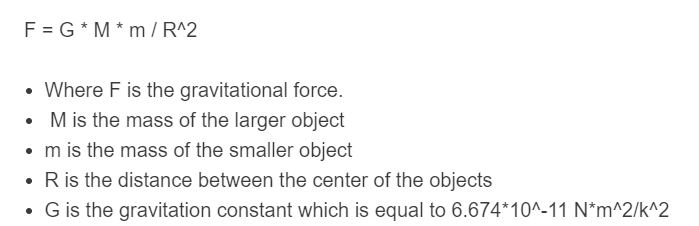
The calculator uses Newton’s law of universal gravitation for point masses or non-overlapping bodies with spherically symmetric density. It can solve for the attraction magnitude, either mass, or center-to-center separation; arbitrary extended bodies require a different calculation.
Rearranged formulas used when a different value is missing:
- F = gravitational force between the two masses
- G = gravitational constant, 6.67430 × 10⁻¹¹ N·m²/kg²
- m1 = mass of object 1
- m2 = mass of object 2
- r = distance between the centers of the two objects
For force, the calculator multiplies the two masses and the gravitational constant, then divides by the square of the center-to-center distance.
For either mass, it rearranges the same formula so the missing mass is isolated.
For distance, it solves for the separation between centers by taking the square root of the gravitational term divided by force.
All inputs are converted to base SI units before calculation: kilograms for mass, meters for distance, and newtons for force. The result is then converted back to the unit you selected.
Common Units and Base Conversions
These are the unit conversions used before applying the gravitational force formula.
| Quantity | Unit | Base conversion |
|---|---|---|
| Mass | 1 g | 0.001 kg |
| Mass | 1 lb | 0.45359237 kg |
| Mass | 1 metric tonne | 1000 kg |
| Distance | 1 cm | 0.01 m |
| Distance | 1 km | 1000 m |
| Force | 1 kN | 1000 N |
| Force | 1 lbf | 4.4482216152605 N |
Example Calculations
Example 1: Find gravitational force
Suppose two objects have masses of 10 kg and 20 kg, and their centers are 2 m apart.
The gravitational force is about 3.3372 × 10⁻⁹ N.
Example 2: Find distance
Suppose the masses are 1000 kg and 500 kg, and the gravitational force is 1.0 × 10⁻⁶ N.
The distance between the centers is about 5.7768 m.
FAQ
Why is the distance measured between centers?
In the point-mass model, use the distance between centers. The same relation applies to non-overlapping spherical bodies with spherically symmetric density. For those spheres, add the radii to surface-to-surface separation; arbitrary extended or overlapping bodies cannot generally be reduced to this relation.
Why are gravitational force results often very small?
The gravitational constant is very small: 6.67430 × 10⁻¹¹ N·m²/kg². For everyday objects, this makes the gravitational attraction tiny. Large forces usually require very large masses, very small distances, or both.
Can the distance or mass be zero?
No. A zero distance would require division by zero in the force formula, and a zero mass means there is no gravitational attraction from that object. The calculator requires nonzero values for the known masses, distance, and force when solving the missing variable.