Calculate uniform-sphere gravitational binding energy or reverse-solve mass and radius with astronomical units, celestial presets, and structure sensitivity.
- All Physics Calculators
- Gravitational Force Calculator
- Moon Weight Calculator
- Drake Equation Calculator
GBE Formula
Gravitational binding energy is the amount of energy required to completely separate a gravitating body so that all of its mass is moved infinitely far apart. For a uniform spherical object, the calculator uses the standard Newtonian approximation:
Where:
- GBE = gravitational binding energy
- G = gravitational constant
- M = mass of the sphere
- R = radius of the sphere
| Input / Output | Meaning | Common SI Unit | Important Note |
|---|---|---|---|
| Mass (M) | Total mass of the object | kg | The result changes with the square of mass, so small mass changes can create large energy changes. |
| Radius (R) | Distance from center to surface | m | Use radius, not diameter. A larger radius lowers the binding energy. |
| GBE | Energy needed to disperse the sphere | J | Higher values indicate a more strongly bound object. |
In gravitational physics, the total self-gravitational potential energy of a bound sphere is negative. The binding energy reported by this calculator is the positive magnitude of that value:
How to Calculate Gravitational Binding Energy
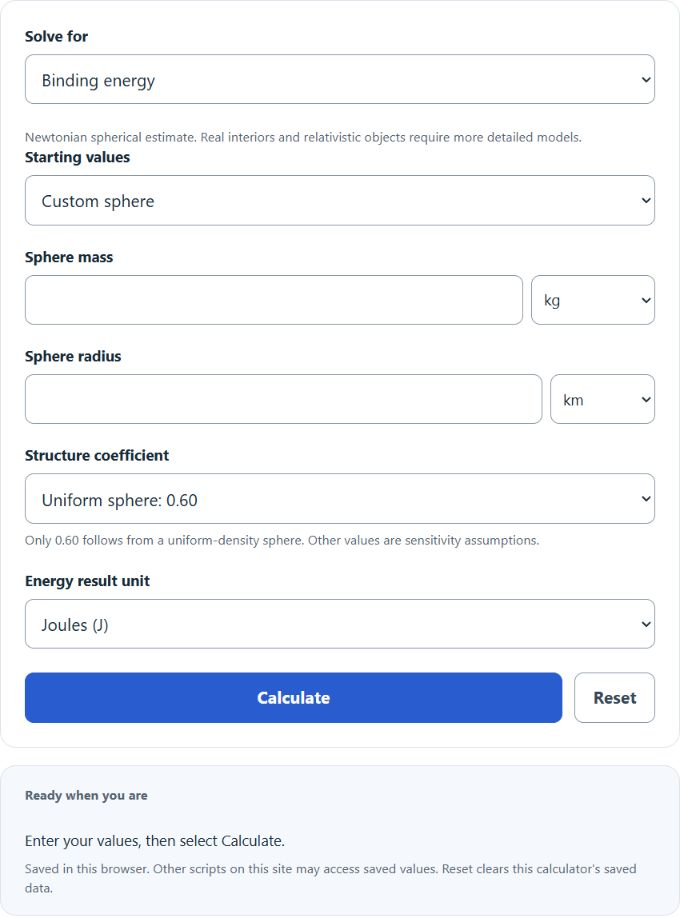
- Enter the mass of the spherical object.
- Enter the radius of the object.
- Select the correct units for each value.
- Calculate to obtain the binding energy in joules or another selected energy unit.
The relationship is especially sensitive to mass, because mass is squared in the equation. Radius affects the result inversely.
- If mass doubles and radius stays fixed, the binding energy becomes 4 times larger.
- If radius doubles and mass stays fixed, the binding energy becomes half as large.
- If both mass and radius increase, the effect depends on how quickly each changes.
Example Calculation
For a sphere with a mass of 100,000,000 kg and a radius of 1,000 m:
This means about 400.46 joules of energy would be required to fully unbind that idealized spherical mass distribution.
What the Result Means Physically
A larger gravitational binding energy means the object is held together more strongly by its own gravity. Massive and compact objects have much larger binding energies than small or diffuse ones. This is why planets, white dwarfs, neutron stars, and other dense astrophysical bodies can require enormous amounts of energy to disrupt.
For small laboratory-scale or engineering objects, gravitational binding energy is usually tiny compared with chemical, thermal, or structural energy scales. For astronomical bodies, it can become extremely important.
Assumptions Behind the Formula
- The object is approximately spherical.
- The standard coefficient 0.60 assumes uniform density. Coefficients 0.75 and 1.00 are hypothetical sensitivity assumptions, not validated interior models.
- Newtonian gravity is an acceptable approximation.
- Rotation, internal pressure gradients, and external gravitational fields are ignored.
- The result represents an idealized self-gravitating body, not a detailed real-world interior model.
Because of these assumptions, the calculator is best used for estimates, comparisons, and educational understanding rather than precision astrophysical modeling.
Alternative Form Using Density
If you know the average density instead of mass, you can first express mass as:
Substituting that into the binding-energy equation gives:
This form is useful when the size and average density of a body are easier to estimate than its total mass.
Connection to Escape Velocity
Binding energy is closely related to how difficult it is for material to leave the object. The escape velocity from the surface is:
The binding energy per unit mass for a uniform sphere can be written as:
This helps show why compact objects are harder to disperse: stronger gravity raises both escape speed and binding energy.
Common Uses of a GBE Calculator
- Estimating how strongly a planet, moon, asteroid, or star is gravitationally bound
- Comparing the compactness of different spherical bodies
- Checking order-of-magnitude values in astronomy and astrophysics problems
- Exploring how mass and radius influence self-gravitational stability
- Teaching energy concepts in orbital and gravitational systems
Common Input Mistakes
- Using diameter instead of radius: entering diameter makes the energy too small by a factor of 2.
- Mixing units: always confirm whether the input is in meters, feet, kilograms, pounds, or tons.
- Using the formula for irregular shapes: the equation is for spherical bodies, not arbitrary geometries.
- Ignoring the mass-squared effect: a small error in mass can create a much larger error in the result.
- Treating the result as exact for real planets or stars: real bodies often have non-uniform density and more complex internal structure.
Frequently Asked Questions
Is gravitational binding energy always positive?
The calculator reports a positive value because it represents the energy that must be added to unbind the object. The corresponding gravitational potential energy of the bound configuration is negative.
Why does mass matter more than radius?
Because the equation contains M2, the result grows much faster with mass than it changes with radius.
Can this be used for stars and planets?
Yes, as a first approximation. The estimate is most accurate when the body can be reasonably modeled as a sphere with roughly uniform density.
What unit should I use for the answer?
Joules are the standard SI unit, but larger systems may be easier to interpret in kilojoules, megajoules, gigajoules, or higher energy units.