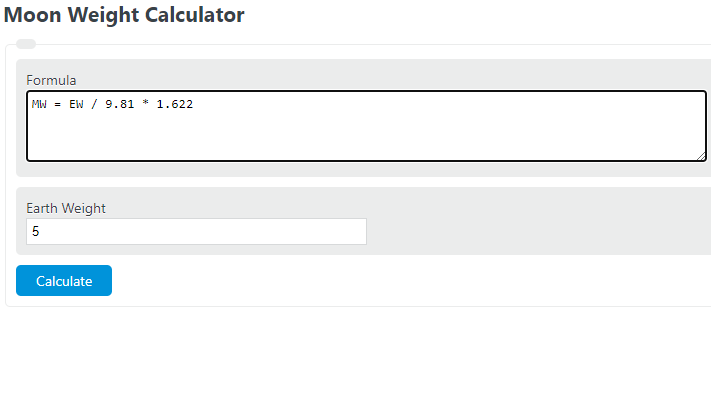
Calculate your weight on the Moon from your Earth weight, or find the Earth equivalent from Moon weight, with results in pounds or kilograms.
- All Physics Calculators
- Venus Weight Calculator
- Mars Weight Calculator
- Jupiter Weight Calculator
- Saturn Weight Calculator
- Uranus Weight Calculator
- Mercury Weight Calculator
- Planet Mass Calculator
Moon Weight Formula
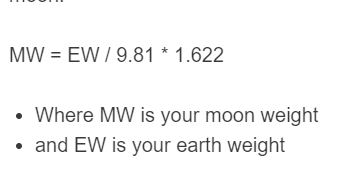
The formula to convert Earth weight to Moon weight is:
Where MW is your Moon weight and EW is your Earth weight, both in the same unit (pounds, kilograms, or newtons). The value 9.81 m/s² is Earth’s gravitational acceleration, and 1.622 m/s² is the Moon’s gravitational acceleration. This ratio (1.622 / 9.81) simplifies to approximately 0.1654, meaning your Moon weight is roughly 16.5% of your Earth weight. In practical terms, you can multiply your Earth weight by 0.165 or divide by 6.05 for a quick estimate.
Earth to Moon Weight Reference Table
The table below shows common Earth weights converted to Moon weights in both pounds and kilograms.
| Earth Weight (lbs) | Moon Weight (lbs) | Earth Weight (kg) | Moon Weight (kg) |
|---|---|---|---|
| 100 | 16.5 | 45.4 | 7.5 |
| 120 | 19.8 | 54.4 | 9.0 |
| 140 | 23.2 | 63.5 | 10.5 |
| 160 | 26.5 | 72.6 | 12.0 |
| 180 | 29.8 | 81.6 | 13.5 |
| 200 | 33.1 | 90.7 | 15.0 |
| 220 | 36.4 | 99.8 | 16.5 |
| 250 | 41.4 | 113.4 | 18.7 |
| 300 | 49.6 | 136.1 | 22.5 |
Why You Weigh Less on the Moon
Weight is the force of gravity acting on mass. It depends on two properties of the celestial body you are standing on: its total mass and its radius. The Moon’s mass is 7.346 × 10²² kg, only 1.23% of Earth’s 5.972 × 10²⁴ kg. Its mean radius is 1,737.4 km, about 27.3% of Earth’s 6,371 km. Plugging these into Newton’s law of universal gravitation (F = GMm/r²) produces a surface gravitational acceleration of 1.622 m/s², compared to Earth’s 9.81 m/s². That 6:1 ratio is why a 180 lb person feels only about 30 lbs of force on the lunar surface.
Importantly, your mass never changes between Earth and the Moon. A 70 kg person has 70 kg of mass everywhere in the universe. What changes is the gravitational force pulling on that mass, and therefore the number a scale reads.
Lunar Gravity Is Not Uniform
The 1.622 m/s² figure is an average. In reality, lunar gravity varies by about 0.0253 m/s² (roughly 1.6%) across the surface. The primary cause is mass concentrations called “mascons,” dense regions beneath large impact basins where asteroid collisions drove mantle material upward toward the crust. NASA’s GRAIL mission mapped these anomalies in detail, revealing a bulls-eye pattern of alternating positive and negative gravity rings around major basins. Over a mascon, gravity can be up to 0.5% stronger than the average, which is enough to deflect a plumb bob by about a third of a degree. For a 180 lb person, that translates to roughly 0.15 lbs of difference depending on where you stand on the Moon.
What Apollo Astronauts Actually Carried
The A7L and A7LB spacesuits used during lunar EVAs weighed approximately 82 kg (180 lbs) on Earth, including the Portable Life Support System (PLSS) backpack. On the Moon, that suit weighed roughly 13.5 kg (30 lbs). Combined with an astronaut’s body weight, a typical moonwalker carried an Earth-equivalent total of about 250 kg (550 lbs), reduced to approximately 41 kg (91 lbs) under lunar gravity. Despite weighing only a sixth of their Earth total, the mass remained the same, meaning astronauts still had to overcome significant inertia when changing direction. This led to the characteristic “loping” gait seen in Apollo footage, where astronauts bounced forward in long, low strides rather than walking heel-to-toe. The high center of mass from the backpack also caused frequent stumbles, and several astronauts reported difficulty stopping quickly or turning sharply.
Weight of Common Objects on the Moon
| Object | Earth Weight | Moon Weight |
|---|---|---|
| Gallon of water | 8.34 lbs (3.78 kg) | 1.38 lbs (0.63 kg) |
| Bowling ball (regulation) | 16 lbs (7.26 kg) | 2.65 lbs (1.20 kg) |
| Apollo Lunar Module (ascent stage) | 10,334 lbs (4,688 kg) | 1,710 lbs (776 kg) |
| Lunar Roving Vehicle | 463 lbs (210 kg) | 76.6 lbs (34.7 kg) |
| Average car (sedan) | 3,500 lbs (1,588 kg) | 579 lbs (263 kg) |
| Grand piano | 990 lbs (449 kg) | 164 lbs (74.3 kg) |
Moon vs Other Solar System Bodies
The table below compares surface gravity across the solar system, expressed as a multiplier of a 150 lb Earth weight.
| Body | Surface Gravity (m/s²) | % of Earth Gravity | 150 lbs on Earth Becomes |
|---|---|---|---|
| Sun | 274.0 | 2,793% | 4,190 lbs |
| Jupiter | 24.79 | 253% | 379 lbs |
| Neptune | 11.15 | 114% | 170 lbs |
| Saturn | 10.44 | 106% | 160 lbs |
| Earth | 9.81 | 100% | 150 lbs |
| Venus | 8.87 | 90% | 136 lbs |
| Uranus | 8.69 | 89% | 133 lbs |
| Mars | 3.72 | 38% | 57 lbs |
| Mercury | 3.70 | 38% | 57 lbs |
| Moon | 1.622 | 16.5% | 24.8 lbs |
| Pluto | 0.62 | 6.3% | 9.5 lbs |
FAQ
The Moon’s surface gravitational acceleration is 1.622 m/s², about 16.5% of Earth’s 9.81 m/s². In everyday terms, you would weigh roughly one-sixth of your Earth weight on the Moon. A 180 lb person would weigh about 29.8 lbs.
Mass is the amount of matter in an object, measured in kilograms. It does not change regardless of location. Weight is the force of gravity acting on that mass, measured in newtons (or commonly in pounds/kg-force). Your mass is identical on Earth and the Moon, but your weight on the Moon is only 16.5% of your Earth weight because the Moon’s gravitational pull is weaker.
On Earth, an average person can jump roughly 0.5 meters (1.6 feet) vertically. Because lunar gravity is about one-sixth of Earth’s, the same muscular force would propel you approximately 3 meters (10 feet) high on the Moon. However, the added mass of a spacesuit reduces this significantly. Apollo astronauts in full gear could jump roughly 0.6 meters (2 feet) on the lunar surface.
No. Lunar gravity varies by about 1.6% across the surface. Regions called mascons (mass concentrations), found beneath large impact basins, have slightly stronger gravity due to dense mantle material pushed upward by ancient asteroid impacts. NASA’s GRAIL mission mapped these variations in detail.
No. The Moon has significant gravity (1.622 m/s²). You would weigh zero only in true freefall or at a Lagrange point between two bodies where gravitational forces cancel. On the lunar surface, you always have measurable weight.