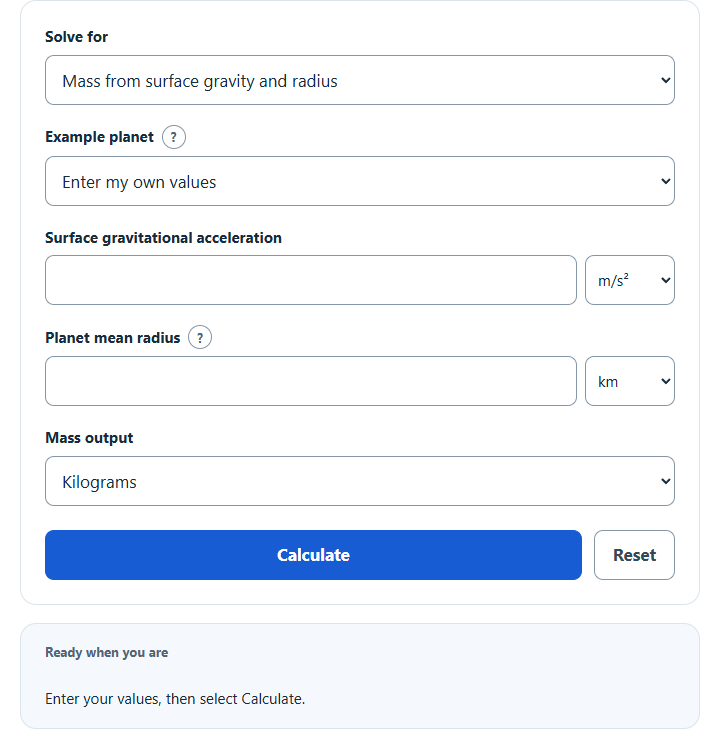
Calculate a planet’s mass from its surface gravity and radius, a moon’s orbit or its mean density, or find surface gravity from mass and radius.
- All Physics Calculators
- All Mass Calculators
- Drake Equation Calculator
- Orbital Period Calculator
- Theoretical Mass Calculator
- Moon Weight Calculator
Planet Mass Formula
The following formula estimates mass from surface gravitational acceleration and mean radius for an idealized spherical, nonrotating body. The calculator also supports mean density and a satellite orbit.
- Where PM is the Planet Mass (kg)
- a is surface gravitational acceleration, excluding rotational effects (m/s²)
- r is the planet’s mean radius for this spherical surface model (m)
- G is the measured gravitational constant, 6.67430 × 10⁻¹¹ m³ kg⁻¹ s⁻² (CODATA 2022; standard uncertainty 0.00015 × 10⁻¹¹)
Multiply surface gravitational acceleration by the square of the mean radius, then divide by G. This idealized model excludes rotation, local terrain and other bodies. In orbit mode, use center-to-center semimajor axis a and period T: total mass = 4π²a³/(GT²). Mean-density mode uses mass = density × 4πr³/3.
How to Calculate Planet Mass?
The following example problems outline how to calculate Planet Mass.
Example Problem #1:
- First, determine the surface gravitational acceleration (m/s²).
- The acceleration due to gravity (m/s2) is given as 9.81.
- Next, determine the planet’s mean radius (m).
- The mean radius is 500 m; select meters, or enter 0.5 km.
- Finally, calculate the Planet Mass using the equation above:
PM = a*r2 / G
The values given above are inserted into the equation below and the solution is calculated:
PM = (9.81 × 500²) / (6.67430 × 10⁻¹¹) ≈ 3.67454 × 10¹⁶ kg.
Example Problem #2:
For this problem, the variables needed are provided below:
acceleration due to gravity (m/s2) = 9.81
planet mean radius = 6000 m (6 km)
This example problem is a test of your knowledge on the subject. Use the calculator above to check your answer.
PM = a*r2 / G = ?