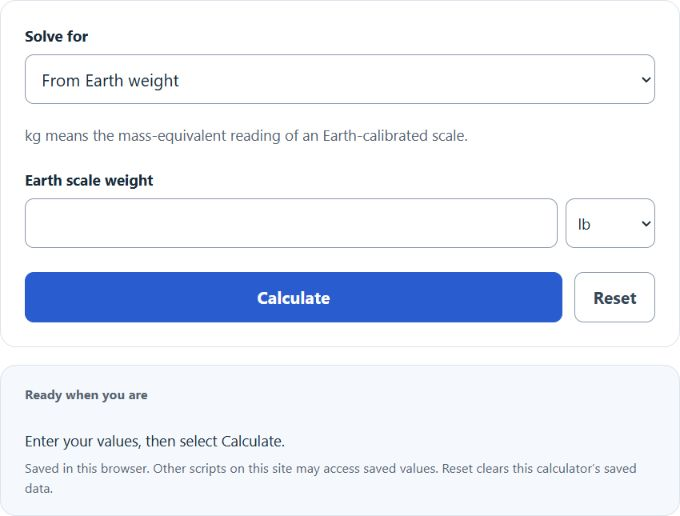
Calculate your weight on Mercury from Earth weight or mass in lb, kg, or st, and see the equivalent weight force in pounds or newtons.
- All Physics Calculators
- Venus Weight Calculator
- Mars Weight Calculator
- Jupiter Weight Calculator
- Saturn Weight Calculator
- Uranus Weight Calculator
- Pluto Weight Calculator
- Moon Weight Calculator
Mercury Weight Formula
The calculator uses one of two formulas depending on the input mode.
From an Earth weight:
From a mass:
- W_mercury = weight on Mercury (lb, kg-equivalent, or N)
- W_earth = weight on Earth (lb, kg-equivalent, or st)
- m = mass (kg)
- 3.70 m/s² = surface gravity on Mercury
- 9.80665 m/s² = standard acceleration of gravity used for the Earth scale reference
The approximate gravity ratio works out to 0.377295, so your Mercury weight is about 37.7% of your Earth weight. Mass does not change between planets; only weight (the force gravity exerts on that mass) does.
Reference Values
Use the first table to spot-check your result. The second compares Mercury to other bodies in the solar system.
| Earth weight (lb) | Mercury weight (lb) | Mercury weight (kg-equiv.) |
|---|---|---|
| 100 | 37.7 | 17.1 |
| 125 | 47.2 | 21.4 |
| 150 | 56.6 | 25.7 |
| 175 | 66.0 | 29.9 |
| 200 | 75.5 | 34.2 |
| 250 | 94.3 | 42.8 |
| Body | Surface gravity (m/s²) | Weight vs. Earth |
|---|---|---|
| Mercury | 3.70 | 37.7% |
| Moon | 1.62 | 16.5% |
| Mars | 3.71 | 37.8% |
| Earth | 9.81 | 100% |
| Jupiter | 24.79 | 252.7% |
Example and FAQ
Example: A 165 lb person on Earth.
W_mercury = 165 × (3.70 / 9.80665) = 165 × 0.377295 ≈ 62.3 lb on Mercury.
Why is Mercury’s gravity so close to Mars’ even though Mercury is much smaller? Mercury has a much denser iron core. The higher density makes up for the smaller radius, so surface gravity ends up almost identical to that on Mars.
Does my mass change on Mercury? No. Mass stays the same anywhere. Only weight, the pull of gravity on that mass, changes.
Should I use pounds or newtons? Pounds and kilograms work for everyday comparisons (what a bathroom scale would read). Newtons are the correct SI unit for force and are preferred in physics problems.