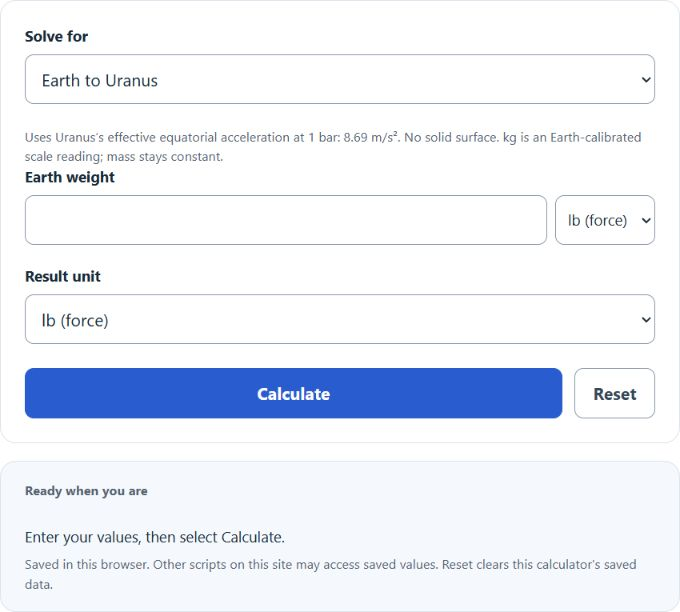
Calculate your weight on Uranus from Earth weight, or convert Uranus weight back to Earth in lb, kg, st, or N with equivalent results.
- All Physics Calculators
- Jupiter Weight Calculator
- Mars Weight Calculator
- Mercury Weight Calculator
- Saturn Weight Calculator
- Venus Weight Calculator
- Pluto Weight Calculator
- Moon Weight Calculator
- Surface Gravity Calculator
Uranus Weight Formula
The calculator scales your weight by the ratio of Uranus’s surface gravity to Earth’s surface gravity.
For the reverse mode, the formula rearranges to:
- W_earth = weight on Earth (lb, kg, st, or N)
- W_uranus = weight on Uranus (same unit as input)
- g_earth = 9.80665 m/s² (standard Earth gravity)
- g_uranus = 8.69 m/s² (Uranus effective equatorial acceleration at the 1 bar pressure level)
The gravity ratio works out to about 0.886, so an object on Uranus weighs roughly 88.6% of what it weighs on Earth. Uranus has no solid surface, so “weight on Uranus” refers to the apparent weight you would feel at the cloud tops where atmospheric pressure equals 1 bar. The calculation uses effective equatorial acceleration, with the rotation convention implicit in that value, and ignores atmospheric buoyancy.
The Earth to Uranus mode multiplies your input by 8.69 / 9.80665 (about 0.8861). The Uranus to Earth mode divides by the same unrounded ratio. Pounds, kilograms, and stones are converted through newtons internally so the answer stays consistent across unit choices.
Reference Tables
Quick conversions for common Earth weights:
| Earth weight (lb) | Uranus weight (lb) | Earth weight (kg) | Uranus weight (kg) |
|---|---|---|---|
| 50 | 44.3 | 25 | 22.2 |
| 100 | 88.6 | 50 | 44.3 |
| 150 | 132.9 | 70 | 62.0 |
| 175 | 155.1 | 80 | 70.9 |
| 200 | 177.2 | 90 | 79.7 |
| 250 | 221.5 | 100 | 88.6 |
Surface gravity comparison for the planets in the solar system:
| Planet | Gravity (m/s²) | Relative to Earth |
|---|---|---|
| Mercury | 3.70 | 0.378 |
| Venus | 8.87 | 0.905 |
| Earth | 9.81 | 1.000 |
| Mars | 3.71 | 0.378 |
| Jupiter | 24.79 | 2.528 |
| Saturn | 10.44 | 1.065 |
| Uranus | 8.69 | 0.886 |
| Neptune | 11.15 | 1.137 |
Worked Example and FAQ
Example. A person weighs 180 lb on Earth. To find their Uranus weight:
W_uranus = 180 × (8.69 / 9.80665) = 180 × 0.8861 = 159.5 lb
They would weigh about 159.5 lb on Uranus, a reduction of roughly 20.5 lb.
Why is Uranus’s gravity lower than Earth’s even though Uranus is much bigger? Surface gravity depends on both mass and radius. Uranus has about 14.5 times Earth’s mass, but its radius is about 4 times larger. Since gravity falls off with the square of the distance from the center, the larger radius nearly cancels out the extra mass.
Does my mass change on Uranus? No. Mass is constant. Only weight, the force gravity exerts on that mass, changes. The kilogram readout on this calculator shows the Earth-equivalent mass that would produce the new weight reading on a spring scale calibrated for Earth gravity.
Why is Uranus’s gravity sometimes listed as 8.87 m/s²? Different sources use slightly different values depending on whether they account for Uranus’s rotation, oblateness, and the chosen pressure level. This calculator uses 8.69 m/s², NASA’s effective equatorial acceleration at the 1 bar level.
Could you actually stand on Uranus? No. Uranus is an ice giant with no solid surface. The “weight” calculated here is the gravitational force you would experience if you were suspended at the cloud tops.