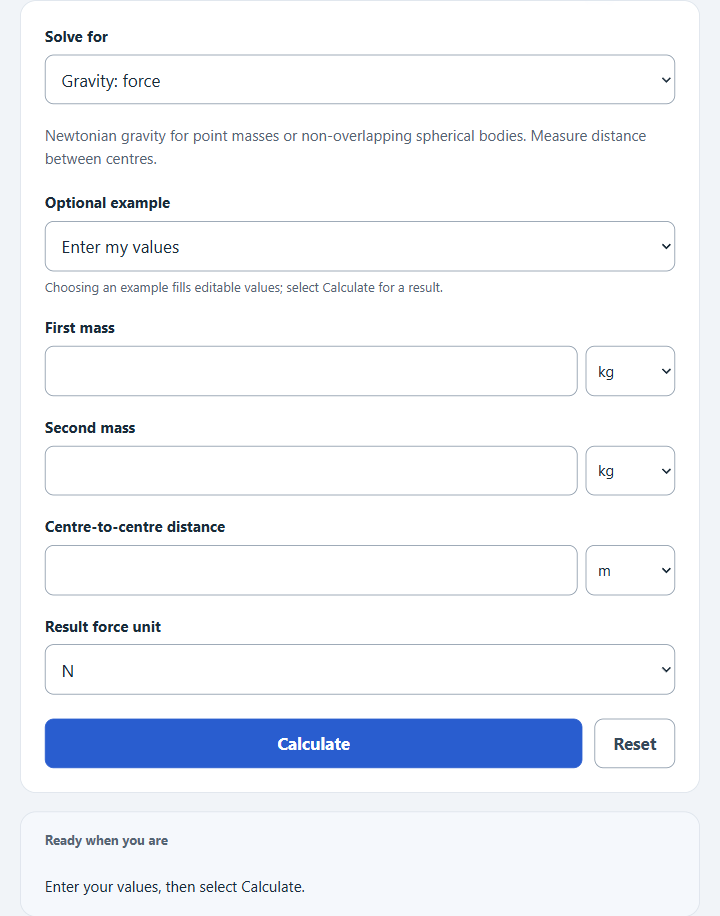
Calculate gravitational or electrostatic attraction force, weight and g, escape velocity, and potential energy from mass, charge, and distance.
- All Physics Calculators
- All Force Calculators
- Tractive Force Calculator
- Gravitational Force Calculator
Attraction Force Formula
The following equation is used to calculate the Attraction Force.
- Where AF is the attraction force (N)
- G is the gravitational constant (6.67430 × 10^-11 N·m²/kg²)
- m1 is the mass of the first object (kg)
- m2 is the mass of the second object (kg)
- d is the centre-to-centre distance between the objects (m)
To calculate the attraction force, multiply the gravitation constant by the mass of both objects, then divide by the distance between objects squared.
What is an Attraction Force?
Definition:
An attraction force, commonly called the gravitational force, is a fundamental force of nature that arises from the gravity between two objects of mass.
How to Calculate Attraction Force?
Example Problem:
The following example outlines the steps and information needed to calculate the Attraction Force.
First, determine the mass of the first object. In this example, the mass of the first object is found to be 1000 kg.
Next, determine the mass of the second object. For this problem, the mass of the second object is found to be 2000 kg.
Next, determine the distance between the objects. In this case, the distance between the objects is measured to be 6 m.
Finally, calculate the Attraction Force using the formula above:
AF = G * m1*m2 / d^2
AF = 6.67430*10^-11 * 1000*2000 / 6^2
AF ≈ 3.70794 × 10^-6 N
FAQ
What is the gravitational constant, and why is it important in calculating attraction force?
The gravitational constant, denoted as G, is a key value in physics that quantifies the strength of the gravitational force between two objects. It is crucial in calculating the attraction force because it allows us to quantify the force of gravity based on the masses of the objects and the distance between them. This calculator uses G = 6.67430 × 10^-11 N·m²/kg².
Can the attraction force formula be used to calculate the gravitational pull between any two objects?
This Newtonian formula applies directly to point masses or non-overlapping spherically symmetric bodies using centre-to-centre distance. Extended irregular bodies require more detailed modelling, and strong gravitational fields may require relativity.
How does the distance between two objects affect the attraction force between them?
The distance between two objects significantly affects the attraction force, as the force is inversely proportional to the square of the distance between the objects. This means that as the distance between the objects increases, the attraction force decreases rapidly. Conversely, decreasing the distance between the objects increases the attraction force according to the inverse-square law: halving the separation quadruples the force.