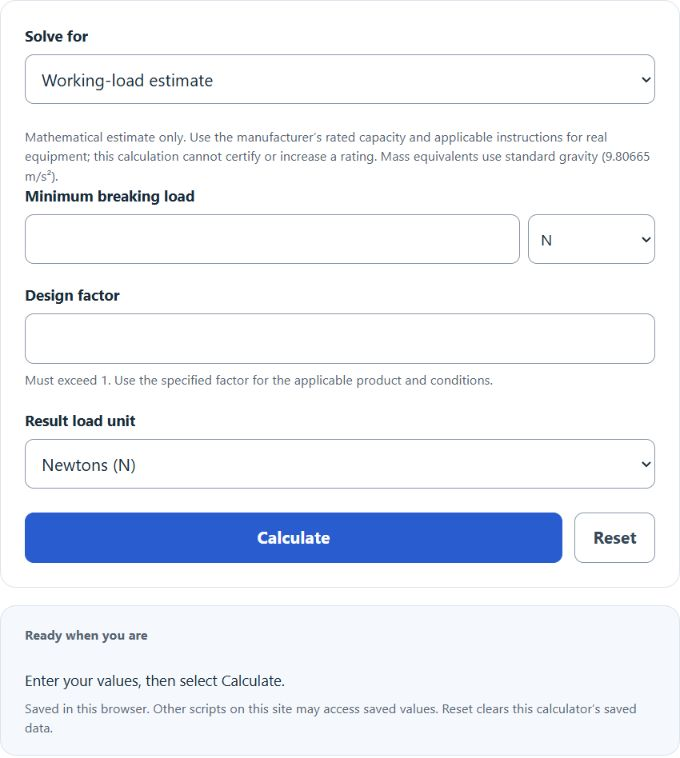
Calculate the mathematical relationship between breaking load, working load and design factor in N, kN, lbf, or mass equivalents in kg, lb and metric tonnes at standard gravity. This does not assign or increase an equipment rating.
Safe Working Load Formula
This calculator evaluates the mathematical relationship between a stated minimum breaking load and an entered design factor. Its working-load estimate is not a certified safe working load (SWL) or working-load limit (WLL). For real equipment, use the manufacturer-approved rating for the actual configuration, applicable rules, inspection and competent lift planning; a calculated value cannot authorize a lift or increase an existing rating.
In this relationship, SWL denotes the working-load estimate, BS the stated minimum breaking load, and SF the design factor. For a fixed BS, a larger positive factor gives a smaller model result. This calculator requires a factor greater than 1; it does not choose the required factor or establish an authorized equipment rating.
If you need to solve for a different variable, the same relationship can be rearranged as follows:
Variable Definitions
- Working-load estimate (SWL in this model): breaking load divided by the entered design factor; not an authorization to load real equipment.
- Minimum breaking load (BS): the stated minimum breaking-load value used in the model. Solving for BS gives the requirement implied by the other inputs, not a measurement or prediction of actual component strength.
- Design factor (SF): the unitless breaking-load/working-load ratio in this model. The applicable factor must come from the relevant product, standard and competent-person instructions; the calculator recommends no factor.
How to Calculate Safe Working Load
- Identify the documented minimum breaking load and applicable manufacturer instructions.
- Enter the design factor specified for the applicable product and conditions; do not choose an arbitrary factor to justify a lift.
- Select the correct force or mass-equivalent units. The calculator normalizes them before calculating.
- Divide the breaking load by the design factor for the mathematical estimate, then follow the actual approved rating and configuration limits.
Choose the result load unit independently from the input units. N, kN and lbf are force units. kg, lb and metric tonnes are mass equivalents at standard gravity, 9.80665 m/s²: 1 kg equivalent is 9.80665 N and 1 lb equivalent is 4.4482216152605 N. These equivalents are not measurements of local gravity.
Example
For an arithmetic example only, a stated minimum breaking load of 1,000 lbf and an entered design factor of 5 give:
The model result is 200 lbf. It is not an equipment recommendation or proof that a component may be used at that load; the actual approved rating and conditions remain controlling.
How to Use the Calculator
This calculator can solve for any one of the three variables when the other two are known:
- Find SWL: enter breaking strength and safety factor.
- Find BS: enter safe working load and safety factor.
- Find SF: enter breaking strength and safe working load.
Why the Safety Factor Matters
The design factor expresses a ratio within the stated model. For a fixed breaking load, increasing the factor reduces the calculated working-load estimate. It cannot, by itself, compensate for damage, shock loading, unsuitable geometry or an unapproved assembly. The factors 3, 5 and 10 in the table are arithmetic illustrations, not recommended factors or rated capacities.
| Breaking Strength | Safety Factor | Working-load estimate | Effect |
|---|---|---|---|
| 5,000 lbf | 3 | 1,666.7 lbf | Higher model result; smaller numerical ratio |
| 5,000 lbf | 5 | 1,000 lbf | Lower model result for the same breaking load |
| 5,000 lbf | 10 | 500 lbf | Largest illustrated ratio; lowest model result |
Safe Working Load vs. Breaking Strength
A stated minimum breaking load and an authorized working-load rating are different values. Dividing a breaking load by an entered factor does not establish a certified rating. For actual planning, use the approved rating for the configuration and relevant instructions; SWL and WLL terminology can depend on the product and jurisdiction.
Practical Factors That Can Reduce the Usable Load
- Shock loading: sudden starts, stops, or impacts can create forces above the static load.
- Wear and damage: abrasion, cuts, corrosion, broken strands, or deformation reduce reliability.
- Angle effects: non-vertical loading can increase tension in slings and attachment points.
- Environmental conditions: heat, cold, moisture, and chemicals can change material performance.
- Load distribution: off-center or uneven loading can overload one part of the system.
- Hardware compatibility: the lowest component rating is only an upper bound; attachments, geometry, condition and configuration may reduce usable assembly capacity further.
Because of these real-world conditions, this calculation is an arithmetic comparison only. It cannot replace equipment inspection, the marked or manufacturer-approved capacity, configuration guidance, applicable rules or competent lift planning.
Common Input Mistakes
- Mixing units: entering breaking strength in one unit and interpreting the answer in another.
- Using the wrong safety factor: choosing an arbitrary value instead of the one appropriate for the task.
- Confusing failure load with working load: the breaking strength is not the normal operating limit.
- Ignoring component condition: damaged equipment may not perform at its original strength.
- Forgetting the weakest link: the overall system capacity cannot exceed the lowest-rated part.
Quick Reference
| If You Know | Use This | Result |
|---|---|---|
| Breaking Strength and Safety Factor | Divide BS by SF | Working-load estimate under the entered model |
| Safe Working Load and Safety Factor | Multiply SWL by SF | Breaking Strength |
| Breaking Strength and Safe Working Load | Divide BS by SWL | Safety Factor |
Frequently Asked Questions
Does a higher safety factor increase or decrease SWL?
For the same breaking load, a higher design factor decreases the working-load estimate in this mathematical model. It does not change the component’s existing approved rating.
Should SWL ever be higher than breaking strength?
This calculator requires positive loads and a design factor greater than 1, so the model working load must be below the minimum breaking load. That mathematical check is not proof that the working load is authorized for actual equipment.
What units should be used?
Choose the correct force or standard-gravity mass-equivalent unit for each load. Mixed units are converted before calculation; the design factor has no units.
Can this calculator be used for any load-bearing component?
It evaluates the stated mathematical relationship only. It does not determine a component’s actual strength, choose a required design factor, certify SWL/WLL or account for every real loading condition. Use the specific manufacturer and competent-person instructions.