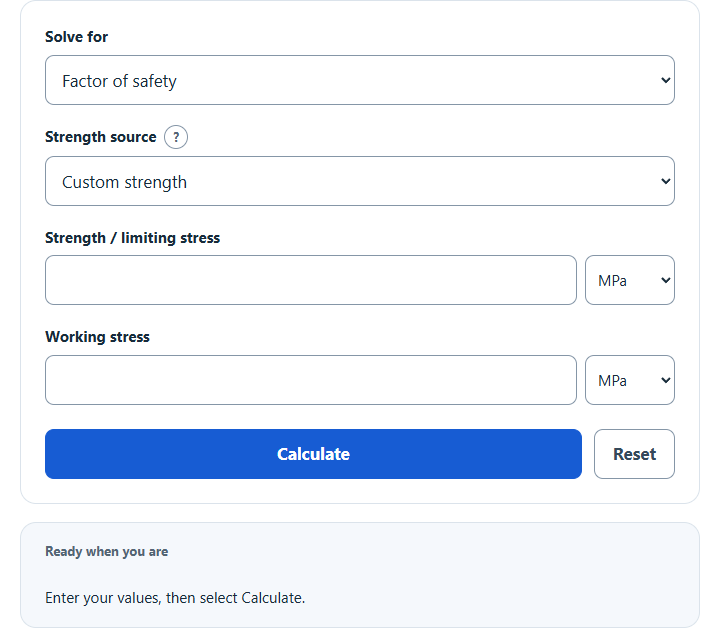
Calculate factor of safety as strength ÷ working stress (FoS = MS / WS), or find the required strength or allowable working stress for a target factor.
- All Construction Calculators
- Yield Strength Calculator
- Bending Stress Calculator
- SWL of Wire Rope Calculator
Factor of Safety Formula
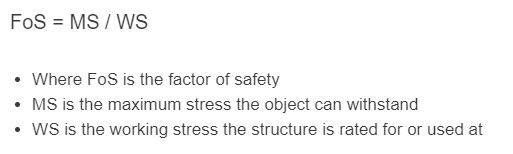
The following formula is used to calculate a factor of safety.
- Where FoS is the factor of safety
- MS is the maximum stress the object can withstand
- WS is the working stress the structure is rated for or used at
To calculate the factor of safety, divide the maximum stress by the working stress.
Factor of Safety Definition
A factor of safety is a measure of the amount of extra strength that is designed into a structure to hold stress in excess of the expected stress in order to have an increased level of safety.
Factor of Safety Example
How to calculate the safety factor?
- First, determine the maximum stress.
Measure the maximum stress the object can withstand.
- Next, determine the working stress.
Measure the working stress the structure is rated for.
- Finally, calculate the factor of safety
Calculate the factor of safety using the formula above.
FAQ
A factor of safety is a term used in engineering to describe the relationship between the maximum stress a structure can hold and the stress the structure is designed to be used at. In other words, the larger the factor of safety the lower the working stress compared to the maximum stress.
The required factor depends on the applicable standard, failure mode, loading, uncertainty and consequences of failure. No universal factor establishes safety; use the governing design requirements and verified material allowables.